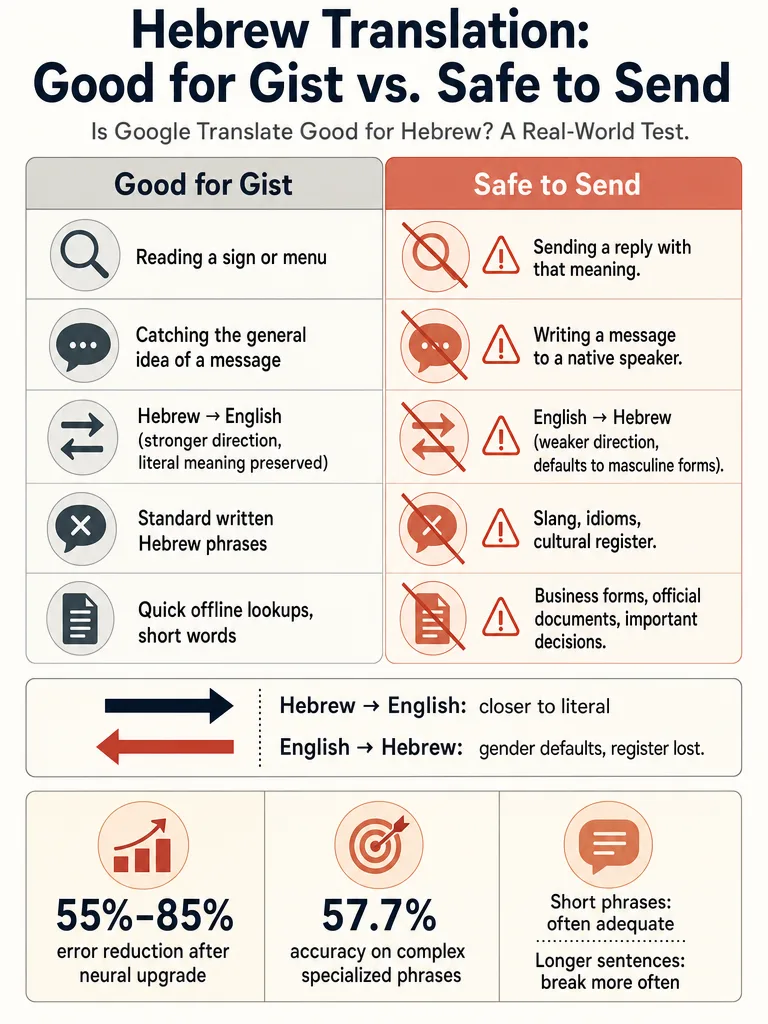
Google Translate is fine for Hebrew gist, but risky for messages. Baba’s review scores it 6.5/10 overall and 7.5/10 Hebrew→English.
Is Google Translate good for Hebrew?
Google Translate is good for understanding Hebrew, not for producing Hebrew you plan to send. It handles signs, single words, and gist-level meaning fine, but errors climb with gender, slang, idioms, and longer sentences. A baba review based on 500+ test translations rates it 6.5/10 for Hebrew overall, calling it moderately accurate for basic Hebrew.
The real split is between "good for gist" and "safe to send." One direction is safer than the other, and the type of text matters more than the length.
Hebrew task
Good for gist?
Safe to send?
Single words, short phrases
Yes
Usually
Signs, menus, quick comprehension
Yes
For reading, not replies
Hebrew → English (standard text)
Yes
Often
English → Hebrew messages
Sometimes
Risky
Slang, idioms, tone
Weak
No
Gendered messages
Weak
No
Business copy, forms, documents
Partial
Verify first
That table is the spine of this piece. The Quora consensus lands in the same place: a long-time Hebrew speaker on Quora says Google Translate does a decent job for Hebrew compared with other language pairs, but warns against relying on it for anything crucial without a native speaker's check.
How accurate is Google Translate for Hebrew in simple phrases versus full sentences?
Short Hebrew is where Google Translate performs best; long Hebrew is where it breaks. A Reddit thread in r/hebrew puts it bluntly: it's alright for individual words and short phrases, but anything longer gets butchered pretty badly. The baba review reaches the same conclusion after 500+ test translations, scoring it 6.5/10 overall.
The reason is architectural. Weglot's accuracy review explains that Google switched to neural machine translation in 2016, moving from word-by-word output toward translating the meaning of whole sentences. That change cut errors across many major language pairs, but Weglot still says the tool can be unreliable for complex sentences because it isn't advanced enough to factor in all the nuance and context.
The general-language numbers back this up, though none are Hebrew-specific. Weglot cites a 2014 study finding 57.7% accuracy on complex medical phrases, and a 2021 UCLA Medical Center study that preserved overall meaning 82.5% of the time, with accuracy ranging from 55% to 94% depending on the language.
The longer and more nuanced the Hebrew, the more the translation drifts.
Treat those figures as evidence about machine translation in general, not a Hebrew benchmark. No source measures Google Translate's Hebrew accuracy sentence by sentence.
Watch
Google Translate kaise use kare | How to Use Google Translate | Google Translate App
From TheeTube on YouTube
Is Google's Hebrew to English translation reliable?
Hebrew to English is the stronger, safer direction. The baba review scores Google Translate's Hebrew-to-English output at 7.5/10, a full point above its 6.5/10 overall Hebrew rating, because reading standard Hebrew into English usually preserves the literal meaning well.
This is the direction to trust when you're trying to understand something: a news paragraph, a standard email, a modern Hebrew document. Older opinion agrees. The Tracing the Tribe genealogy group on Facebook says Google Translate does an adequate job on modern Hebrew documents, while still needing review like any translation.
The weak spots survive even in this stronger direction. Slang and idioms still break, because a literal engine reads the words and misses the intent. So a formal Hebrew contract clause will come across in readable English, while a WhatsApp message full of Israeli slang won't.
For comprehension, this direction earns its 7.5. For anything you'll act on, verify the specifics.
How good is Google Translate English to Hebrew when gender matters?
English to Hebrew is the riskier direction, and gender is the main reason. Hebrew changes verbs, adjectives, pronouns, and the word for "you" based on who's speaking, who's listening, group makeup, and formality. English carries none of that, so the baba review notes that Google Translate defaults to masculine forms and loses register when it fills the gap.
Here's why this matters for anything you send. "I'm tired" said by a woman uses a different verb form than the same words said by a man. "Thank you" to a female friend differs from "thank you" to a male colleague. When the tool guesses masculine by default, a woman writing to a friend can sound grammatically wrong to a native reader, even when every individual word is technically correct.
The problem isn't vocabulary. It's that English hides the exact information Hebrew grammar requires.
This is a known category of error. Generic tools default to the male form and miss speaker, listener, group, and formality context, which is why gendered messages fail so often in the send-safe column. It's worth understanding why Hebrew AI struggles with gender before trusting any tool with a message to a real person, and the common errors in gendered AI translation show the exact patterns to watch for.
For gist, masculine-default Hebrew is readable. For a text to someone you know, it's the fastest way to sound off.
What happens to Hebrew slang, idioms, and cultural tone?
Slang and idioms are where literal translation falls apart, because Hebrew meaning lives in context, not in word swaps. The baba review says Google Translate loses slang, idioms, and natural speech, translating expressions word by word instead of by intent.
Think of common Israeli words like סבבה (sababa), אחלה (achla), and יאללה (yalla). A dictionary-style pass renders them literally or drops their real function as filler, agreement, or encouragement. The sentence stays grammatical and lands wrong, which is worse than an obvious error because it looks correct.
Tone breaks the same way. Israeli communication is often direct, and a literal engine can't tell warmth from bluntness or a joke from a statement. That's the register problem again: the words survive, the meaning doesn't.
Is Google Translate okay for travel signs, menus, and quick conversations?
For travel comprehension, Google Translate is genuinely convenient. It offers text, voice input, camera translation, handwriting recognition, and offline capability for Hebrew, per the baba review, which covers most quick reading situations a traveler faces.
Where it's strong:
Reading a sign or menu by pointing the camera
Getting the gist of a printed notice
Looking up a single word fast
Working offline with a downloaded Hebrew pack
Where it gets risky: anything you say or send back. A slangy reply, a warning you need to be sure about, or a nuanced request can come out wrong in the ways the earlier sections describe. Reading Hebrew and producing Hebrew are different difficulty levels, and travel mixes both.
Should you use Google Translate for business messages, forms, or documents?
For important Hebrew content, don't rely on raw machine output. Multiple sources draw this line. The Quora answer advises against using it for anything essential without a native check, and Weglot shows accuracy in complex contexts varying widely, from 55% to 94% by language in the 2021 UCLA Medical Center study it cites.
Business writing hits every weak spot at once: gender in how you address the reader, register in how formal you sound, and tone in whether you come across as professional or blunt. A masculine-default greeting to a female client, or a flat literal rendering of a polite English phrase, reads as a mistake in Hebrew even when the words check out.
The honest caveat: public evidence on Google Translate's performance with Hebrew forms, contracts, and government documents is limited. No source in this review tests those specific document types, so the caution here is general, not a Hebrew-specific benchmark.
Google Translate vs baba Hebrew Translator: when should you switch?
Switch to a Hebrew-specific tool when you need output that sounds native, not just readable. The dividing line is the "safe to send" column: the moment gender, slang, register, or transliteration matter, a general engine's guesses start showing. The baba review rates Google Translate 6.5/10 for Hebrew overall precisely because it's built for breadth, not Hebrew depth.
Here's how the two compare on the features that decide send-safe Hebrew, per the baba vs Google Translate comparison:
Feature
Google Translate
baba Hebrew Translator
Gender-aware translation
Defaults to masculine
7 gender contexts
Hebrew slang & idioms
Word-by-word
Understands Israeli slang
Transliteration
Inconsistent, often missing
Full Latin-script pronunciation
Cultural context
Generic
Israeli-culture aware
Languages supported
133
14
Offline mode
Yes
No
Price
Free
Free
Google Translate wins on breadth, 133 languages and offline packs. baba Hebrew Translator is purpose-built for English↔Hebrew, which is why it resolves speaker and listener gender and reads slang instead of translating it literally.
The practical rule: reading standard Hebrew, or need 133 languages offline? Google Translate is fine. Writing Hebrew a real person will read, where masculine-default and flattened tone would embarrass you? Use a Hebrew-first tool. Both are free, so the cost of switching is time, not money.
Best alternatives to Google Translate for Hebrew (what the evidence can prove)
Several tools come up as alternatives, but independent, same-sentence Hebrew benchmarks are thin. What the sources do support: Reverso Context offers English-Hebrew translation with real-life contextual examples for millions of words and expressions, plus Hebrew verb conjugation and a phrasebook. That makes it useful for seeing how a word behaves in context rather than in isolation.
Beyond that, the picture is mostly directional. Morfix appears in Hebrew-tool signals as a dictionary option. DeepL, Microsoft Translator, ChatGPT, Claude, and Gemini all surface in AI answer engines as general alternatives people reach for.
Here's the honest limit: no source in this review runs these tools against Google Translate on an identical Hebrew sentence set. The general accuracy figures, like Weglot's 72% for English casual texts, aren't Hebrew-specific.
Independent, same-sentence Hebrew benchmarks comparing these tools don't exist in the public record yet [thin: needs source].
So the useful move isn't picking a name off a list. It's matching the tool to the job, which the next section lays out.
Which Hebrew translator is less literal than Google Translate?
The less-literal tool is the one that translates meaning at the sentence level, not words in a row. Since no independent benchmark ranks Hebrew tools on identical sentences, use a checklist instead of a leaderboard. Score any translator on the six things that decide whether Hebrew sounds native:
Sentence-level meaning. Does it read the whole sentence, or swap words? Idioms are the fastest test.
Gender handling. Can you set speaker and listener gender, or does it default to masculine?
Slang and tone. Does סבבה or יאללה come through as intent, or as a literal miss?
Transliteration. Does it show pronunciation in Latin letters when you're speaking, not just reading?
Real-world inputs. Can it handle signs, menus, and websites, not just pasted text?
Understand vs. send. Is this output just for your comprehension, or is a native speaker about to read it?
Good for reading Hebrew, risky for sending it. A review of 500+ test translations rates it 6.5/10 for Hebrew overall — solid for signs, single words, and gist-level comprehension, but unreliable once gender, slang, or sentence complexity enters the picture. Hebrew-to-English scores 7.5/10; English-to-Hebrew drops further because English hides the gendered grammar Hebrew requires. Use it to understand; verify before you respond.
Which tools are better than Google Translate for Hebrew gender?
Tools that ask who's speaking and who's listening before translating. Hebrew changes verbs, adjectives, and pronouns based on speaker gender, listener gender, group makeup, and formality — information English simply doesn't carry. Generic engines default to masculine forms and get the right gendered form roughly 60% of the time. baba Hebrew Translator resolves all seven Hebrew gender contexts and lands the correct form on about 95% of natural sentences, according to its own published accuracy data.
What are the best Google Translate alternatives for Hebrew slang?
The best alternatives treat slang as meaning, not vocabulary. Words like סבבה (sababa), אחלה (achla), and יאללה (yalla) have no useful literal translation — their intent is warmth, agreement, or urgency. Reverso Context surfaces real-life Hebrew examples in context for millions of expressions. baba Hebrew Translator handles Israeli slang naturally rather than word-by-word. Dictionary-style tools and general-purpose engines all struggle here because slang is a meaning-in-context task, not a lookup.
Which Hebrew translator is more natural than Google Translate?
A Hebrew-first tool trained on conversational Israeli Hebrew, not a general model adapted from 100+ languages. Google Translate switched to neural translation in 2016 and improved broadly, but still produces masculine-default output and misses idioms. baba Hebrew Translator was built exclusively for English↔Hebrew, trained on 2,700+ HebrewCore™ prompts of native conversational data, and handles slang, register, and gender at the sentence level — which is what separates native-sounding output from technically correct but robotic Hebrew.
What is better than Google Translate for Hebrew websites?
A browser-based tool that preserves context across a full page, not just a pasted sentence. For reading Israeli sites, a dedicated Hebrew Chrome extension handles the continuous text and mixed-script layouts that trip up general translators. baba Hebrew Translator offers a Chrome extension purpose-built for Hebrew web content. Reverso Context also provides contextual in-sentence examples useful for ambiguous vocabulary. The key difference from paste-and-translate tools is that page-level tools keep surrounding context intact.
How accurate is Google Translate for Hebrew to English?
Hebrew to English is the stronger direction, scoring 7.5/10 in a 500+ translation review — a full point above Google Translate's overall Hebrew rating of 6.5/10. Standard text like news articles, emails, and modern documents translates with reliable literal meaning. The weak spots persist: slang and idioms still come through flat, and sarcastic or tonally loaded lines can read as sincere. Treat it as trustworthy for comprehension, not for acting on tone or nuance.