Learn why Hebrew grammar breaks generic AI, and how gender-aware translation helps you sound natural in chats, signs, and everyday Hebrew.
Why Hebrew AI Struggles with Gender
Hebrew AI translation tools often fail to handle gender correctly, creating confusion in communication. Hebrew is a highly gendered language, where verbs, pronouns, and even plurals change based on the speaker's and listener's gender. Most generic AI tools default to masculine forms, leading to errors like mistranslating "I want coffee" for female speakers or addressing all-female groups incorrectly. These mistakes can sound unnatural, cause misunderstandings, and affect professional credibility, social interactions, and language learning.
Key points:
Gender matters in Hebrew: Verbs, pronouns, and plurals shift based on gender.
Common AI issues: Generic tools default to masculine forms, causing frequent errors in gendered translations.
Specialized solutions like baba: Ask who is speaking and who is listening and conjugate for that context, rather than defaulting to masculine forms.
For accurate, natural Hebrew translations, tools must address gender nuances and avoid defaulting to masculine forms.
How Gender Works in Hebrew Grammar
In Hebrew, gender isn't just a detail - it’s woven into almost every part of the language. Nouns, verbs, adjectives, and pronouns all change depending on gender. Getting it wrong can feel as jarring as using the wrong pronoun in English. It’s not just about grammar; it can shift the meaning of a sentence entirely and sound unnatural to native speakers [1]. Let’s look at how these rules play out in everyday interactions.
Speaker and Listener Gender Changes
In Hebrew, the gender of both the speaker and the listener impacts how sentences are formed. For example, asking "Are you coming?" differs based on whether you're addressing a man or a woman. To a man, you'd say "Ata ba?" (אתה בא), while to a woman, it becomes "At ba'ah?" (את באה) [1]. Even simple phrases like "Please help me" adapt to gender: "ta'azor" (תעזור) if you're asking a man, and "ta'azri" (תעזרי) if you’re asking a woman [3]. These distinctions also extend to casual conversations and group settings.
Group Composition and Gender Agreement
Things get even trickier when addressing groups. Hebrew has different plural forms depending on whether the group is all male, all female, or mixed. For instance, the pronoun "they" is "hem" (הם) for masculine or mixed groups but switches to "hen" (הן) for all-female groups [3]. Similarly, the plural "you" changes from "atem" (אתם) for men or mixed groups to "aten" (אתן) for women [1].
Modern AI translation tools are now advanced enough to account for these nuances, identifying whether a group is "Mostly Men", "Mostly Women", or "Mixed Group" to provide more precise translations [1].
Cultural Context and Informal Speech
Gender rules in Hebrew don’t loosen up in casual speech. Even slang and idiomatic phrases follow strict gender agreements. Missing these cues can make translations sound stiff or unnatural, something native speakers pick up on right away [3][4]. Beyond grammar, social norms also influence when to use feminine plural forms. For example, in certain settings, addressing a group of mostly women with "aten" or "hen" is expected, even though the masculine plural is the default in many cases [1][3].
"As a woman using translation apps in Israel, I was always embarrassed when other apps made me sound like a man. baba finally solves this problem." - Sarah Goldstein, Business Traveler [2]
Using the wrong gender form in casual or social interactions can lead to awkward moments. Whether it’s a casual chat or a professional setting, getting the gender right is key to sounding natural and building rapport [1][2].
sbb-itb-7e51dcc
Why Most AI Tools Fail at Hebrew Gender
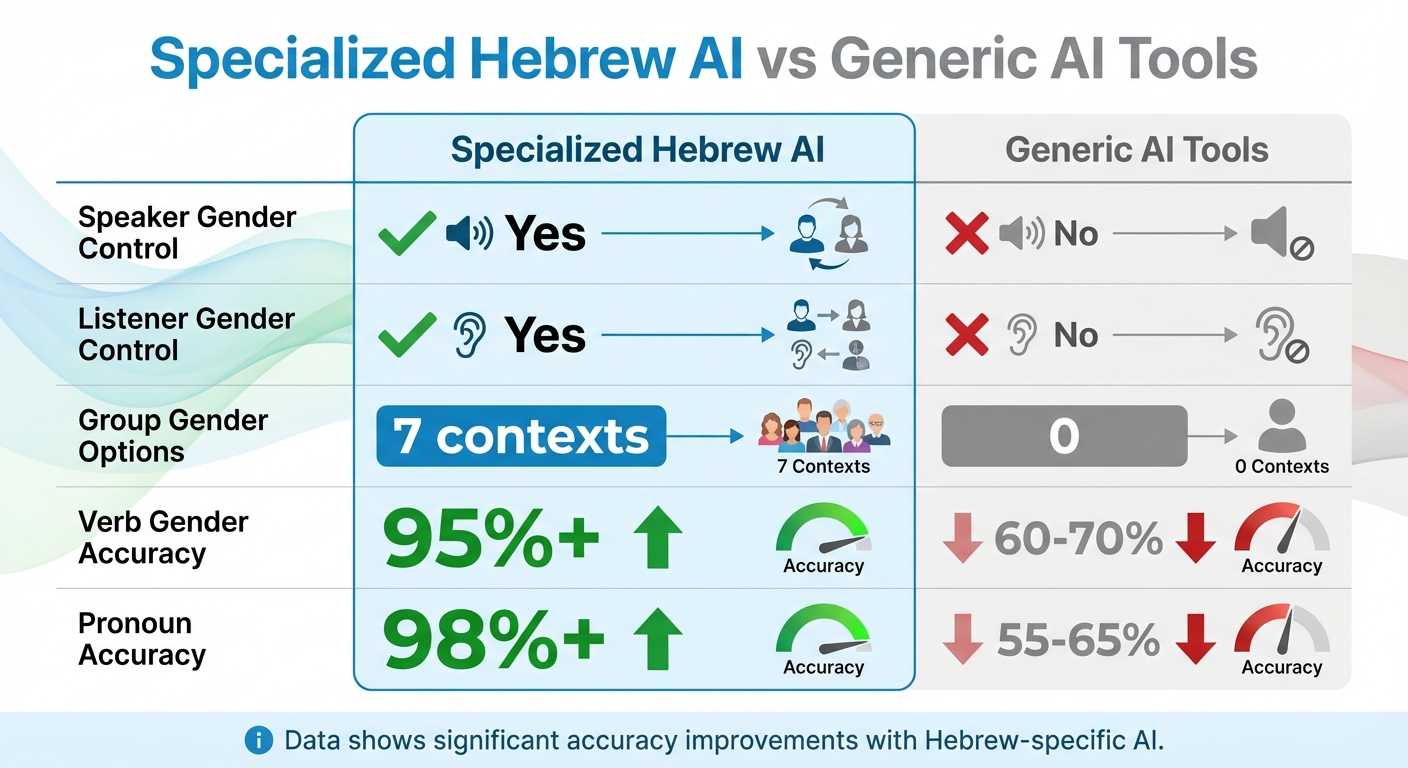
Specialized Hebrew AI vs Generic AI Tools: Gender Translation Accuracy Comparison
Most translation tools struggle with Hebrew because they overlook its unique grammar and root-based structure. Hebrew's gendered language rules are complex, and generic AI systems often default to masculine forms, ignoring the nuances required for accurate translations. These systems rely on broad models designed for multiple languages, which simply don’t account for Hebrew's intricacies [3].
Defaulting to Masculine Forms
One major issue is the lack of differentiation between the speaker and the listener. Generic tools default to masculine forms because the English input carries no gender signal. For women, this means many gendered words are mistranslated, leading to awkward errors in professional emails, social interactions, and even casual conversations [1][2]. These inaccuracies highlight the tools' inability to handle gender context effectively.
Missing Context Awareness
Another shortfall is the absence of context awareness. Most AI tools translate sentences without understanding whether the speaker is addressing a man, woman, or group. This is critical in Hebrew, where verbs, adjectives, and pronouns change based on gender[1][2][3]. Furthermore, these tools fail to maintain context across conversations or adjust for different levels of formality, often defaulting to informal masculine forms, regardless of the situation [2].
Inferred from the text, often defaulting to masculine forms
Pronoun Accuracy
Explicit speaker and listener controls
Inferred from context, often defaulting to masculine forms
Training Data and Bias Problems
The training data used by generic tools adds another layer of issues. These systems are often trained on formal texts, which don’t reflect the dynamic and conversational nature of Hebrew [3]. Without the ability to parse context - like identifying the gender of the speaker or listener - these tools frequently default to masculine forms, leading to inconsistent results [1][3].
"Unlike generic translation AI that handles dozens of languages with the same model, baba's artificial intelligence was built from the ground up to understand Hebrew's unique characteristics."
Specialized tools like baba tackle these challenges head-on. By training on over 2,700 HebrewCore™ prompts, baba focuses specifically on Hebrew's gender and plurality rules. This approach focuses on producing correct verb and pronoun gender by asking who is speaking and who is listening, rather than defaulting to masculine forms. Instead of relying solely on formal texts, baba incorporates real conversations and slang into its training data, bridging the gap between formal and everyday Hebrew use [3]. These improvements underscore the importance of a gender-aware approach for authentic Hebrew translation.
Real-World Impact of Gender Errors in AI Translation
Hebrew’s detailed gender rules can lead to more than just grammatical hiccups - they create real-world challenges that ripple through professional, social, and educational settings. These errors aren’t minor; they can affect how people are perceived, how they connect with others, and even how they learn.
Professional Communication Problems
In the workplace, gender translation errors can erode professional credibility. Using the wrong gender form in Hebrew is comparable to misusing pronouns in English - it feels unprofessional and, at times, disrespectful.
"I'm a Hebrew teacher, and I've tried every translation app out there. baba is in a completely different league when it comes to accuracy, especially with gender and formality." - Dr. Rachel Cohen, Hebrew instructor [2]
The issue is especially challenging for women in professional environments. Many AI translation tools default to masculine forms, which can result in female professionals sending emails that make them sound like men or receiving translations that misaddress them. These inaccuracies can harm credibility in negotiations, client discussions, and team collaborations where precision and tone are critical.
Social and Cultural Mistakes
In casual conversations, gender errors create awkward moments that alienate native Hebrew speakers. Mistakes like these are immediately noticeable and can make the speaker sound robotic or unnatural.
"Other translators produce robotic Hebrew that native speakers find confusing or amusing." - David Levy, tour guide [2]
Such errors go beyond simple misunderstandings - they can disrupt social dynamics in dating, friendships, and group interactions. For example, when AI defaults to masculine plural forms for all-female groups, it feels both grammatically incorrect and exclusionary. In informal settings where natural, fluid conversation is expected, these errors can create a sense of distance rather than connection. Add in the inability to properly switch between formal and informal tones, and the speaker might unintentionally come across as overly blunt or even rude [2].
Learning Barriers for Hebrew Students
For Hebrew learners, gender translation errors present a significant hurdle. Many tools default to masculine forms, leading students to unknowingly practice incorrect grammar. This is particularly problematic in Hebrew, where the speaker’s gender is just as important as the listener’s. For instance, the verb for "want" changes depending on who is speaking, not just who is being addressed [1].
When students repeatedly encounter these mistakes, they risk forming bad habits that are tough to break later. Tools like baba aim to solve this issue by asking who is speaking and who is listening and conjugating for that context, rather than defaulting to masculine forms. By providing accurate models, learners can start with a solid foundation in Hebrew grammar.
These challenges highlight the importance of a translation tool that truly grasps Hebrew’s gender complexities and delivers reliable, context-aware results.
Hebrew's gendered grammar can be tricky, but baba is here to make it easier. Designed specifically for Hebrew, baba tackles the language's unique gender complexities with technology built from the ground up to address these challenges.
Gender-Aware Translation Technology
What sets baba apart is its ability to handle seven distinct gender contexts. These include a general mode, a personalized setting (where users can set their gender in their profile), and specific options like "To One Man", "To One Woman", "To Mostly Men", "To Mostly Women", and "To Mixed Group." Unlike other tools that default to masculine forms, baba gives users full control over gender settings in Hebrew translations.
This isn't just a surface-level fix. baba uses over 2,700 specialized prompts tailored to Hebrew's root-based structure and complex gender rules. Once you set your gender in the app, it automatically applies the correct masculine or feminine forms, ensuring unmatched accuracy. This technology has been tested and validated through tens of thousands of translations across 14 languages.
On top of precise gender handling, baba also makes sure your Hebrew sounds natural and modern.
Handling Slang and Everyday Contexts
Getting gender right is important, but if your Hebrew still sounds stiff or overly formal, it won't feel authentic. That’s why baba includes a Slang Mode to capture the casual tone of contemporary Israeli speech. For example, instead of translating "אחי" as the literal "my brother", baba understands its casual meaning, offering equivalents like "dude" or "bro" and explaining when to use it.
The AI is trained on real-life conversations, not just formal texts. It recognizes idioms, cultural nuances, and day-to-day speech patterns, so your translations feel natural. Whether you're chatting with friends or posting on social media, baba ensures your Hebrew doesn’t come across as robotic or out of touch.
But baba isn’t just about language - it’s also designed with privacy and ease of use in mind.
Privacy and Accessibility
baba takes privacy seriously. Unlike many tools that require accounts or track user data, baba is completely anonymous - no email, no accounts, no tracking. You can open the app and start translating with total peace of mind.
Available for both iOS and Android, baba keeps things lightweight with a storage size under 50MB. It also boasts a stellar 4.8/5 rating on the App Store, backed by hundreds of glowing reviews. Whether you're learning Hebrew in the U.S. or communicating internationally as an Israeli, baba delivers accurate, natural translations while keeping your privacy intact.
Conclusion: Why Gender-Aware AI Matters for Hebrew
Hebrew’s gender rules add a layer of complexity to every aspect of communication. It’s not just a technical quirk - it’s the difference between sounding natural and sounding awkward. Since verbs, adjectives, and pronouns shift depending on who’s speaking and who’s being addressed, generic translation tools that default to masculine forms often fall short. This can result in business translations that feel clunky, social interactions that miss the mark, and extra hurdles for language learners. Addressing this challenge requires a tailored solution.
baba steps up to this challenge with a highly accurate, focused approach. It asks who is speaking and who is listening and conjugates for that context, rather than defaulting to masculine forms - leaving generic tools far behind.
But it’s not just about accuracy. baba also keeps Hebrew’s natural tone intact. Its Slang Mode handles modern Israeli expressions in context, ensuring translations that aren’t just correct but also feel right.
The app’s 4.8/5 rating on the App Store speaks volumes, with users consistently praising how it transforms their experience [4]. Gender-aware translation isn’t just a theoretical need - it’s essential for professional communication, social interactions, and mastering the language.
Ready to tackle Hebrew’s gender nuances with confidence? Download baba for iOS or Android at https://get.itsbaba.com/blog. It’s free to start and doesn’t require a login, so you can dive in immediately.
FAQs
Why does Hebrew change based on who’s speaking?
Hebrew is a language deeply rooted in gender distinctions, where verbs, adjectives, and pronouns align with the gender of both the speaker and the audience. For instance, the phrase "I am happy" translates to ani same'ach when spoken by a male and ani sme'cha when spoken by a female. These nuances make translating Hebrew accurately a complex task. However, tools like baba help bridge this gap by providing gender-aware translations, ensuring communication feels natural and respectful.
How do I know which plural form to use for a group?
In Hebrew, plural forms change based on the gender composition of the group. For groups of men or mixed-gender groups, the masculine plural is used (e.g., "הם" meaning "they"). For groups composed entirely of women, the feminine plural is applied (e.g., "הן"). Traditionally, Hebrew defaults to masculine forms when referring to mixed groups. However, there’s a growing trend toward using inclusive language, which encourages specifying gender or adopting neutral expressions where applicable.
How can I ensure AI translations keep the correct gender and tone?
To ensure accurate gender and tone in Hebrew translations, it’s essential to use tools specifically designed to handle the language’s gender nuances. Apps like baba adjust translations based on the speaker’s gender, audience, and context. This means verbs, adjectives, and pronouns are tailored to fit naturally within the language. By setting gender preferences within the app, users can achieve even greater precision, including support for inclusive and non-binary options. Unlike generic translation tools, these specialized apps help avoid common mistakes, resulting in translations that feel natural and culturally appropriate.
Frequently Asked Questions
Does gender matter even in short, casual Hebrew messages?
Yes — even a two-word text like 'I'm coming' changes form depending on whether the sender is male or female. Slang and informal speech follow the same gender agreement rules as formal Hebrew, so skipping gender context produces output that sounds off to any native speaker.
What happens when I'm addressing a mixed-gender group in Hebrew?
Traditional Hebrew defaults to the masculine plural for mixed groups, but the right choice depends on the group's composition and the social context. A tool that lets you specify whether the group is mostly men, mostly women, or truly mixed will produce a more appropriate and natural result than one that always defaults to masculine.
Why do generic translation tools get Hebrew gender wrong so often?
Most general-purpose AI translators are trained across many languages using formal written texts, so they never develop a real understanding of Hebrew's speaker-and-listener gender system. Without knowing who is speaking and who is being addressed, they default to masculine forms and miss a large share of gendered words.
Can setting my gender preference in a translation app actually improve accuracy?
It makes a significant difference — once the app knows whether the speaker is male or female, it can automatically apply the correct verb and adjective forms throughout the translation instead of guessing. This is especially noticeable in first-person sentences and anything involving direct address.
Is gender-aware translation just for learners, or does it matter for fluent speakers too?
It matters for everyone: fluent Hebrew speakers switching to an English interface still need output that maps back to the correct gendered forms when communicating with Israeli colleagues, clients, or friends. A mistranslated gender form in a professional email can undermine credibility just as much as a grammar mistake.