Hebrew transliteration can follow sounds or letters. Learn when to use each, why Hanukkah has multiple spellings, and what gets lost in English.
Which Hebrew transliteration should an English speaker use first?
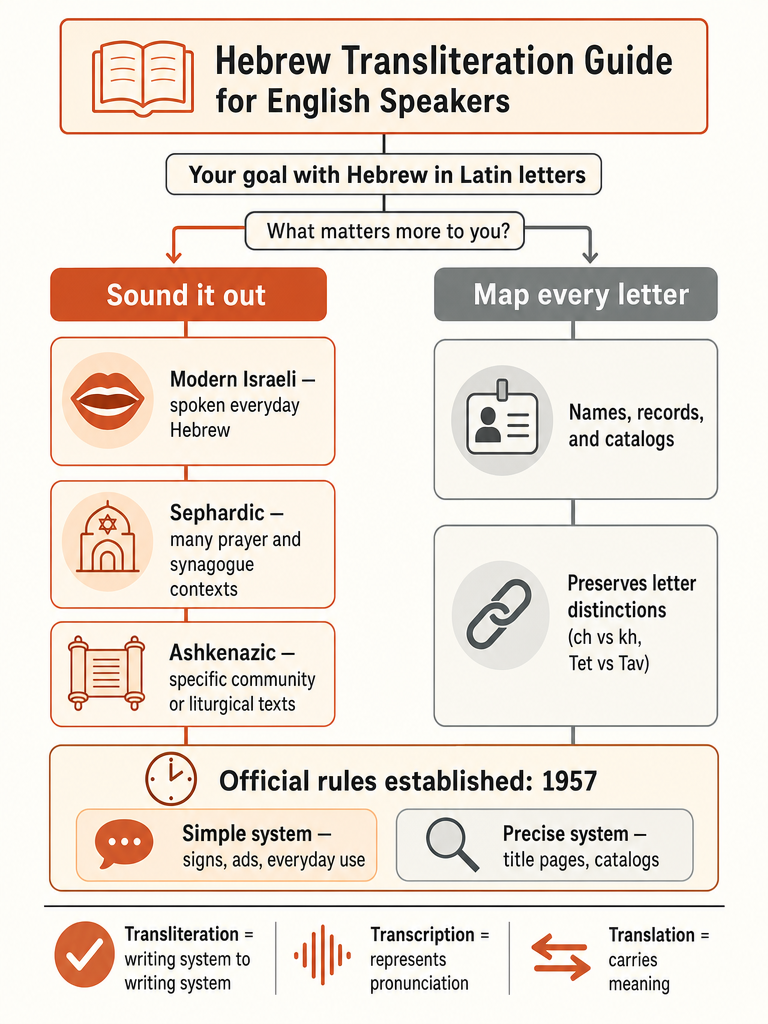
Start by asking what you're trying to do, not which system is "correct." If you want to say a word out loud or read a prayer, use pronunciation-based transliteration that mirrors how the word sounds. If you're recording a name for a family tree, a catalog entry, or a prayer text where the underlying letters matter, use letter-preserving transliteration that keeps Hebrew's distinctions intact.
The Hebrew Language Academy builds this split into its own guidance. It offers a simple transliteration for popular use such as ads and street signs, and a more precise transliteration for uses like title pages or catalogs (Source: Hebrew Language Academy). Those are two jobs, not two competing standards.
Your goal
System to reach for
Why
Speaking, reading aloud, learning phrases
Pronunciation-based (sound-first)
Matches how Israelis actually say the word
Names, prayer texts, records, catalogs
Letter-preserving (precise)
Keeps Hebrew letter distinctions for accuracy
Signs, ads, casual public text
Simple transliteration
Easy to read, no special characters
There's a second choice underneath the first: which pronunciation model you're representing. Modern Israeli suits everyday life in Israel. Sephardic pronunciation is common in synagogue contexts. Ashkenazic shows up when a specific community or text expects it. Pick the job, then pick the accent — and you'll skip most of the confusion that trips up beginners.
What is Hebrew transliteration?
Hebrew transliteration is the practice of writing Hebrew words in Latin letters so people who don't read Hebrew script can still approximate how the words sound. Learn Hebrew Pod defines it plainly: Hebrew transliteration means "Hebrew words written in the English alphabet for English speakers and readers who don't read Hebrew" (Source: Learn Hebrew Pod). It's a reading aid, not a replacement for the Aleph-Bet.
The idea is old. Jewish Languages notes that transliteration has been part of Jewish textual traditions for practically as long as Hebrew and Aramaic texts have existed, and that today "the primary direction of transliteration is Hebrew words rendered in Latin letters" (Source: Jewish Languages).
It solves real problems for people who can't yet read the script. Learn Hebrew Pod points out that transliteration is often invaluable for learning prayers, for people who want to speak before they read, and as one way of writing Hebrew with vowels — since traditional Hebrew is generally written without them.
Transliteration lets you read Hebrew without learning a new alphabet first, which is exactly why it works best as a starting tool rather than a finish line.
Watch
Lesson 1: The Hebrew Alphabet | Crash Course in Hebrew Reading & Pronunciation
From The WORD in HEBREW on YouTube
What is the difference between transliteration, transcription, and translation?
These three words describe three different jobs, and mixing them up causes half the confusion English speakers feel. Transliteration maps one writing system onto another. Transcription represents how a word is pronounced. Translation carries meaning from one language into another. Jewish Languages frames transliteration specifically as "rendering part of a language using a different script" (Source: Jewish Languages).
Here's the split in practice:
Term
What it maps
Example goal
Transliteration
Writing system → writing system
Show the Hebrew letters in Latin script
Transcription
Sound → symbols
Capture exactly how a word is said
Translation
Meaning → another language
Say what the word means in English
The history shows both directions at work. Jewish Languages says early Christian scholars used transcription in their translations: Origen of Alexandria transcribed Hebrew biblical text into ancient Greek characters in his Secunda in the 2nd–3rd century CE, and Jerome used many transcribed place and personal names in his Latin Vulgate in the 4th century CE (Source: Jewish Languages).
Transliteration also flowed the other way for centuries. The eleventh-century scholar Rashi wrote glosses that translated difficult Hebrew terms using Old French words spelled in Hebrew letters (Source: Jewish Languages). Same tools, different direction. Knowing which job you need tells you which output to expect.
How do you write Hebrew with English letters?
Writing Hebrew in English letters comes down to four decisions, made in order. First, pick a system and stick to it — consistency inside one document beats jumping between spellings. Second, decide whether you're representing letters or sounds. Third, handle vowels, since Hebrew usually omits them and Latin script needs them. Fourth, stay consistent to the end.
The order matters because each choice constrains the next:
Pick a system. The Hebrew Language Academy's transliteration rules for Modern Hebrew were first approved in 1957 and aim to reflect pronunciation rather than the original spelling (Source: Hebrew Language Academy).
Choose letters or sounds. Virtual Ulpan takes the sound-based route for learners, stating that it transliterates sounds rather than letters (Source: Virtual Ulpan).
Make vowels visible. Learn Hebrew Pod notes that transliteration is one way of writing Hebrew with vowels, because traditional Hebrew is generally written without them (Source: Learn Hebrew Pod).
Stay consistent. One word, one spelling, throughout your text.
A sound-based approach reads more naturally for speaking practice. A letter-preserving approach protects details you'll want later, like the difference between two Hebrew letters that sound identical in modern Israeli speech. Each answers a different question, so match the choice to your goal.
Hanukkah has multiple English spellings because there's no single universal standard, and different people transliterate it for different reasons. Learn Hebrew Pod puts it bluntly: is it Hanukkah, Chanukah, or Hannukah? "All of them? Well, actually it's none of them!" The only "real" spelling is the Hebrew חנוכה — "once you try to write it in Hebrew transliteration, all bets are off" (Source: Learn Hebrew Pod).
The variation traces to two things. First, no uniform standard exists. Prizmah's HaYidion identifies this directly, naming "Multiple Hebrews, Lack of Uniform Standards" as the core challenge (Source: Prizmah/HaYidion). Second, Hebrew's pronunciation has varied across time and community even though its spelling stayed remarkably stable — Prizmah notes the Hebrew of the Torah is spelled the same way as the Hebrew of Yediot Achronot today, while pronunciation shifted significantly (Source: Prizmah/HaYidion).
So publishers just choose. HaYidion says it "chose to create a transliteration style that adapts elements from existing systems in a way that seems faithful to the Hebrew language" (Source: Prizmah/HaYidion).
Each spelling reflects a deliberate choice about which sound, which community, and which goal the writer is serving.
Modern Israeli vs Sephardic vs Ashkenazic: which pronunciation should beginners follow?
For everyday life in Israel, learn modern Israeli pronunciation first — it's what you'll hear on the street, in shops, and in chats. For synagogue reading, Sephardic pronunciation is the common baseline. Use Ashkenazic when a specific community or text expects it. JewFAQ confirms the practical default: "Sephardic pronunciation is used in Israel and in most American synagogues today," while many Orthodox synagogues and older Jews use Ashkenazic (Source: JewFAQ).
Here's a starting framework:
Situation
Pronunciation model
Source note
Everyday life, travel, chats in Israel
Modern Israeli
Matches street and daily use
Most synagogue and prayer contexts
Sephardic
"Used in Israel and in most American synagogues today" (JewFAQ)
Specific traditional communities/texts
Ashkenazic
Common in many Orthodox settings (JewFAQ)
The differences are real and audible. JewFAQ notes that a letter transliterated as "t" in Sephardic is sometimes pronounced "s" in Ashkenazic — the Kaddish opens as Yit'gadal in one and Yis'gadal in the other (Source: JewFAQ). Prizmah adds that the original Ashkenazi pronunciation survives in nicknames like "Yankel" for Yaakov, and that Bialik's poems were written for an Ashkenazic reading (Source: Prizmah/HaYidion).
JewFAQ's own transliterations follow Sephardic pronunciation as heard in northeastern America (Source: JewFAQ). Beginners aiming at real Israel use should start modern Israeli, then adjust as a specific community or text asks.
Should transliteration preserve Hebrew letters or match modern Israeli sounds?
Letter-preserving transliteration keeps distinct Hebrew letters distinct even when they sound identical today. Pronunciation-first transliteration collapses them to match how Israelis actually speak. This is the choice that separates a learning aid from a record-keeping tool, and each option hides and reveals different information.
Virtual Ulpan makes the collapse explicit. In modern Israeli pronunciation, several letter pairs become indistinguishable in sound-based transliteration: Tet and Tav, Kaf and Kuf, and Sin and Samech (Source: Virtual Ulpan). A sound-first system writes them the same. A letter-preserving system marks the difference — useful if you ever need to reconstruct the Hebrew spelling.
The clearest case is ch versus kh. JewFAQ transliterates two different Hebrew letters as ch and kh on purpose: both are throat-clearing sounds like the Scottish loch, but JewFAQ notes the ch is "a little bit softer" and writes them differently "because they are different letters in Hebrew and I wanted to preserve that information" (Source: JewFAQ).
Simplification helps a beginner speak faster, but it quietly erases Hebrew information a name or prayer text may depend on.
Gender and context carry the same tension — Hebrew gender rules reward the same "what job am I doing?" thinking.
How do Hebrew transliteration rules work?
Transliteration rules reduce confusion inside one project, but no rule set is universal — the right one depends on audience and purpose. Rules earn their keep when several people work on the same document and a name could otherwise be spelled three ways. The Kremenets Shtetl CO-OP built its own system for exactly that reason: consistent use of a single system "mitigates the problems, and reduces confusion" when multiple translators touch one record (Source: JewishGen / Kremenets Shtetl CO-OP).
The scale shows why consistency mattered there. The Kremenets Shtetl CO-OP, affiliated with Jewish Records Indexing - Poland (JRI-Poland), reported working on 15,000 vital records from 1870–1907, almost 2,500 pages of Kremenets and Vishnevets yizkor books, and more than 4,000 matzevot from historic cemeteries (Source: JewishGen). Their guidelines, dated 10 October 2005, note something honest about the whole exercise: transliteration from handwritten Hebrew and Yiddish "has more exceptions than rules" (Source: JewishGen).
That guide also draws on prior standardization work. It references Alexander Beider's term "non-standardized Yiddish" for the spelling used before 20th-century linguists led by Max Weinreich developed a conventional standard for Yiddish (Source: JewishGen).
The lesson: adopt a rule set for a project, apply it consistently, and accept that a different project may need a different one.
When does transliteration help with prayers, signs, names, and everyday Hebrew?
Transliteration earns its place in five real jobs: learning prayers, reading before you know the Aleph-Bet, decoding public text like signs, recording names in documents, and building everyday speaking practice. Learn Hebrew Pod flags the first three directly — it says transliteration is often invaluable for learning Jewish prayers and just the tool needed for people more interested in speaking than reading (Source: Learn Hebrew Pod).
Where it fits, by job:
Prayers. Read the service before you can read the script. Learn Hebrew Pod calls transliteration invaluable here (Source: Learn Hebrew Pod).
Public text. The Hebrew Language Academy explicitly offers a simple transliteration for street signs and ads (Source: Hebrew Language Academy). For live signs, translating Hebrew signs in Israel fast and right covers the on-the-ground version.
Names in records. The Kremenets guidelines exist to keep name spellings consistent across genealogical documents, drawing on work by Alexander Beider and Max Weinreich (Source: JewishGen).
Transliteration is a bridge for these jobs, useful right up to the point where reading Hebrew takes over.
What sounds, stress, and vowels get lost in plain-English transliteration?
Plain-English transliteration loses three things reliably: exact sounds English doesn't have, word stress, and the vowels Hebrew normally leaves out. English letters can only approximate Hebrew, so certain sounds arrive blurred or misread. Set your expectations here and you'll trust transliteration for what it's good at.
Stress is the quiet casualty. JewFAQ notes that most Hebrew words are pronounced with emphasis on the final syllable — yet its own prayer transliterations "do not provide any indication of where the emphasis lies" (Source: JewFAQ). Read the letters right, and you can still land the stress on the wrong syllable.
Specific sounds confuse English readers too:
h is silent at the end of a word, as in Sarah, but pronounced elsewhere (Source: JewFAQ).
r is a guttural back-of-throat sound for Israelis and purists, though most Americans just say the "r" in "rail" (Source: JewFAQ).
ch and kh are both throat-clearing sounds like the Scottish loch, with no equivalent English letter (Source: JewFAQ).
Then there's collapse: Virtual Ulpan notes that Tet and Tav, Kaf and Kuf, and Sin and Samech become indistinguishable in modern Israeli sound-based transliteration (Source: Virtual Ulpan). And because Hebrew is usually written without vowels, transliteration adds them in — helpful, but one more layer between you and the original.
Transliteration gets you close enough to be understood, but "close enough" is the ceiling — the last mile lives in the Hebrew itself.
When you want output that sounds native rather than close enough, baba Hebrew Translator is built for English↔Hebrew with gender-aware grammar, slang, and cultural context. Try the free web translator.
Frequently asked questions
What is Hebrew transliteration and why do English speakers need it?
Hebrew transliteration writes Hebrew words in Latin letters so English speakers can approximate pronunciation without learning a new alphabet first. Learn Hebrew Pod defines it as "Hebrew words written in the English alphabet for English speakers and readers who don't read Hebrew." It's especially useful for learning prayers, practicing spoken Hebrew before reading it, and decoding everyday words — since traditional Hebrew is written without vowels, transliteration also adds them in.
Why does Hanukkah have so many different English spellings?
No single universal standard exists, so every publisher chooses. Learn Hebrew Pod puts it plainly: the only real spelling is the Hebrew חנוכה — once you transliterate it, "all bets are off." Prizmah's HaYidion names "Multiple Hebrews, Lack of Uniform Standards" as the core challenge, noting that Hebrew spelling stayed consistent for millennia while pronunciation shifted significantly across communities and centuries.
Should beginners use modern Israeli, Sephardic, or Ashkenazic pronunciation for Hebrew transliteration?
For everyday life in Israel, start with modern Israeli pronunciation — it's what you hear on the street and in conversation. For synagogue and prayer contexts, Sephardic is the practical default: JewFAQ confirms it's "used in Israel and in most American synagogues today." Ashkenazic applies in specific Orthodox communities and older texts. The same letter can sound like "t" in Sephardic but "s" in Ashkenazic — the Kaddish opens as Yit'gadal or Yis'gadal depending on which tradition you follow.
Should Hebrew transliteration preserve the original letters or match modern Israeli sounds?
It depends on your goal. Letter-preserving transliteration keeps distinct Hebrew letters distinct even when they sound identical today — JewFAQ deliberately writes ch and kh differently "because they are different letters in Hebrew." Pronunciation-first transliteration, used by Virtual Ulpan, collapses pairs like Tet/Tav and Kaf/Kuf to match how Israelis actually speak. Sound-first reads more naturally for speaking; letter-preserving protects details you'll need to reconstruct the original spelling.
What sounds and stress patterns get lost when writing Hebrew in English letters?
Three things drop out reliably: exact sounds English lacks, word stress, and the vowels Hebrew normally omits. JewFAQ notes most Hebrew words stress the final syllable, yet its own prayer transliterations give no stress indication at all. Specific pitfalls include ch and kh (both throat-clearing sounds with no English equivalent), a guttural r, and a silent h at word endings. Virtual Ulpan adds that Tet/Tav, Kaf/Kuf, and Sin/Samech become indistinguishable in sound-based systems.
What is the difference between transliteration, transcription, and translation?
Transliteration maps one writing system onto another. Transcription captures how a word sounds in phonetic symbols. Translation carries meaning into another language. Jewish Languages frames transliteration specifically as "rendering part of a language using a different script." Origen of Alexandria used transcription in the 2nd–3rd century CE to preserve early Hebrew pronunciation in Greek characters; Rashi went the other direction in the 11th century, spelling Old French words in Hebrew letters to gloss difficult terms.