English to Hebrew translator for natural full sentences, gender-aware chat, slang, and daily texts — plus gender-aware verb conjugation on the site.
Which English to Hebrew translator is best for natural full sentences?
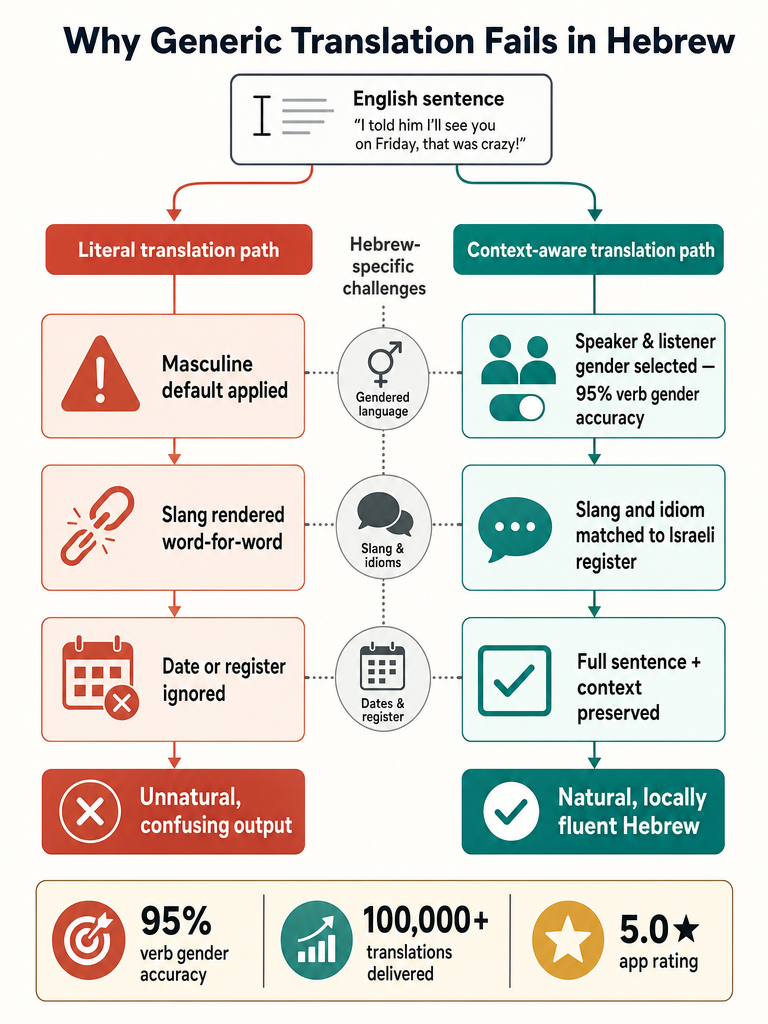
Pick a sentence-level English to Hebrew translator when meaning, gender, tone, and slang matter more than looking up single words. Hebrew changes verbs, adjectives, and pronouns based on who's speaking and who's listening, so a translator that reads the whole sentence beats one that swaps words one at a time.
The tools worth your time treat a message as a whole thought. Take "I'm proud of you, sis." A word-for-word tool defaults to a masculine speaker and produces stiff, textbook Hebrew — the kind that reads as אני גאה בך, אחות, technically correct but flat. A context-aware version marks a female speaker and sister-to-sister warmth: אני ממש גאה בך, אחותי, with the natural Israeli ממש.
That gap is the whole decision. If you're translating a WhatsApp reply, a warm note, or a casual chat, the literal version often lands wrong even when every word is technically correct. A sentence-level tool wins for daily communication because Hebrew grammar bends around context that isolated words can't carry.
On its homepage, baba Hebrew Translator says it asks who is speaking and who is listening and conjugates for that context, rather than defaulting to masculine forms, and it lists support for 14 languages, and it runs across web, iOS, Android, and a Chrome extension — one example of a Hebrew-first tool built around this problem rather than adapted from English. For deeper background on why literal output fails, see how to translate Hebrew slang without sounding robotic.
How do I translate English to Hebrew without sounding literal?
Start with the full sentence, not the phrase. Literal Hebrew usually comes from feeding a translator fragments or single words, which strips out the context Hebrew grammar needs. A short, repeatable workflow fixes most of it before you hit send.
Paste the whole sentence. Give the translator the complete thought, including the sentence around it, so idioms and tone survive rather than getting swapped word by word.
Keep the surrounding context. If the message is part of a chat, translate a line or two together so the tone carries.
Set speaker and listener gender. Hebrew verbs and pronouns shift by gender, so tell the tool who's talking and who's listening. This is the core rule of natural Hebrew, and it's the step most tools skip.
Read it back for register. Ask whether it sounds like something a person would actually text. If it reads like a 1998 textbook, adjust the tone.
The gender step matters most in everyday messages. A single wrong verb ending signals "a machine wrote this," which is why translating the whole sentence with gender set correctly is the difference between native-sounding Hebrew and robotic output.
Hebrew is gendered at the grammar level, so the same English sentence has different correct Hebrew depending on who says it and who hears it. Verbs, nouns, adjectives, and pronouns all carry gender. When a translator defaults to masculine — as generic tools tend to — a message from a woman, or to a woman, reads wrong even when the meaning is intact.
This is the mechanic behind the earlier rule about setting speaker and listener gender. Take "I'm proud of you, sis." The generic version defaults to a masculine speaker and sounds textbook-formal; a gender-aware version marks a female speaker and sister-to-sister warmth.
This isn't a rare edge case. It touches routine sentences: "I'm glad," "I understand," "can you help me." Each one changes form based on gender.
baba's homepage lays out the mechanic directly, explaining that baba asks who is speaking and who is listening and conjugates for that context rather than defaulting to masculine forms, which is why gendered grammar is the single biggest reason literal English-to-Hebrew output sounds off. For the full breakdown of the rules behind this, see the complete beginner's guide to Hebrew gender rules.
Can an English to Hebrew translator handle slang, idioms, and casual Israeli phrasing?
Slang and idioms are exactly where literal translation collapses. Israeli Hebrew is full of casual terms — סבבה, אחי, תכלס, וואלה — that word-for-word tools either skip or mangle. Idioms fail even harder because they mean something other than their words.
The classic break is "She told me to break a leg before the audition." A generic tool renders לשבור רגל — literally injuring your leg — which will confuse any Israeli listener. The meaning-based version translates the intent instead: היא איחלה לי בהצלחה ("she wished me good luck").
That's the core test. A tool that translates the meaning of an idiom, not its words, is doing the job. One that hands back a literal phrase is leaving you to sound strange. The same rule applies to casual register — a good translator renders the Hebrew people actually text, not the textbook version from 1998.
For English speakers who can't read Hebrew script yet, transliteration matters too: seeing eifo beit hamerkachat hachi karov alongside the Hebrew tells you how to say it out loud. See more on when to swap in a natural equivalent in how to translate Hebrew slang without sounding robotic.
How should you translate English to Hebrew for texts and daily chats?
Daily chats live or die on tone, so translate the message the way you'd say it, not the way a dictionary lists it. WhatsApp replies, warm notes to family, quick work answers — each has a register, and Hebrew has both formal and casual forms for the same idea. Picking the wrong one makes a friendly text feel cold.
Three quick habits keep chat translation natural:
Match the warmth. A message to a friend or partner should use casual phrasing — small words like the Israeli ממש ("really") signal you're not a bot.
Set gender for both people. In a two-person chat, speaker and listener gender both shape the verbs, the same rule that drives everything else in natural Hebrew.
Keep slang as slang. If you'd write "sababa" in English transliteration, let the tool render the real Hebrew term rather than a formal substitute.
How should you handle dates, times, and time-sensitive Hebrew instructions?
Verify anything with a number attached. Dates, appointment times, amounts, and official instructions are the pieces where a translation mistake costs you real time or money, so treat them as a separate checking step rather than trusting the first output.
The corpus doesn't include independent accuracy testing for translating dates and time-sensitive phrasing into Hebrew, so the honest advice is process, not a guarantee: translate the full instruction, then confirm the specifics. Read back the deadline, the time, and any figure to make sure they survived intact.
A few habits help:
Re-check every number. Confirm the day, the time, and any amount against the original before you act on it.
Translate the whole instruction together. An official notice reads more accurately as a full sentence than as fragments, because the surrounding words anchor the meaning.
When it's official, verify twice. Government notices, bank messages, and appointment confirmations deserve a second read.
How do signs, menus, forms, and websites change the translation workflow?
Different surfaces need different tools, so match the method to what you're reading. A street sign, a restaurant menu, a government form, and a Hebrew website each present Hebrew differently — and the fastest path changes with each one.
Here's a practical split based on what each situation demands:
Surface
Best approach
Why it differs
Street signs
Camera / photo translation
Text is short, right-to-left, and often needs a fast read for parking or warnings
Menus
Camera plus structure reading
Section headers and dish names matter more than word-by-word
Forms & gov sites
Full-sentence translation, verify details
Official instructions, deadlines, and amounts need checking
Hebrew websites
Browser extension
Read in place without copy-pasting into a separate tool
Camera modes handle menus, signs, and books, while a browser extension lets you highlight Hebrew text on any website and see a translation pop up in place.
For each surface, there's a dedicated walkthrough:
Translator vs dictionary vs context examples: which should you use?
Use a full-sentence translator for messages, a dictionary for single words, and a context-example search when you want to see how a phrase behaves in real use. Each solves a different problem, and reaching for the wrong one is why translation often feels either too literal or too vague.
Tool type
Best for
Main limit
Full-sentence translator
Chats, emails, signs, full thoughts
Only as good as the context you give it
Dictionary lookup
Single words, roots, conjugations
Too narrow for real conversation
Context-example search
Seeing a phrase used across real sentences
Not built to translate your specific message
Reverso Context describes itself as providing relevant Hebrew-English translations in context with real-life examples for millions of words and expressions, using a natural language search engine applied on bilingual data. That's useful for study — but it's example search, not a translator for the exact sentence you need to send.
For daily messages, the full-sentence approach wins because Hebrew grammar depends on context a dictionary can't supply. More on the split between single-word tools and real-sentence translation in baba vs dictionary-only Hebrew tools for real sentences.
Best Hebrew translator app for English speakers: what features matter?
Prioritize the features that solve Hebrew's actual problems: gender controls, slang handling, and access where you already work. Speed and "free" show up on every translator page, so they don't separate the good tools from the weak ones. The Hebrew-specific features do.
Here's what to weigh:
Gender controls. The ability to set speaker and listener gender — the core rule of natural Hebrew.
Slang and idiom handling. Real Israeli phrasing, not textbook Hebrew.
Transliteration. For English speakers who can't yet read Hebrew script, seeing the pronunciation matters.
Camera and voice input. Point at a menu or speak naturally.
Browser access. A Chrome extension to read Hebrew sites in place.
Mobile apps. Native iOS and Android for translation on the go.
Free access. Some tools run with no login and no daily cap.
baba Hebrew Translator centers gender controls, asking who is speaking and who is listening and conjugating for that context rather than defaulting to masculine forms, and its free-translator page states no login, no credit card, and no daily limit — a useful benchmark for what "genuinely free" should mean. For travel specifically, camera, voice, and offline phrases matter most — see best Hebrew translator app for travel in Israel.
Top English Hebrew translation apps in 2026: how do free limits compare?
Free tiers differ more in their limits than in their promises, so read the caps before you commit. Most pages advertise fast, free translation, but the character and request ceilings vary widely by tool and format. These caps are vendor-specific and subject to change.
Tool
Stated free limit
Lingvanex
Up to 3,000 characters at once, up to 1,000 requests a day
QuillBot
Up to 5,000 characters for free
PROMT.One
5,000 characters at a time
Translate.com
Daily free machine translation, shown as 500 characters left today (page also states up to 1,000 characters per day)
baba
No login, no credit card, no daily limit (per baba's free-translator page)
Lingvanex says its tool is free for short texts, phrases, and everyday messages. QuillBot says it supports 52 different languages and dialects, including Hebrew. PROMT.One says it preserves meaning and style and offers translation suggestions.
For heavy chat use, a character cap can interrupt you mid-conversation — worth checking against how much you actually translate in a sitting. Translate.com also notes a discrepancy in its own free allowance figures, which is why labeling limits as vendor-specific and changeable is the safe read.
When do documents, PDFs, articles, and websites need a different workflow?
Larger content jumps from casual translation to a managed workflow once volume, formatting, or review enters the picture. A WhatsApp thread and a full article aren't the same job — documents need format handling, articles need editorial review, and a whole site needs localization at scale.
The corpus shows two clear tracks. For one-off documents, QuillBot says it can translate entire documents as well as words and paragraphs. For professional output, Translate.com offers both machine translation and human translation, priced at $0.07 per word for editable or copyable text and $25 per page for non-editable documents like scanned images. Translate.com also describes a multi-step process: machine translation, editing by a translator, expert editing, and a client check.
For teams, the requirements grow:
Article and CMS translation so published content reads naturally in Hebrew, not literally.
Editorial review workflows so a human confirms tone, gender, and register before publishing.
API access for translation inside existing systems.
Localization at scale across a full site.
baba's homepage points to enterprise products for API and editorial workflows and lists a 99.9% uptime SLA. For a hybrid approach on sensitive content, see the human-AI workflow for Hebrew legal translation.
Frequently asked questions
best english to hebrew translator for natural sentences
A sentence-level, gender-aware translator produces the most natural Hebrew. baba Hebrew Translator asks who is speaking and who is listening and conjugates for that context, rather than defaulting to masculine forms the way many generic tools do. That difference separates native-sounding output from the stiff, textbook Hebrew most tools produce.
best hebrew translator app for english speakers
The features that matter most are gender controls, slang handling, transliteration, and access on iOS, Android, and Chrome. baba Hebrew Translator offers all four with no login, no credit card, and no daily character cap. For travel, camera and voice input are essential too — pointing at a sign or speaking naturally gets you a translation faster than typing.
top english hebrew translation apps in 2026 — how do free limits compare?
Free tiers vary widely. Lingvanex caps users at 3,000 characters per input and 1,000 requests per day. QuillBot allows up to 5,000 characters free. Translate.com's free allowance is 500 characters per day. baba's free-translator page states no login, no credit card, and no daily limit — and as of May 2026 has served 100,000+ translations at no cost.
best alternatives to google translate for english to hebrew
Generic tools including Google Translate default to masculine Hebrew forms, which produces grammatically wrong output for female speakers or listeners. Hebrew-first tools that resolve speaker and listener gender before translating — and that handle Israeli slang like סבבה, תכלס, and וואלה — close that gap. baba asks who is speaking and who is listening and conjugates for that context, rather than defaulting to masculine forms.
why does hebrew gender change the translation so much?
Hebrew encodes gender into verbs, adjectives, pronouns, and even the word for 'you' — so the same English sentence has multiple correct Hebrew forms depending on who's speaking and who's listening. A translator that defaults to masculine gets the grammar wrong for any message from or to a woman. That's not a style issue; native readers notice it immediately as a grammatical error.
can an english to hebrew translator handle slang and idioms correctly?
Literal tools fail hard on both. 'Break a leg' rendered word-for-word becomes לשבור רגל — meaning actual physical injury to an Israeli listener. A meaning-aware translator outputs היא איחלה לי בהצלחה ('she wished me good luck') instead. The same logic applies to everyday Israeli terms like אחי, סבבה, and וואלה, which word-for-word tools either skip or mistranslate.