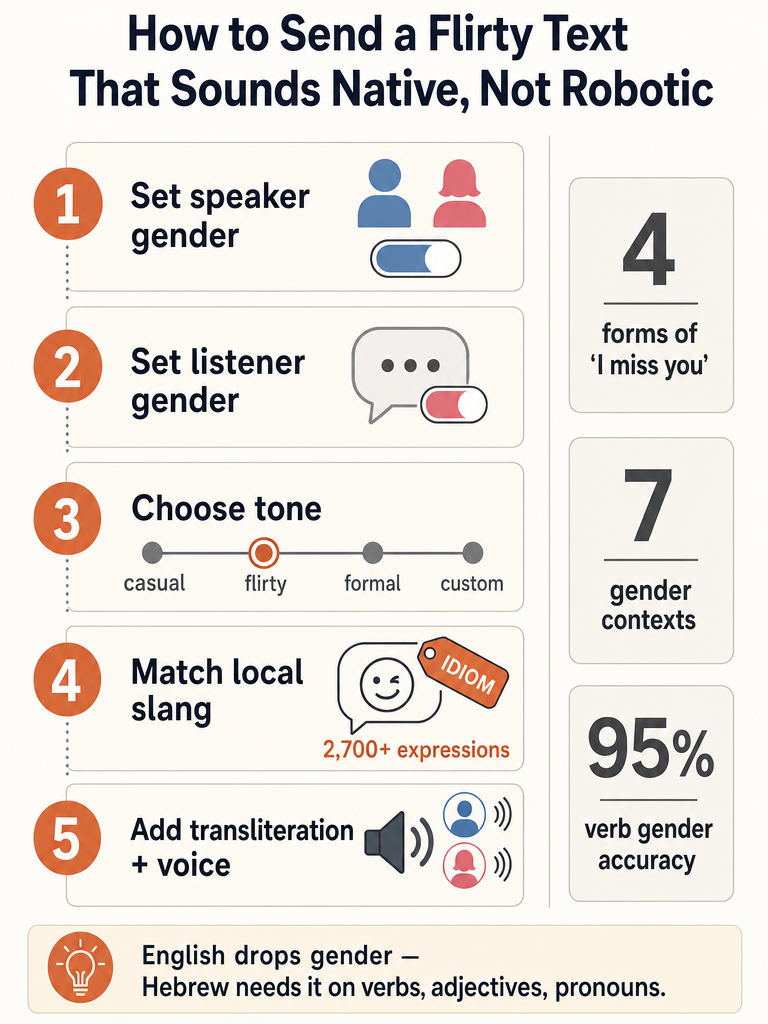
English to Hebrew texting translator with 7 gender contexts, casual or custom tone, and transliteration so flirty messages sound natural, not robotic.
How should you translate a flirty English text into natural Hebrew?
Start by setting four things before you hit translate: who's speaking (your gender), who's reading (their gender), the tone you want, and whether you need transliteration. Hebrew encodes gender on verbs, adjectives, and pronouns, so the same English line shifts based on who says it to whom. The baba Hebrew Translator App Store listing notes that "I miss you" has 4 different forms in Hebrew for exactly this reason.
That's why a flirty text fails when a tool just swaps words. "I'm thinking about you" needs to know if a woman is writing to a man or a man to a woman before it can pick the right verb form. Get the gender wrong and the message reads grammatically broken, like a textbook exercise.
Here's the workflow that keeps a romantic message warm instead of robotic:
Set your gender as the speaker.
Set the recipient's gender as the listener.
Choose a tone — casual works for flirting; formal will sound cold.
Turn on transliteration so you can read it aloud or check it before sending.
Translate, then read it back in your head for tone.
The baba App Store listing lists "a flirty text" as a supported situation, with casual, formal, professional, or custom style options. Set those switches first, and the Hebrew comes out sounding like a real person wrote it.
Will an English-to-Hebrew texting translator let you choose speaker and listener gender?
Gender choice is the first decision in any Hebrew text, not an afterthought. English drops most gender markers, but Hebrew requires gender on verbs, adjectives, and pronouns — so a translator has to know who's speaking and who's listening before it can produce a correct sentence. baba's Hebrew ⇄ English translator page makes this explicit: English-to-Hebrew needs gender intelligence because the two languages handle gender so differently.
The clearest example comes from baba's App Store listing, which says the English phrase "I miss you" has 4 different forms in Hebrew. A man texting a woman, a woman texting a man, woman to woman, man to man — each takes a different verb ending. Pick the wrong one and your sweet message reads like a grammar mistake.
baba supports 7 gender contexts for this, according to its App Store listing, asking who is speaking and who is listening and conjugating for that context rather than defaulting to masculine forms. That coverage matters most in flirty texts, where the whole point is sounding personal and getting the small things right.
Generic translator pages emphasize broad language coverage or document handling, but they don't flag the risk that a romantic Hebrew text lands wrong because nobody set the gender. For a beginner, that's the difference between charming and confusing. If you want the underlying rules, see how Hebrew gender rules work.
Can it translate the meaning and tone of a romantic message, not just the words?
Tone and meaning matter more than literal words in a flirty message, because idioms and warmth don't survive a word-for-word swap. A translator that matches words instead of intent will turn affection into nonsense. baba's HebrewCore page gives a sharp example: חבל על הזמן literally reads like "waste of time," but in modern Israeli Hebrew it's enthusiastic praise.
That gap is exactly where romantic texts go wrong. The baba homepage shows a generic tool translating "I'm proud of you, sis" as stiff, masculine-default, textbook Hebrew, while a context-aware version produces "אני ממש גאה בך, אחותי" — female speaker, sister-to-sister warmth, with the natural Israeli "ממש." Same English, very different feel.
To control that feel, you set the register before translating. baba's App Store listing offers casual, formal, professional, or custom style options. For flirting, casual keeps it light; formal will make you sound like you're writing a cover letter. A romantic Hebrew text needs the meaning and the tone set on purpose, because the literal words rarely carry the warmth.
Think about register the way you'd think about voice in any message — what reads as playful in one tone reads as cold in another. The difference between Hebrew slang and formal Hebrew is the difference between a text that feels like you and one that feels like a form letter.
What are Hebrew texting abbreviations and WhatsApp slang?
Israeli texting leans heavily on slang and idioms that read strangely when translated literally, which is why a tool's slang range matters for casual messaging. A line that sounds natural in a WhatsApp chat often breaks the rules of formal Hebrew on purpose, and a literal translator can't tell the difference.
baba's App Store listing says the app understands 2,700+ Israeli expressions, and the HebrewCore page describes 2,700+ specialized AI prompts tuned for Hebrew gender, slang, and cultural nuance. That's the layer that turns an idiom like חבל על הזמן into "amazing" instead of "waste of time."
Public detail on a fixed list of Hebrew texting abbreviations is limited in the sources here, so rather than guess at specific shorthand, the safer move is to translate the full phrase you mean and let the tool handle the casual register. If you want a grounded starting set of everyday expressions, baba publishes a Hebrew slang guide of common daily phrases.
How do I translate words, phrases, and sentences between Hebrew and English in real time while texting?
You can translate Hebrew and English wherever you already text, because baba's HebrewCore engine runs across four surfaces. The baba homepage says the same gender-aware, context-aware engine powers the web translator, the iOS and Android mobile apps, the Chrome extension, and enterprise workflows. So whether you're in a browser tab or on your phone, the translation logic stays consistent.
Each surface fits a different texting moment:
Surface
Best for
Source detail
Web translator
Quick copy-paste from any chat
Free, no account required (baba homepage)
iOS & Android apps
Texting on the go
Runs HebrewCore (baba homepage)
Chrome extension
Highlight-to-translate on any site
Tooltip shows translation plus transliteration (baba homepage)
Two features make texting smoother. The baba App Store listing says every translation includes transliteration plus AI-powered text-to-speech with male and female voice options — so you can both read the Hebrew phonetically and hear how it sounds before sending. The Chrome extension's highlight-to-translate, per the homepage, means you can decode an incoming Hebrew message without leaving the page.
How do I install a Hebrew keyboard on my phone for Hebrew texting?
A Hebrew keyboard lets you type Hebrew characters directly, which pairs with a translator when you want to reply in Hebrew rather than just read it. The two tools solve different jobs: the keyboard handles input, the translator handles meaning, gender, and tone.
Step-by-step setup instructions for Gboard or Samsung Keyboard aren't covered in the sources here, so check your phone's official keyboard settings for the current process rather than relying on outdated steps. The general path on most phones is to open language or keyboard settings, add Hebrew, and switch layouts when you type.
In practice, many people skip typing Hebrew entirely for flirty texts. You write in English, set your speaker and listener gender, translate, and paste the Hebrew straight into your chat — transliteration included, so you can still pronounce it. That workflow sidesteps the right-to-left typing learning curve while keeping the message natural.
Which Hebrew translator is better in 2026 for flirty texting on iPhone or Android?
For flirty texting specifically, the gap between tools is gender and slang handling, not raw language count. Most translators convert English to Hebrew accurately at the word level. Few set speaker and listener gender or read Israeli idioms the way a native would — and that's exactly what a romantic text depends on.
Here's how the sourced evidence compares across tools relevant to texting:
Quillbot's strength is breadth — it covers over 52 languages and handles documents. iTranslate leads on its privacy statement. MobiLion's Android app advertises voice, camera, and conversation mode, though its Google Play listing notes it contains ads. None of these list speaker/listener gender control in the sources.
baba is the one built Hebrew-first for this exact job: its App Store listing names "a flirty text" as a supported situation and reports 100,000+ translations completed with a 4.9 out of 5 rating from 24 ratings on Apple's App Store. For a flirty Hebrew text, the tool that lets you set gender and reads slang wins — accuracy at the word level isn't enough.
What is free, and which features require a Pro upgrade?
baba's core translation is free, and the gender features cost nothing. The App Store listing says core translation with all 7 gender contexts is free and that no login is required. The baba homepage echoes the no-account claim alongside its free positioning. So the single most important feature for flirty texting — getting speaker and listener gender right — is available without paying or signing up.
What's behind a Pro upgrade is less clearly documented. The App Store page lists baba as free with in-app purchases and notes that Pro unlocks features, but a current price isn't provided in the sources here. Treat any specific number you see elsewhere as something to verify directly on baba's pricing page before relying on it.
Confirmed free (App Store listing)
Pro-gated (price not in sources)
Core translation
Unlocks additional features
7 gender contexts
Price not stated
No login required
Verify on pricing page
For everyday flirty and daily texting, the free tier covers the essentials. You can set gender, choose a casual tone, and get transliteration without a paywall.
Is an English-to-Hebrew translator private enough for personal or romantic messages?
Privacy claims vary by tool, and the strongest sourced statement comes from iTranslate, which states on its English-to-Hebrew page: "100% Private, we do not store any of your translations." That's a clear, specific commitment for anyone texting something personal.
baba's relevant claim in the sources is narrower: its App Store listing and homepage say no login is required to translate. Not needing an account reduces how much you hand over up front, but it's a different thing from a retention or deletion policy. Policy-level detail on how long any of these tools keep messages, or whether they delete them, isn't covered in the sources here.
So the honest answer: for casual flirty texts, the practical risk is low, but if a message is genuinely sensitive, read the actual privacy policy of whatever tool you use rather than trusting a homepage line.
When the message really matters, the safest approach is the same as with any app — assume a tool's marketing claim is a starting point, not the full policy.
Where should you go next for dating texts and daily Hebrew messages?
Deeper Hebrew texting help lives in a few baba guides that go past the basics covered here. Each tackles a piece of the natural-sounding-text problem from a different angle.
The thread across all of them is the same idea this guide started with: set the gender, set the tone, and translate the meaning rather than the words. Do that, and your Hebrew texts sound like you wrote them — not like a machine did.
Why does 'I miss you' have 4 different forms in Hebrew?
Hebrew encodes gender on verbs, adjectives, and pronouns — so the same English phrase shifts depending on who's speaking and who's listening. A man texting a woman, a woman texting a man, woman-to-woman, and man-to-man each require a different verb ending. Get it wrong and the message reads like a grammar mistake, not a sweet text. That's why setting speaker and listener gender before translating is the single most important step.
How do I translate a flirty English text into natural Hebrew without it sounding robotic?
Set four things before you hit translate: your gender as the speaker, your recipient's gender as the listener, a casual tone, and transliteration on. Hebrew verb forms change based on both speakers' genders, and casual register keeps the warmth — formal tone reads like a cover letter. baba's App Store listing names 'a flirty text' as a supported use case and offers casual, formal, professional, or custom style options, so the switches are built in.
What does baba's verb gender accuracy claim mean for a Hebrew texting translator?
It means the translator asks who is speaking and who is listening and conjugates the verb for that context — covering 7 gender contexts such as man-to-woman, woman-to-man, and so on — rather than defaulting to a single masculine form. In a romantic text, one wrong ending turns an affectionate message into a grammatical error that a native speaker notices immediately. baba's App Store listing also reports 100,000+ translations completed with a 4.9/5 rating from 24 App Store ratings.
Can an English-to-Hebrew translator handle Israeli slang and idioms in texts?
Standard word-for-word translation breaks on Israeli slang. חבל על הזמן literally means 'waste of time' but functions as enthusiastic praise in everyday Hebrew. baba's HebrewCore engine is trained on 2,700+ Israeli expressions, per its App Store listing, so idioms get translated by meaning rather than by words. For casual flirty texts where slang signals warmth and familiarity, that layer is what separates native-sounding output from textbook Hebrew.
Where can I translate Hebrew texts in real time — web, iPhone, or Android?
The same gender-aware engine runs across four surfaces: the free web translator at app.itsbaba.com (no login required), iOS and Android mobile apps, and a Chrome extension that translates any highlighted text on any site. Every translation includes transliteration and AI text-to-speech with male and female voice options, so you can hear the Hebrew before you send it. The baba homepage confirms all four surfaces share the same HebrewCore engine.
Is a Hebrew translator safe to use for personal or romantic messages?
Privacy commitments vary by tool. iTranslate states explicitly on its English-to-Hebrew page: '100% Private, we do not store any of your translations.' baba's homepage and App Store listing confirm no login is required to translate, which limits what you hand over upfront — but that's different from a data-retention policy. For anything genuinely sensitive, read the actual privacy policy of whichever tool you use rather than relying on a homepage tagline.