Learn how to read Hebrew street signs, menus, and WhatsApp messages faster with context-aware Hebrew translation that handles slang and gender.
How to Understand Hebrew Street Signs, Menus, and WhatsApp Messages Instantly
Navigating Hebrew can feel overwhelming, especially when dealing with gender-specific grammar, evolving slang, and context-dependent meanings. Whether you're deciphering street signs, ordering from menus, or responding to WhatsApp messages, baba is designed to make it easier. This app handles Hebrew's unique complexities, including gender nuances, modern slang, and cultural context, offering real-time translations for iOS and Android users. Here's what you'll learn:
Street Signs: Common Hebrew terms like "Entrance" (כניסה) or "Caution" (זהירות) and how baba translates them instantly using your phone camera.
Menus: Understand menu items, including borrowed words and gender-specific grammar, with baba's context-aware features.
WhatsApp Messages: Decode slang and abbreviations like מה נשמע? ("How are you?") or יאללה ("Let’s go") with baba’s Slang Mode.
With over 30,000 translations and a 5.0 user rating, baba simplifies Hebrew communication, making you feel more confident in everyday interactions. Download it today and start navigating Hebrew like a pro!
Why Hebrew Street Signs, Menus, and Messages Are Hard to Translate
Hebrew poses unique challenges that most translation tools just aren't equipped to handle. The language shifts based on context, gender, and even formality. For example, a street sign directed at women uses different wording than one aimed at men, and a menu item changes depending on whether it's singular or plural. Meanwhile, WhatsApp messages are often packed with rapidly evolving slang. Below, we’ll explore how gender, slang, and context create hurdles for conventional translation tools.
How Gender Grammar Changes Meaning
Hebrew grammar is deeply tied to gender - every verb, adjective, and noun must align with the gender of the person being addressed. A simple street sign saying "Stop" or a menu inviting you to "Try our special" will look and sound completely different depending on whether it's directed at a man, a woman, or a mixed group [2].
This complexity often leads to misunderstandings. For example, a casual message might come across as overly formal if the gender or plurality isn't accounted for. Translation tools that ignore these nuances often fail to capture the essence of everyday Hebrew communication [2].
"Automatically adapts Hebrew for male, female, or mixed audiences. No more awkward gender mistakes that plague other tools." - baba [2]
But gender is only one piece of the puzzle. Modern slang adds another layer of difficulty.
Modern Hebrew Slang and Regional Differences
Hebrew slang evolves at lightning speed. The phrases you hear in Tel Aviv today might not even exist in a textbook. Standard translation tools, which rely on static databases, often fall short when faced with this ever-changing vernacular [2]. Abbreviations on street signs or casual expressions in a WhatsApp chat can leave generic translators scrambling, frequently delivering literal translations that make zero sense in context [1][2].
The gap between a robotic literal translation and fluent, natural Hebrew is huge. A phrase that works perfectly in a formal email might feel completely out of place in a casual text. Without understanding the "soul" of the conversation, you risk sounding more like a confused tourist than someone who truly fits in [2].
When Context Changes Everything
In Hebrew, context isn’t just helpful - it’s essential. The same word can take on entirely different meanings depending on where it appears. A term on a restaurant menu might refer to a food item, while the exact same word in a WhatsApp message could be slang for something entirely unrelated [2].
"Hebrew isn't just words, it's context." - baba [2]
The problem with most translation tools is that they treat every situation the same. They don’t adjust for whether you’re reading a formal street sign, decoding a casual text, or ordering food at a café. Differences in tone, formality, and cultural nuances often lead to miscommunication [2].
These challenges underline why baba’s tailored translation approach is so effective for navigating real-life Hebrew interactions. It’s not just about translating words - it’s about understanding the context behind them.
Common Hebrew Words You'll See on Signs, Menus, and Messages
Essential Hebrew Words for Street Signs, Menus, and WhatsApp Messages
Let’s dive into some essential Hebrew words that can help you navigate street signs, read menus, and even keep up with WhatsApp chats. Recognizing these terms can make your daily interactions smoother and more enjoyable.
Street Sign Vocabulary
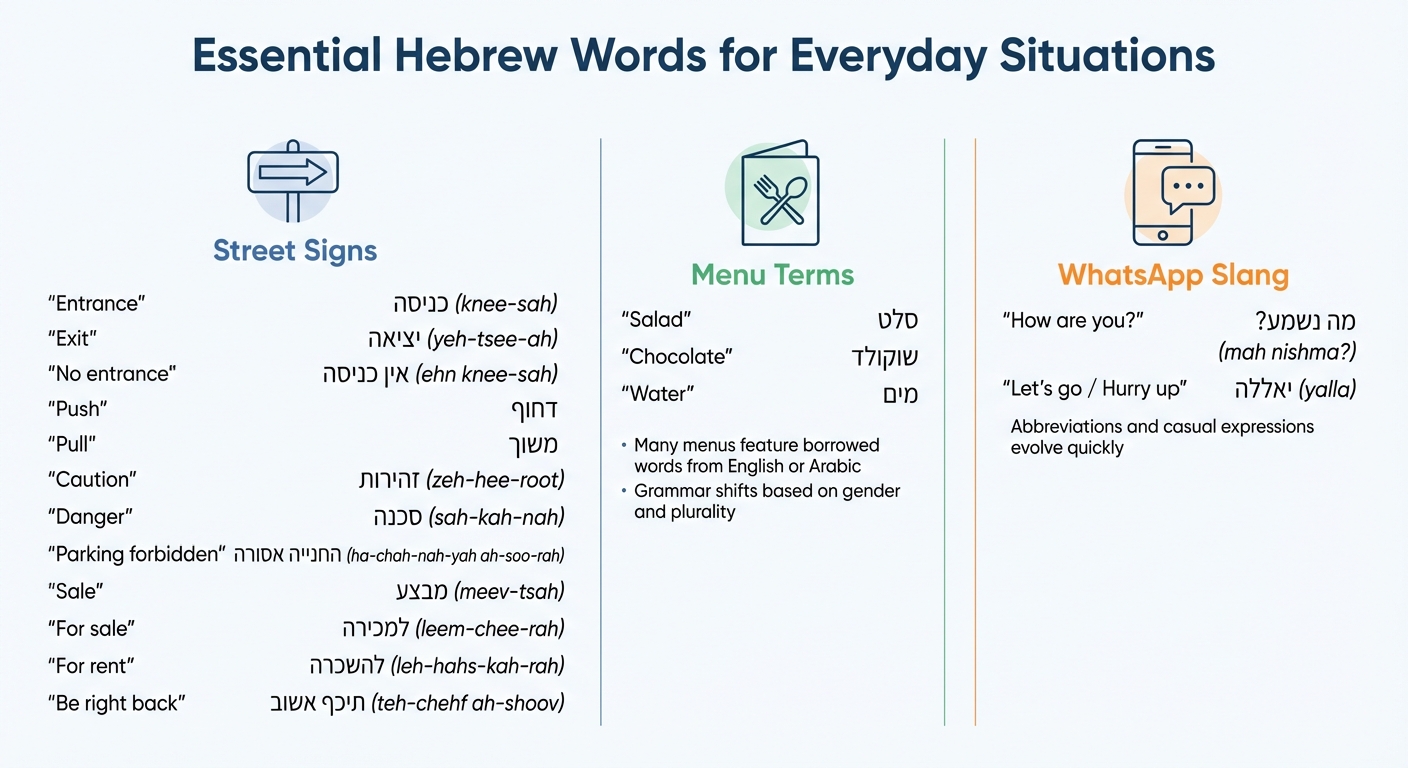
Street signs in Hebrew are packed with words you’ll encounter often. For example, כניסה (knee-sah) means "Entrance", while יציאה (yeh-tsee-ah) translates to "Exit." If you see אין כניסה (ehn knee-sah), it means "No entrance." You’ll also come across practical terms like דחוף (Push) and משוך (Pull). Be mindful, as similar-sounding words can carry entirely different meanings.
Safety-related signs are common too. Look out for זהירות (zeh-hee-root – Caution) and סכנה (sah-kah-nah – Danger). Driving-related terms might include החנייה אסורה (ha-chah-nah-yah ah-soo-rah – "Parking is forbidden") or נהג/ת חדש/ה (nah-hahg chah-dahsh – "New driver").
If you’re shopping or renting, you’ll likely see words like מבצע (meev-tsah – Sale), למכירה (leem-chee-rah – For sale), and להשכרה (leh-hahs-kah-rah – For rent). Occasionally, you might spot a handwritten note on a shop door saying תיכף אשוב (teh-chehf ah-shoov – "Be right back"). These small phrases can go a long way in helping you feel more at ease while exploring [5].
Menu Terms for Food and Drinks
Hebrew menus can feel tricky at first, especially since they’re read right-to-left and often lack vowel marks [6]. But once you get the hang of it, you’ll start recognizing common items like סלט (salad), שוקולד (chocolate), and מים (water). Keep in mind that Hebrew grammar shifts based on gender and plurality, so dish descriptions might vary depending on the context.
Interestingly, many menus also feature borrowed words from English or Arabic, which become easier to recognize once you’re familiar with the Hebrew alphabet. And if you’re ever stuck, you can always use baba’s instant translation feature to decode the menu with ease.
Hebrew texting is full of abbreviations and casual expressions that evolve quickly. For example, מה נשמע? (mah nishma?) is a friendly way to ask, "How are you?" while יאללה (yalla) is a versatile term meaning "Let’s go" or "Hurry up."
"Hebrew isn’t just words, it’s context." – baba [2]
Whether you’re trying to keep up with a group chat or respond to a quick voice message, understanding these phrases can help you sound more natural and confident. And with baba on iOS and Android, you can get accurate, context-aware translations instantly, making it easier to stay in the loop and communicate effectively.
baba makes translating Hebrew a breeze, whether you're deciphering street signs, ordering from menus, or navigating WhatsApp chats. Available on both iOS and Android, the app boasts a 5.0 rating and has already handled over 30,000 translations [1][3]. Here’s how baba simplifies Hebrew translation in everyday situations.
Translating Street Signs with baba
Navigating Israeli streets can be tricky, especially if you’re unfamiliar with Hebrew. baba’s real-time camera translation feature lets you point your phone at a sign, instantly overlaying the English translation on your screen. This works offline too, which is perfect if you're in an area with poor reception or want to avoid international data charges.
The app doesn’t just translate - it also offers transliteration, teaching you how to pronounce street names. This is especially handy when asking locals for directions. Plus, baba’s gender-smart technology ensures accurate translations, even for Hebrew’s gendered directional signs.
Using it is simple: open the app, select the camera feature, and aim at the sign. You can even save translations for future reference. And baba isn’t just for the streets - it’s a game-changer for dining out too.
Reading Restaurant Menus with baba
Deciphering Hebrew menus can feel overwhelming, especially with modern culinary terms. baba goes beyond basic word-for-word translation, offering context-aware explanations for ingredients and preparation styles that might be unfamiliar.
Just snap a picture of the menu through the app, and it overlays English translations directly onto the Hebrew text. Want to sound confident when ordering? Check the transliteration to pronounce dish names correctly. You can also enable baba’s Slang Mode to decode trendy food terms that traditional dictionaries might miss.
Thanks to baba’s ability to handle Hebrew’s grammatical quirks, including gender and plurality, menu descriptions are translated clearly. Whether it’s adjectives like "fresh" or "spicy", baba ensures the translation makes sense, no matter how the original Hebrew changes based on grammar rules.
Understanding WhatsApp Messages with baba
baba also shines in the digital world, making sense of Hebrew WhatsApp chats filled with slang, abbreviations, and informal phrases. Its dedicated Slang Mode deciphers modern idioms and regional expressions, offering translations that feel natural and culturally accurate. The app’s gender-smart technology ensures translations are grammatically correct, avoiding awkward mistakes.
To translate a WhatsApp message, simply copy and paste the text into baba for an instant, polished translation. You can also use the voice input feature to translate spoken Hebrew from voice notes. For longer texts, like emails or extended chats, baba offers a forwarding service for seamless translations.
The app’s chat-style interface mirrors real conversations, making it easy to switch between WhatsApp and baba. Core features are free, but upgrading to the Pro version unlocks perks like unlimited character limits and faster translation speeds.
Ready to make sense of Hebrew? Download baba today at get.itsbaba.com/blog and experience instant, hassle-free translations.
sbb-itb-7e51dcc
Tips for Learning to Recognize Hebrew Words and Slang
While tools like baba can provide instant translations, developing a deeper understanding of Hebrew patterns can significantly improve your reading speed and confidence. Hebrew has a logical structure that, once grasped, makes recognizing related words much easier.
Hebrew Word Patterns to Know
Hebrew words are built around three-letter roots, known as shoresh, which carry core meanings. For instance, the root ש-ל-ם connects words like שלום (shalom, peace), שלם (shalem, whole), and לשלם (leshalem, to pay). Learning these roots allows you to quickly spot connections between words, whether you're reading signs, menus, or other texts.
Pay attention to endings, as they indicate gender and plurality. Words ending in ה- are often feminine singular, while ים- typically marks masculine plural. This knowledge is especially handy when deciphering menu descriptions or WhatsApp messages, where adjectives like "fresh" or "spicy" change form depending on what they describe [2]. Writing down frequently encountered words can help reinforce these patterns.
By understanding these word structures, you'll be better equipped to interpret Hebrew in various contexts without relying solely on translations.
Using Visual Clues and Context
Situational cues can be incredibly helpful. For example, signs at bus stops often include transit-related terms, while menus with pictures of food make it easier to associate Hebrew words with their meanings. These visual aids can reduce your reliance on translation tools and help you build vocabulary naturally [4].
When it comes to WhatsApp messages, the context of the conversation is key. Informal chats often include slang and abbreviations, while formal emails stick to more standard Hebrew. Recognizing the type of communication can help you anticipate the tone and vocabulary without needing to translate every word [2]. Regular exposure to Hebrew in real-life situations strengthens your understanding and helps you internalize the language [4].
Conclusion
The essentials outlined above form the groundwork for gaining a strong grasp of Hebrew. By understanding common vocabulary patterns, recognizing gender-specific endings, and using visual context cues, you can start feeling at ease in Hebrew-speaking settings. The three-letter root system and gender markers provide a solid framework for figuring out unfamiliar words on your own.
With these tools in mind, baba takes things further by offering gender-aware technology for instant translations, ensuring your messages and menus always sound natural. Its slang mode even picks up on modern expressions that standard tools often overlook. Whether you're exploring the streets of Tel Aviv, ordering your favorite dish at a café, or chatting with friends on WhatsApp, baba captures the subtleties that make Hebrew communication flow effortlessly.
For those diving deeper - whether for work or personal growth - baba Pro offers advanced features like voice input, three speed settings, and unlimited character limits for longer translations. Ready to take your Hebrew to the next level? Download baba on iOS and Android at get.itsbaba.com/blog and experience seamless Hebrew communication.
"baba was built by Hebrew language experts who understand the soul of the language. We capture nuances that other tools miss – because Hebrew isn't just words, it's context." [2]
With baba, you'll sound like a local, not a machine - an essential step in building genuine connections with Hebrew speakers in everyday situations.
FAQs
How does baba handle Hebrew's gender-specific grammar when translating?
baba’s advanced AI, HebrewCore™, is built to tackle the complexities of Hebrew’s gender-specific grammar with ease. It can automatically identify the gender of the speaker and the audience, ensuring translations reflect the correct masculine, feminine, or mixed-gender forms. This ensures your Hebrew translations are accurate and aligned with the cultural and linguistic nuances of any context.
Can baba accurately translate Hebrew slang and regional phrases?
baba’s AI-powered translator is built to tackle Hebrew slang and regional expressions with impressive accuracy. Thanks to its slang mode and context-aware processing, it delivers translations that reflect the real meaning behind casual conversations and distinctive local phrases. With baba, you can easily grasp and engage in authentic Hebrew exchanges.
How is baba’s translation technology uniquely tailored for Hebrew?
baba’s AI-powered translation goes beyond just converting words - it grasps the context of your message. It takes into account details like speaker and listener gender, plural forms, levels of formality, and even slang or cultural subtleties, ensuring translations that sound natural and make sense in Hebrew.
Unlike standard translation tools, baba doesn’t just translate - it tailors your message to suit the situation, making communication smooth and contextually accurate.
Frequently Asked Questions
Can I translate Hebrew signs without an internet connection?
Yes, the camera translation feature works offline, which is useful when you're traveling in areas with spotty reception or want to skip international data charges. You can point your phone at a sign and get an instant overlay of the English translation without needing a live connection.
What's the easiest way to translate a Hebrew WhatsApp voice note?
baba includes a voice input feature that lets you translate spoken Hebrew directly, so you're not stuck manually transcribing audio before translating. For regular text messages, copying and pasting into the app gives you an instant, context-aware translation including slang and informal phrasing.
Why do some Hebrew words on menus look different from what I learned?
Hebrew adjectives and nouns change form based on the gender and plurality of what they describe, so the word for 'fresh' looks different on a dish meant for one person versus a shared platter. Menus also frequently borrow words from English or Arabic written in Hebrew characters, which can trip up anyone relying on a basic word list.
How do three-letter Hebrew roots help me read signs faster?
Hebrew words are built from three-letter roots that carry a core meaning, so once you recognize a root you can often guess related words without translating from scratch. For example, spotting the root in שלום (shalom, peace) also unlocks שלם (whole) and לשלם (to pay), turning unfamiliar text into something you can reason through.
Is there a free version, or do I need to pay to use the translator?
Core translation features are free, covering everyday use cases like street signs, menus, and chat messages. Upgrading to the Pro version unlocks extras like unlimited character limits and faster translation speeds for longer texts or more demanding workflows.