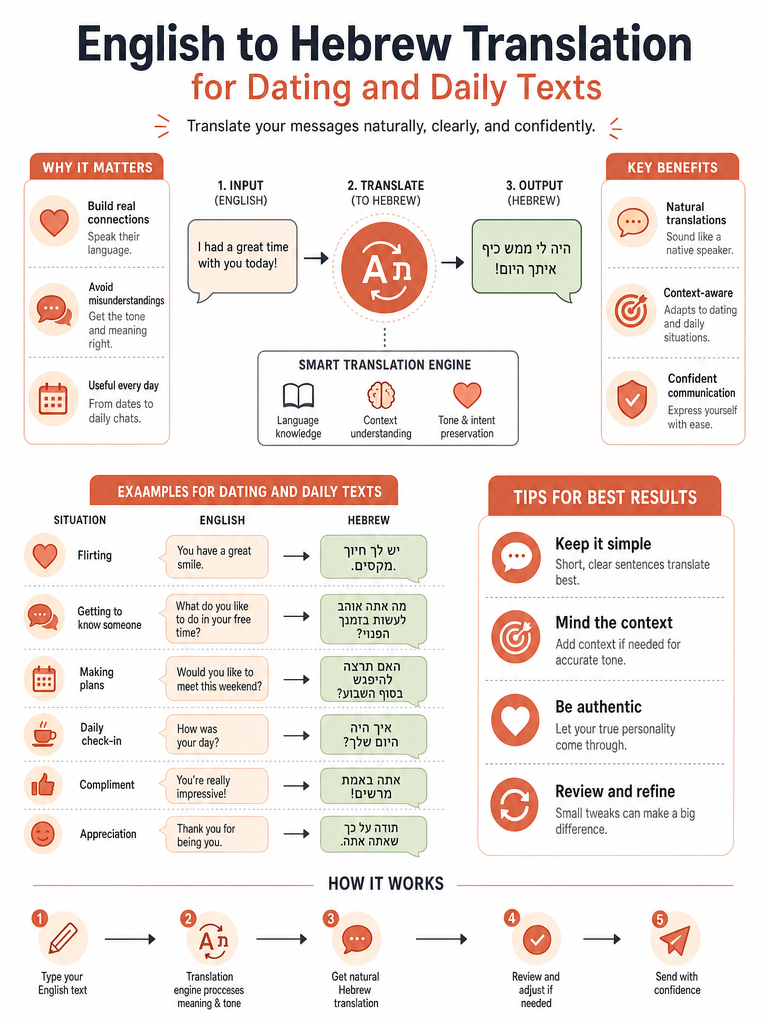
Master english to hebrew for texting with gender-aware, natural phrases for dating, chats, and daily plans. Try baba Hebrew Translator.
What is English to Hebrew texting translation, and why does it matter for real messages?
English to Hebrew texting translation is sentence-level translation built for short, real-world messages — chats, dating openers, plans with friends, errands, and the kind of one-line replies you fire off a hundred times a day. It is not the same job as translating a document or looking up a single word. A text message carries tone, relationship, and gender all at once, and Hebrew encodes most of that into the grammar itself.
That is what makes Hebrew texting harder than English speakers expect. In English, "I miss you" is one sentence. In Hebrew, the verb changes depending on whether you are male or female, and depending on whether the person you are texting is male or female. Add slang ("סבבה", "יאללה", "אחלה"), formality choices, and Israeli directness, and a literal translation can land as cold, weirdly formal, or grammatically wrong for your gender.
The right Hebrew text is not the most accurate dictionary match — it is the version a native speaker would actually type back.
A few things shift the meaning of a Hebrew message in ways English texters rarely see:
Gender of the speaker changes verb endings (אני אוהב vs. אני אוהבת).
Gender of the recipient changes how you address them (אתה vs. את).
Formality shifts vocabulary entirely — work Hebrew and friend Hebrew barely overlap.
Slang and abbreviations carry tone that literal translators flatten.
Get those four right and your text reads as warm, normal, or flirty. Get them wrong and it reads as a translation.
How do you translate an English text into natural Hebrew before you send it?
Write the full English sentence first, then translate the whole sentence — not the words. The single biggest mistake people make is typing one word at a time and stitching them together. Hebrew word order, gender agreement, and definiteness all break when you do that.
Here is a workflow that takes under a minute and reliably produces Hebrew that sounds like a person, not a machine:
Write your full English message the way you would actually say it in English, including tone (casual, flirty, polite, annoyed). Do not pre-simplify it.
Note the relationship and tone. Friend, date, coworker, landlord, parent — each one shifts the Hebrew vocabulary.
Clarify the gender of speaker and recipient. "I'm running late" needs to know if you are male or female. "Are you free tonight?" needs to know if they are male or female.
Translate the entire sentence at once, not phrase by phrase. Sentence-level tools handle gender, verb tense, and idiom in one pass.
Sanity-check the register. If the Hebrew looks heavy on formal words like אדוני or בבקשה when you wrote a casual text to a friend, it is too stiff. Ask for a more casual version.
Use transliteration if you are going to say it out loud, and text-to-speech if you want to hear the rhythm before pronouncing it on a date or a call.
The baba Hebrew Translator is built around this sentence-level, context-aware workflow and works the same way across web, iOS, Android, and the Chrome extension, so you can translate inside WhatsApp, Tinder, Gmail, or wherever you actually text. If you want a deeper breakdown of why sentence-level beats word-level for real Hebrew, see baba vs. dictionary-only Hebrew tools for real sentences.
What changes when the Hebrew text is for dating?
Dating texts in Hebrew live or die on tone, and tone in Hebrew is mostly grammar. The gap between "interested" and "intense," or between "warm" and "stiff," is often a single verb ending or a missing slang word. For dating, the goal is Hebrew that sounds like a person flirting, not a person translating.
A few patterns that consistently go wrong in dating texts:
Over-literal compliments. "You are very beautiful" translated word-for-word becomes "את יפה מאוד" — technically correct, but it reads like a greeting card. A native flirt is closer to "וואי, את ממש יפה" or "את מהממת" depending on how forward you want to be.
Wrong gender on the speaker. A man writing "I was thinking about you" needs חשבתי עליך, and the עליך itself changes based on the recipient's gender. Generic translators routinely default to masculine recipients.
Formality mismatch. Dating Hebrew is almost never formal. If your translation includes אני מעוניין ("I am interested in") instead of בא לי ("I'm into / I'd like to"), you sound like a lawyer, not a date.
Missing the soft slang. Words like חמוד, מהמם, סבבה, יאללה, and תכלס do real tonal work. Stripping them out makes a message feel cold.
Situation
Too literal / robotic
Sounds like a real text
First message
שלום, מה שלומך?
היי, מה קורה?
Suggesting plans
האם תרצי להיפגש מחר?
בא לך להיפגש מחר?
Light compliment
את נראית טוב
את ממש חמודה
Confirming a date
אני מאשר את הפגישה
סבבה, נתראה ב-8
The dating-specific stakes are why context matters more here than anywhere else. Tell your translator who you are, who they are, and how flirty you want to be — and review the output before sending. If you want a primer on the gender side of this specifically, Gender and Politeness in Hebrew covers the patterns that show up most often in personal messages.
How should daily Hebrew texts sound in chats, errands, and plans?
Daily Hebrew texts are short, direct, and full of slang shortcuts. The mistake most English speakers make is writing them too politely. Israeli texting is famously direct, and translations that hedge with extra please-and-thank-you wording immediately sound foreign.
Take a few common situations:
Confirming plans: "Sounds good, see you at 8" is closer to "סבבה, נתראה ב-8" than to a full polite sentence. סבבה does the work of "sounds good," "cool," "fine by me," and "ok" all at once.
Asking a quick question: "Are you home?" is just "אתה בבית?" or "את בבית?" — no "Hi, I hope you're well, I was wondering if…" preamble.
Coordinating with friends: יאללה (let's go / come on / hurry up / ok bye) ends roughly half of real chats. Tools that translate it as the literal Arabic-origin meaning miss the function entirely.
Apartment, delivery, or travel logistics: Hebrew texts to landlords, plumbers, or delivery drivers stay short. "I'll be there in 10" → "אני שם עוד 10 דקות". Adding politeness words makes you sound like a tourist.
Replying to a Hebrew message you barely understood: Translate the whole incoming message first, then reply with a full sentence rather than guessing one word.
A practical rule: if your translated Hebrew text is noticeably longer than the original English, it is probably too formal. Daily Hebrew compresses. For a deeper read on the casual–formal spectrum, Hebrew Slang vs. Formal Hebrew: Key Differences walks through which register fits which situation, and the Hebrew Slang Guide covers the 20 expressions you will see in chats almost every day.
English to Hebrew texting vs. word-by-word lookup: which sounds more natural?
Sentence-level translation wins for texting, every time. Word-by-word lookup is a dictionary — useful for learning a single verb root or checking a noun's gender, useless for producing a message you actually want to send.
The reason is structural. Hebrew is not English with different vocabulary. It has different word order, mandatory gender agreement across verbs and adjectives, definite-article rules that attach to the noun, and idioms that do not survive literal translation. Translating word by word and concatenating the results produces grammar that is wrong in at least three places per sentence.
Word-by-word lookup
Sentence-level translation
Best for
Single words, roots, conjugation tables
Full messages, chats, real texts
Handles gender agreement
No — you have to match it yourself
Yes, when given speaker/recipient context
Handles slang and idioms
Translates literally (often nonsensical)
Recognizes idiomatic patterns
Word order
English order, which is wrong in Hebrew
Native Hebrew order
Tone (casual vs. formal)
None — neutral dictionary forms
Adjustable to register
Time to a sendable message
Minutes of stitching
Seconds
A concrete example: "I'm thinking about you" word-by-word gives you אני / חושב / על / אתה. The actual Hebrew sentence is אני חושב עליך (or חושבת עליך if you are female), with the preposition fused into the pronoun. A dictionary cannot fix that gap; only sentence-level translation can.
What can go wrong with gender, slang, and tone in Hebrew texts?
Gender is the number one source of awkward Hebrew texts. Hebrew assigns gender to nouns, adjectives, and almost every verb form, and texting tools that ignore speaker or recipient context will routinely default to masculine — which is wrong for roughly half of users and half of recipients.
The mistakes cluster into a few predictable categories:
Speaker-gender errors. A woman writing "I'm tired" should send אני עייפה, not אני עייף. Generic translators that don't ask about the speaker often output the masculine form by default.
Recipient-gender errors. "How are you?" to a female friend is מה שלומך with feminine verbs in any follow-up; to a male friend the verbs change. Mass-market tools regularly mix the two within the same message.
Literal slang. סבבה translated as its dictionary roots is gibberish. יאללה translated literally loses its function. Slang has to be recognized as a unit, not parsed.
Over-formal register. Outputs full of אדוני, גבירתי, אני מעוניין, or אבקש in a casual chat read as a customer-service script, not a friend.
Idioms translated as facts. "חבל על הזמן" literally means "a waste of time" but often means "amazing" in Israeli slang. Get the direction wrong and you've insulted someone.
Definiteness and prepositions. Hebrew attaches the definite article and many prepositions directly to the next word (הבית, בבית, לבית). Word-by-word tools spell them as separate words, which is jarring to read.
How do you choose a Hebrew texting tool for real conversations?
Pick a tool that was designed for Hebrew from the start, not an English-first translator with Hebrew bolted on. The single best predictor of natural Hebrew output is whether the tool understands speaker and recipient gender as a first-class input.
Use this checklist when comparing options for everyday texting:
Capability
Why it matters for texting
Hebrew-first design
Built around Hebrew grammar, not adapted from a generic engine
Gender-aware grammar
Handles speaker/recipient gender across verbs, adjectives, and pronouns
Sentence-level meaning
Translates the whole message, not stitched-together words
Slang and idiom recognition
Treats סבבה, יאללה, תכלס, חבל על הזמן as units with real meaning
Tone / register control
Lets you choose casual vs. formal output
Transliteration
Hebrew written in Latin letters so you can say it out loud
Text-to-speech
You hear the pronunciation before sending or speaking
Web app + mobile + browser extension
Works inside WhatsApp, Tinder, Gmail, and any chat
RTL handling
Hebrew renders right-to-left correctly, no broken punctuation
Cultural context
Knows Israeli phrasing, not just dictionary Hebrew
The baba Hebrew Translator is built to that checklist: Hebrew-first, gender-aware, sentence-level, with transliteration, AI text-to-speech, and the same experience across web, iOS, Android, and Chrome extension (Source: baba Hebrew Translator on the App Store). For the longer product walkthrough, see the baba review or the best Hebrew translation app for real life in Israel.
Where can you keep improving your Hebrew texting confidence?
Whenever you hit a Hebrew text you cannot quite read or write naturally, drop it into the baba Hebrew Translator — full sentence, with context, gender set correctly — and send a reply that sounds like you, not like a translation.
Frequently asked questions
How do I make sure my Hebrew text uses the right gender?
Before you translate, tell the tool whether you are male or female and whether the person you're texting is male or female — Hebrew verbs, adjectives, and pronouns all change based on both. Any tool that doesn't ask those two questions upfront will default to masculine and get it wrong roughly half the time.
Can I translate Hebrew texts I receive, not just ones I'm sending?
Yes — paste the full incoming Hebrew message into a sentence-level translator rather than guessing word by word, since idioms like חבל על הזמן mean something completely different from their literal parts. Translating the whole message at once gives you the actual meaning and tone, not just a word list.
What Hebrew slang words come up most in everyday texting?
סבבה (cool / sounds good), יאללה (let's go / ok / bye), תכלס (honestly / bottom line), חמוד (cute / sweet), and מהמם (amazing) show up constantly in Israeli chats and do real tonal work that literal translations miss entirely. Learning to recognize them as units — not parse them word by word — is what separates readable Hebrew from robotic output.
Is there a way to hear how a Hebrew text sounds before I say it out loud?
baba Hebrew Translator includes AI-powered text-to-speech alongside transliteration, so you can hear the correct pronunciation before a date, phone call, or in-person conversation — not just read a phonetic guess.
Why does my Hebrew translation sound too formal even for a casual text?
Most translation tools default to dictionary-form Hebrew, which skews formal — words like אני מעוניין or אדוני belong in business emails, not WhatsApp threads. The fix is to specify the register explicitly (casual, friend, dating) before you translate, or to ask for a less formal version of the output you get back.