Gender Awareness
Generic translation tools often default to male forms, which can result in translations that feel inaccurate or even unprofessional to native Hebrew speakers. Hebrew’s gender-specific grammar presents a significant challenge for these tools, leading to frequent errors in gender agreement across verbs, adjectives, and pronouns. According to benchmark tests, these tools demonstrate high error rates when working with Hebrew [3]. For scenarios where precise gender alignment is critical, such as professional or formal communication, these shortcomings become glaringly obvious, highlighting the limitations of these tools in fully capturing the nuances of Hebrew.
Slang and Cultural Context
When it comes to slang and informal expressions, generic translation apps often fall short. They tend to miss the essence of modern Israeli speech [4]. Take, for instance, the Hebrew slang "אחי" (achi), which is commonly used to mean "dude" rather than its literal translation, "my brother." Similarly, "חלאס" (khalas) is better understood as "enough already" rather than the straightforward "finished." Generic tools often translate these phrases literally, stripping them of their intended meaning. These apps also struggle with code-switching - mixing Hebrew and English within the same sentence (e.g., "אני צריך להזמין קפה לפני ה-meeting"). Add in the challenges of regional accents, fast-paced speech, and background noise, and it becomes clear that these tools are not equipped to handle the complexity of real-world Hebrew usage [2][3].
Privacy and Data Security
Privacy is another area where generic translation tools raise concerns, especially for sensitive legal or business communications. Many of these platforms rely on global cloud servers to process data, which means your inputs might be stored or even used for model training. This lack of control over data residency and security can be a major issue for users handling confidential information. Unlike specialized solutions that prioritize cultural context and secure handling, generic tools often lack offline functionality, leaving users with limited options for safeguarding their data [2][3].
Real-World Usability
In fast-paced, everyday situations, generic translation apps often struggle to keep up. Whether it’s a lively exchange at an open-air market, casual chats in messaging apps, or conversations filled with local slang, these tools frequently fall short. They’re not designed to handle the dynamic and nuanced nature of Israeli life. For example, they typically provide a single translation without explaining tone, formality, or the cultural context behind the output. This leaves users uncertain about whether their Hebrew sounds natural or appropriate for the situation at hand.
sbb-itb-7e51dcc
Pros and Cons
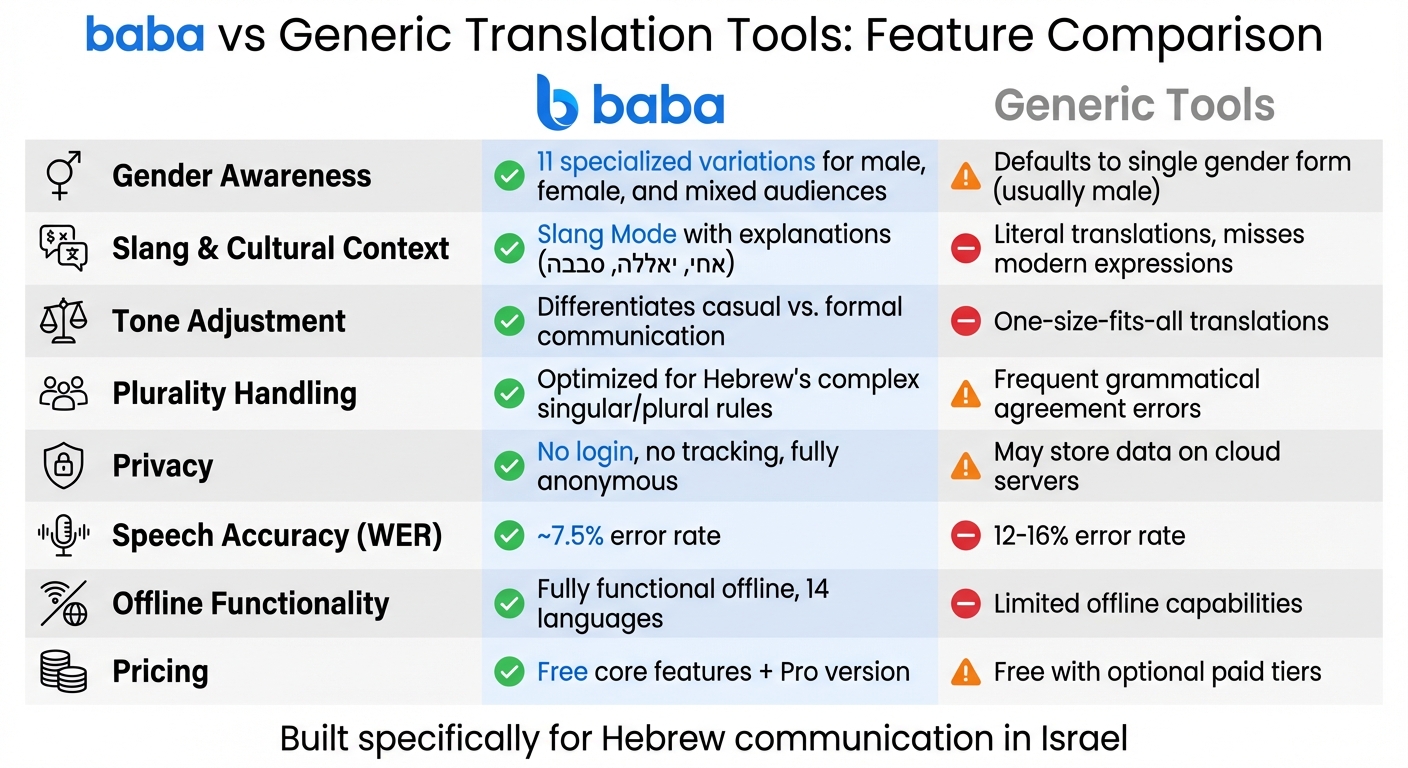
Choosing the right Hebrew translation tool for daily life in Israel comes down to understanding the strengths and weaknesses of your options. Here's how baba compares to generic translation tools in key areas:
| Feature |
baba |
Generic Translation Tools* |
| Gender Awareness |
Automatically adjusts for male, female, or mixed audiences with 11 tailored variations |
Often defaults to a single gender form, leading to awkward or off-key translations |
| Slang & Cultural Context |
Includes a slang mode with explanations for phrases like "אחי" (achi) and "חלאס" (khalas) |
Translates literally, often missing the meaning behind modern Israeli expressions |
| Tone Adjustment |
Differentiates between casual conversations and formal emails |
Offers one-size-fits-all translations that can sound unnatural or stiff |
| Plurality Handling |
Optimized for Hebrew's complex singular and plural grammar rules |
Frequently struggles with proper grammatical agreement in group settings |
| Privacy |
No login required, no data tracking - fully anonymous |
May store user data on global cloud servers, raising privacy concerns |
| Speech Accuracy (WER) |
Leverages specialized AI models with an error rate around 7.5% |
Typically sees higher error rates, ranging from 12–16% [3] |
| Pricing |
Core features are free, with a Pro version for advanced tools |
Usually free, with optional paid tiers for extra features |
| Platform |
Available on iOS and Android |
Broadly accessible across multiple platforms |
*Refers to standard translation apps without Hebrew-specific features
Looking at these features, it's clear that baba stands out for its ability to handle the unique challenges of Hebrew. Its specialized AI is designed to capture the complexities of gender-neutral Hebrew translation, cultural nuances, and modern slang - elements that generic tools often overlook. While standard translation apps are fine for basic word lookups, baba excels in delivering translations that feel authentic to native speakers. Whether you're navigating business emails, casual chats, or connecting on a deeper level in Israel, baba ensures your communication feels natural and accurate.
Conclusion
When it comes to using Hebrew in everyday communication in Israel, the choice is obvious. Generic translation tools might give you word-for-word results, but they often miss the mark when it comes to the finer points of Hebrew - like gender-specific grammar, modern slang, and the subtle cultural layers that make the language come alive. These details can mean the difference between sounding fluent and creating awkward misunderstandings.
That’s where baba steps in. Designed specifically to handle the unique aspects of Hebrew, baba uses advanced AI to provide translations that feel natural to native speakers. Whether you're writing a professional email or having a casual conversation, baba ensures your Hebrew sounds authentic. It’s this attention to detail that makes baba stand out as the go-to solution for Hebrew translation in Israel.
Available on both iOS and Android, baba offers its core features for free, with a Pro version for those who need more advanced options[4]. Created by Hebrew language experts, the app is built on the understanding that "Hebrew isn't just about words; it's about context"[4].
If you’re living in, moving to, or even just visiting Israel, baba is a must-have for seamless communication. Ready to speak Hebrew like a local? Download baba today at get.itsbaba.com/blog.
FAQs
How does baba ensure accurate gender-specific translations in Hebrew?
Baba leverages advanced AI technology to fine-tune translations based on gender. Whether the situation requires masculine, feminine, or mixed-gender phrasing, Baba ensures Hebrew translations are precise and fit the context seamlessly. This allows for natural, confident communication in any scenario.
How does baba’s slang mode help you communicate like a true local in Israel?
baba’s slang mode is built to make your Hebrew flow naturally, like a local’s. By combining advanced AI with insights from native speakers, it goes beyond simply translating words. It picks up on the context of your conversation - whether you're chatting casually on the street, sending a WhatsApp message, or leaving a comment on social media. The app adapts its slang, tone, and even gender-specific forms to make your responses feel like they’re coming from a close friend, not a machine.
What sets baba apart from traditional translation tools is its ability to capture the cultural layers of modern Israeli Hebrew. It understands region-specific idioms, the blend of Hebrew and English in everyday speech, and the subtle shifts in meaning depending on who’s talking. With real-time processing and offline capabilities, baba makes navigating Israeli conversations effortless - whether you’re visiting, settling in as a new immigrant, or just trying to connect on a deeper level.
Is my personal data safe when using baba for translations?
Your data is safe when using baba. The app prioritizes user privacy, taking steps to protect your personal information and translation history. With adherence to industry-standard security measures, baba ensures your data stays secure.
Feel assured knowing that your privacy and security are always at the forefront when using baba.
Frequently Asked Questions
Can I use a Hebrew translation app offline when I have no internet in Israel?
baba works fully offline, so you can translate signs, menus, and conversations even without a data connection. It supports 14 languages in offline mode, making it practical for travel situations where Wi-Fi and roaming aren't reliable.
Why does Hebrew grammar trip up most translation apps?
Hebrew changes verb forms, adjectives, and pronouns depending on the gender of the speaker and the audience, which most generic tools ignore by defaulting to male forms. A Hebrew-first tool built with gender awareness handles these variations automatically, so your message doesn't come across as awkward or grammatically off to native speakers.
How do I translate Hebrew slang that doesn't have a direct English equivalent?
Words like 'sababa' or 'khalas' lose their meaning when translated word-for-word, so you need a tool that explains the cultural intent behind the phrase, not just a dictionary definition. A slang-aware translator surfaces the real-world usage and tone so you understand when and how to actually use the expression.
Is there a free Hebrew translation tool that doesn't require signing up?
baba's core features are free and require no login or account, so you can start translating immediately without handing over an email address. There's also a Pro version for users who need more advanced options like extended translation modes.
What's the best way to translate Hebrew emails or documents accurately?
For written content like emails or contracts, you need a translator that handles full sentences in context rather than word-by-word substitution, because Hebrew sentence structure and formality levels differ significantly from English. baba lets you forward Hebrew emails directly for instant translation, and its tone adjustment distinguishes between casual and formal registers so the output fits the situation.