AI-Powered Solutions for Gender-Neutral Hebrew Translation
Hebrew's gendered grammar poses unique challenges for creating inclusive, gender-neutral translations. To tackle these complexities, hybrid AI methods are emerging, blending machine learning with human expertise to achieve more accurate and culturally sensitive results.
Participatory Design for Better AI
Some initiatives prioritize participatory design, actively involving native speakers to address linguistic and cultural nuances. For example, Microsoft conducted a study between April and July 2026 across 42 languages and dialects, including Hebrew. The goal? To develop guidelines that significantly reduce misgendering in large language models. The results were promising: gender assumptions dropped from 70% to 24%, and misgendering rates fell from 26% to 14% [7].
"Even though addressing misgendering over gendered or formally regulated languages goes beyond linguistics, participatory design informs deeper understanding of local culture and customs, leading to better system performance." [7]
This approach bridges gaps that algorithms alone might miss. Similarly, Google’s Crowdsource app invites users to complete micro-tasks, helping refine AI services and better support underrepresented linguistic patterns in Hebrew [8].
Human-in-the-Loop Translation Models
Human-in-the-Loop (HITL) translation emphasizes the collaboration between AI and human expertise. This method is particularly valuable for Hebrew, where grammatical precision must be matched with cultural sensitivity. As the global machine translation market is projected to grow to $983.3 million by 2026, with a 14.6% annual growth rate, HITL systems are becoming increasingly relevant. In fact, a 2023 European Language Industry Survey reported that over 30% of professional translation businesses already use machine translation, and 55% of academic participants predict it will handle the majority of translations by 2030 [6].
In HITL systems, human translators refine AI-generated text, creating feedback loops that improve outcomes. Dr. Emily Bender, a linguistics professor at the University of Washington, highlights the importance of this collaboration:
"While A.I. has made remarkable progress in translation, it still lacks the nuanced understanding of cultural context and idiomatic expressions that human translators bring to the table. The human element remains crucial for ensuring not just linguistic accuracy, but cultural appropriateness." [6]
OpenAI’s ChatGPT incorporates similar feedback mechanisms, allowing users to upvote or downvote responses. This real-time input fine-tunes the system, ensuring it adapts to practical usage [6]. Such human involvement not only refines translations but also lays the groundwork for addressing biases in AI systems.
Bias Reduction in AI Models
One of the biggest hurdles in Hebrew translation is gender bias, which demands careful technical strategies. Context injection, for instance, uses external cues to clarify ambiguities - a critical step in a language like Hebrew, where gender-neutral pronouns don’t exist [10].
AI models also employ techniques like gender tagging and the use of diverse datasets to identify and explore neutral alternatives. However, biases can stem from multiple sources, including training data, technical limitations, and even user interactions [9]. In some cases, these systems may inadvertently amplify stereotypes. Translation technology consultant Jost Zetzsche explains:
"As A.I. translation tools evolve, the role of human translators is shifting from mere language conversion to that of cultural mediators and content curators. This evolution is creating new opportunities for linguists to add value in ways that machines simply cannot." [6]
sbb-itb-7e51dcc
Case Study: baba – Smart Hebrew Translation
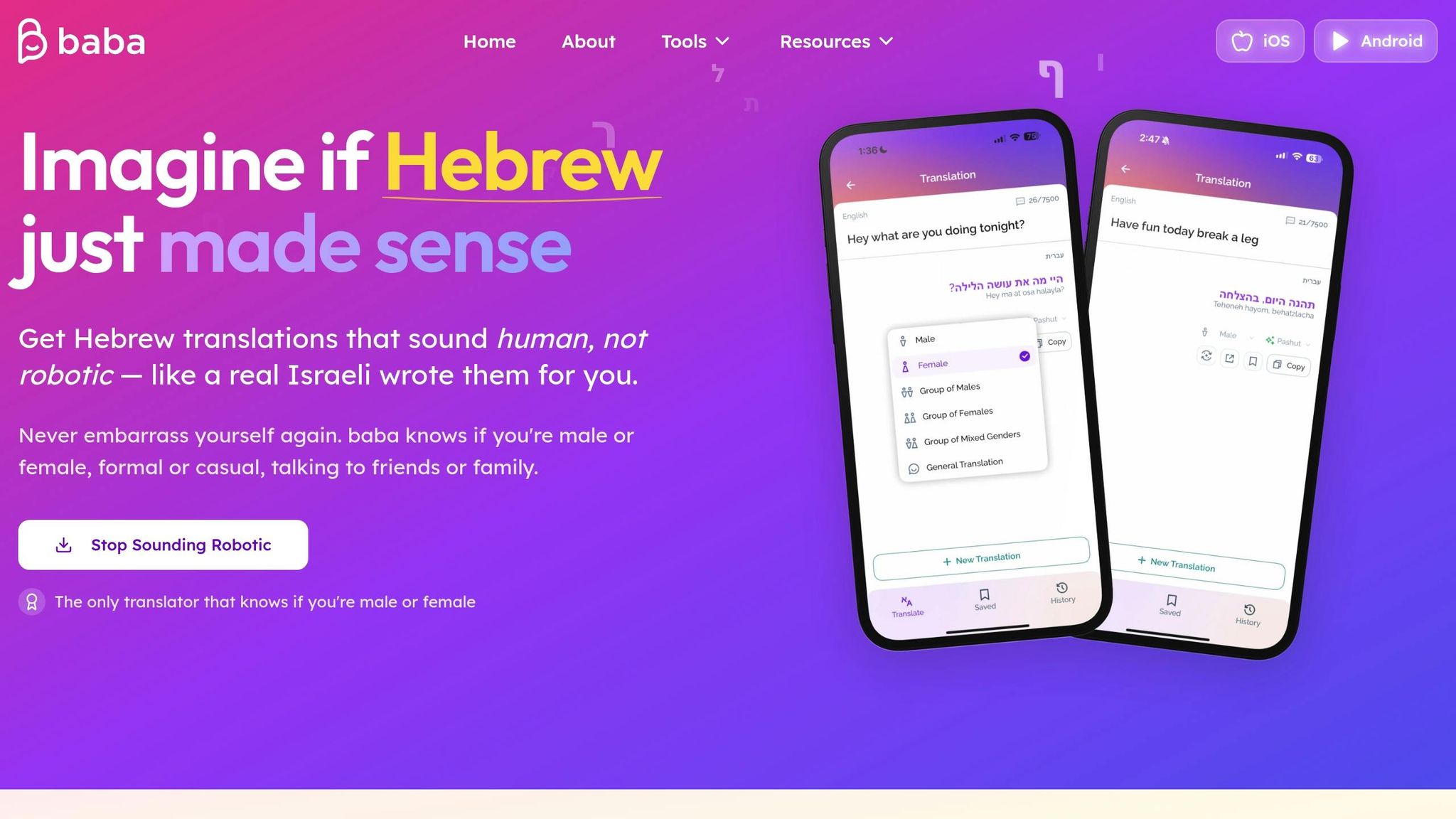
Hebrew, with its intricate gender system, poses a unique challenge for AI translation tools. Yet, baba, a Hebrew translation app, has managed to bridge the gap between technology and cultural nuance. By addressing the complexities of gendered grammar, baba demonstrates how AI can tackle gender-neutral translation in a practical and effective way. This case study highlights how advanced AI can be combined with deep linguistic understanding to provide real-world solutions.
Handling Gender and Plurality Complexities
One of Hebrew's biggest translation hurdles lies in its heavy reliance on context, particularly regarding gender and plurality. baba goes beyond simple word-for-word translation, offering a more nuanced approach [11]. For example, it adjusts greetings based on whether the intended recipient is male, female, or a mixed group.
The app also handles plurality with precision, ensuring it can differentiate between addressing a single person versus a group. By managing these singular, plural, and gender-specific variations, baba's AI models provide translations that feel natural and contextually appropriate.
Features Supporting Context-Aware Communication
baba's gender-sensitive translation system represents a major step forward in meeting Hebrew's complex grammatical demands [13]. It eliminates the guesswork that often plagues generic translation tools, offering precise translations tailored for male, female, or mixed audiences.
To accommodate a range of needs, baba includes multiple AI models. Users can select Mahir m1.5 for quick, context-aware translations or Chacham c1.5 for enhanced precision in gender and tone [12]. This dual-model system ensures the app can handle everything from casual conversations to highly detailed translations.
Other features make baba even more user-friendly. Smart language detection automatically identifies whether input text is in English or Hebrew, removing the need for manual switching [13]. The app also includes AI-powered voice-to-text, allowing users to speak naturally and receive accurate translations. Additional tools like a regenerate button, translation history, and phrase-saving options streamline the process of refining translations, especially when tackling gender-neutral Hebrew [12].
Personalization and Sensitivity
baba stands out for its personalized approach. Users can set their gender and audience preferences, ensuring the app consistently delivers translations that align with their identity and typical communication needs [13]. Audience-specific modes make it easy to switch between general translations and those fine-tuned for specific groups, offering flexibility for both casual and professional use.
For those with more extensive translation needs, baba Pro supports texts up to 7,500 characters. This feature is especially useful for professionals, students, and Hebrew learners working with longer documents. By combining context-smart technology with a sensitivity to cultural nuances, baba delivers translations that are not only accurate but also inclusive.
Join the waitlist for the mobile app at www.itsbaba.com
Ethics and Future of AI in Translation
As AI translation tools continue to evolve, they come with a set of responsibilities - especially for gendered languages like Hebrew, where translation choices can either uphold or challenge existing biases. The task isn’t solely about achieving accuracy; it’s about ensuring fairness, inclusivity, and respect for cultural nuances. These ethical considerations play a major role in how AI systems address the biases inherent in gendered languages.
AI's Role in Reinforcing or Reducing Bias
AI systems often reflect the biases present in their training data, which can lead to issues like gender bias, cultural stereotypes, and racial discrimination [14]. For example, data imbalances may cause AI to default to masculine forms, reinforcing outdated societal norms while failing to include non-binary perspectives.
The impact of these biases extends far beyond language. In 2018, Amazon had to abandon an AI-driven recruitment tool because it systematically downgraded resumes that mentioned the word "women's." The system had been trained on a decade’s worth of applications, where men dominated, leading the AI to favor male candidates. This incident highlights how AI can perpetuate disparities if not carefully monitored [17]. Similarly, in Hebrew translation, such biases can be particularly harmful when AI struggles to recognize situations where gender-neutral language is necessary.
Creating ethical AI translation systems requires a commitment to transparency and accountability. The European Union’s Ethical Guidelines for Trustworthy AI underscores this:
"The quality of the data sets used is paramount to the performance of AI systems. When data is gathered, it may contain socially constructed biases, inaccuracies, errors and mistakes. This needs to be addressed prior to training with any given data set." [16]
To address these issues, regular audits are essential for identifying and correcting discriminatory patterns [17]. Transparency in how decisions are made allows for external scrutiny, making it easier to spot and fix biases in real time. As the Zendesk CX Trends Report 2026 highlights:
"Being transparent about the data that drives AI models and their decisions will be a defining element in building and maintaining trust with customers." [19]
A robust ethical framework for AI translation should prioritize accountability, transparency, privacy, fairness, and respect for cultural differences [14]. Human oversight remains indispensable for catching and addressing biases that AI might miss.
Looking forward, advancements in fair language strategies will continue to shape AI’s ethical progress.
Future Developments in Fair Language
Efforts to address Hebrew’s complex gender system are gaining momentum, with research driving the development of fair language options. Participatory design is emerging as a key approach, involving native speakers and cultural experts throughout the AI development process [15]. Zinnya del Villar, Director of Data, Technology, and Innovation at Data-Pop Alliance, explains:
"To reduce gender bias in AI, it's crucial that the data used to train AI systems is diverse and represents all genders, races, and communities." [18]
Diverse training datasets are becoming more common, helping AI learn inclusive communication patterns that reflect the full spectrum of language use [20]. Bias auditing, once an occasional practice, is evolving into a continuous process. Localization experts are increasingly demanding transparency, diverse training data, and regular audits as standard practices [2].
As researchers Maudslay et al. point out:
"Mitigating gender bias depends on how bias is defined. As a direct consequence, how researchers choose to operationalise bias determines both the techniques at one's disposal to mitigate bias, as well as the yardstick by which success is determined." [16]
The importance of minority languages and identities is also gaining recognition. One expert emphasizes:
"Translation is not just about words - it's about context, culture, and connection. If we want AI to truly serve everyone, then minority languages must be treated not as an afterthought, but as essential threads in the global linguistic tapestry." [20]
These advancements are paving the way for AI to overcome the gendered challenges of Hebrew translation. The aim is not just to provide accurate translations but to ensure they empower all users, regardless of their gender identity or expression.
Get on the waitlist for our mobile app at www.itsbaba.com
Conclusion: Advancing Gender-Neutral Hebrew with AI
The journey to achieving gender-neutral Hebrew translation is both intricate and filled with potential. Hebrew's deeply gendered structure - with its gender-specific nouns, verbs, and the absence of neutral pronouns - poses challenges that traditional translation tools struggle to address. This is where AI steps in, offering solutions that go beyond mere word-for-word translation to grasp context, cultural subtleties, and the balance between linguistic precision and inclusivity.
The growing reliance on AI for translation highlights its transformative role. For instance, 69% of companies reported using machine translation in 2018, up from 59% in 2017 [21]. This rise reflects not only technological improvements but also a growing acknowledgment of AI's ability to make accurate and culturally sensitive translations more accessible.
What truly stands out is the emerging collaboration between humans and AI. As Peter Brassington, a translation expert, explains:
"AI can enhance the process, but it should not yet be fully trusted for Bible translation without human involvement. Its strengths lie in facilitating the work, not completing it autonomously. The combination of AI's speed and human expertise is the most reliable and respectful approach."
This collaborative model extends far beyond religious texts, proving essential for all Hebrew translation work, where cultural sensitivity and linguistic accuracy must work hand in hand. It's this synergy that powers tools like baba.
baba leverages participatory design and bias-reduction techniques to tackle Hebrew's gender complexities. By understanding not only the speaker but also the intended audience, baba provides translations that feel natural and culturally appropriate. Its gender and plurality awareness ensures that every translation respects Hebrew's unique structure while promoting inclusive communication.
The benefits go beyond linguistic accuracy. Studies show that AI-assisted language learners experience a 30% improvement in vocabulary retention compared to traditional methods [22]. For those learning Hebrew and navigating gender-neutral language, this boost enhances both confidence and cultural understanding.
Looking ahead, the ethical principles discussed - such as transparency, diverse training data, and ongoing bias audits - will guide how AI handles not only Hebrew but other gendered languages as well. The aim isn't just technological progress; it's about creating tools that empower everyone to communicate authentically and respectfully, regardless of gender identity or expression.
The future of Hebrew translation lies in this human-AI partnership, where technology and human insight come together to solve linguistic challenges while fostering inclusivity and accessibility. Tools like baba are leading the way, not just as translation platforms but as bridges to more inclusive and culturally aware communication.
Get on the Waitlist
Ready to see what the future of Hebrew translation looks like? baba's mobile app brings gender-aware, context-sensitive translations straight to your device. Whether you're handling business conversations in Tel Aviv, chatting with Israeli friends, or immersing yourself in Hebrew culture, baba turns complex linguistic challenges into smooth, natural communication.
Join the waitlist for baba's mobile app at www.itsbaba.com.
FAQs
How does AI create accurate gender-neutral translations in Hebrew, a language with gendered grammar?
AI is now capable of producing gender-neutral translations in Hebrew thanks to context-aware algorithms. These algorithms carefully examine sentence structures, conversational context, and the dynamics between the speaker and the audience. By doing this, they adjust verbs, adjectives, and pronouns to accurately reflect the intended meaning.
Moreover, AI takes into account the evolving use of inclusive and non-binary language in modern Hebrew. This approach ensures that translations are not only grammatically precise but also respectful and natural, making them suitable for a wide range of contexts.
What ethical challenges arise when using AI to translate gendered languages like Hebrew?
Using AI to translate gendered languages like Hebrew brings up a host of ethical challenges. A key issue is bias in training data, which can unintentionally embed or even amplify gender stereotypes. Tackling this means carefully selecting and refining datasets to ensure translations promote fairness and avoid reinforcing harmful assumptions.
Another crucial factor is privacy and data security, especially when translations involve sensitive or personal information. Ethical AI practices require transparency, robust protections for user data, and an awareness of the nuances in languages with intricate gender systems, such as Hebrew. Addressing these hurdles is essential for developing translation tools that are both accurate and respectful of linguistic and cultural complexities.
How does involving communities improve AI translations for gender-neutral Hebrew?
Involving communities in the development of AI translation systems plays a key role in capturing the subtleties of language and culture, particularly for gender-neutral Hebrew. Hebrew presents unique grammatical challenges, such as gendered verbs and pronouns, which require thoughtful solutions. Collaborating with diverse speakers allows these systems to incorporate practical, real-world perspectives.
By using these contributions to create specific guidelines, AI systems can minimize instances of misgendering and produce translations that feel more natural, inclusive, and reflective of the language's cultural context. This approach leads to more precise and contextually aware communication in a variety of scenarios.
Frequently Asked Questions
Why does Hebrew translation often sound unnatural or robotic in English?
Hebrew's grammar requires constant gender choices for nouns, verbs, and pronouns that don't exist in English, so tools that translate word-by-word rather than sentence-by-sentence produce awkward, overly literal output. A Hebrew-first approach that reads full context—who's speaking, who's being addressed, and what tone is intended—produces phrasing that actually sounds like something a native speaker would say.
How do you correctly translate Hebrew when you don't know the gender of the person being addressed?
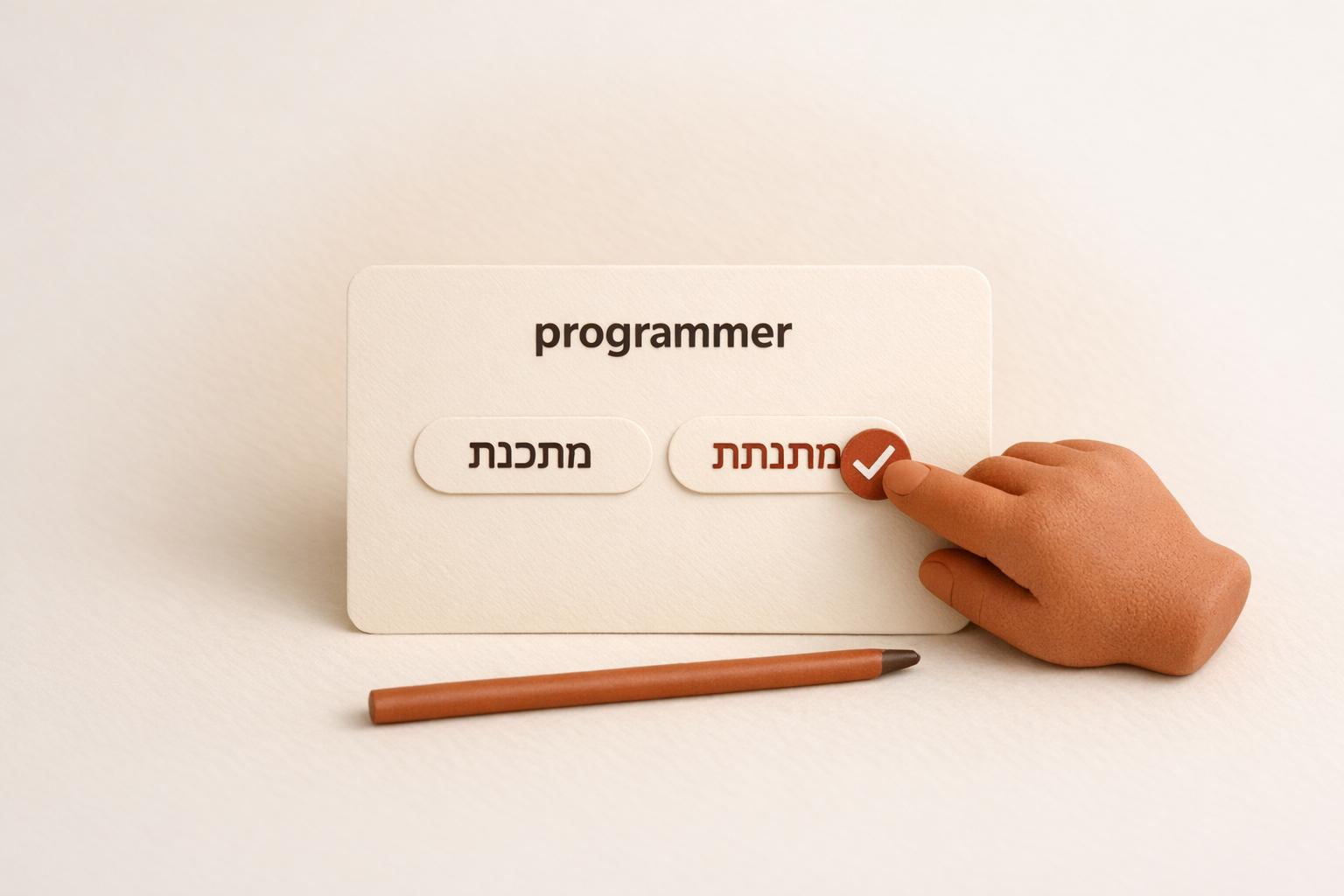
Most tools default to masculine forms, which can exclude women and nonbinary individuals and change the meaning of a message. Context-aware AI can use conversational cues, user-set preferences, or explicit audience settings to choose the most appropriate gendered form—or flag the ambiguity so the user can decide, rather than silently making the wrong call.
Can AI handle Israeli slang and informal Hebrew, or just formal text?
Formal Hebrew and everyday Israeli speech are quite different—slang, contractions, and colloquial phrases rarely appear in academic training data, which is why generic tools fall flat in real conversations. A platform trained specifically on modern Hebrew usage, including informal registers, handles casual chat, street signs, and social media in ways that match how Israelis actually communicate.
What's the difference between using a Hebrew dictionary app and an AI translation tool?
Dictionary apps look up individual words, so they break down completely when a phrase, idiom, or grammatically complex sentence doesn't map cleanly word-for-word. AI translation works at the sentence level, preserving meaning, tone, and grammatical agreement—which is especially important in Hebrew where a single-word lookup can give you the wrong gender, number, or conjugation for your actual context.
How do bias audits help improve Hebrew AI translation over time?
Bias audits systematically test whether an AI defaults to masculine forms in ambiguous cases, misrepresents nonbinary speakers, or carries over stereotypes from its training data. Regular audits, combined with diverse training datasets and human review, let developers catch and correct those patterns before they affect real users—making the system more accurate and inclusive with each iteration.