baba: AI-Powered Hebrew Translation That Understands Context
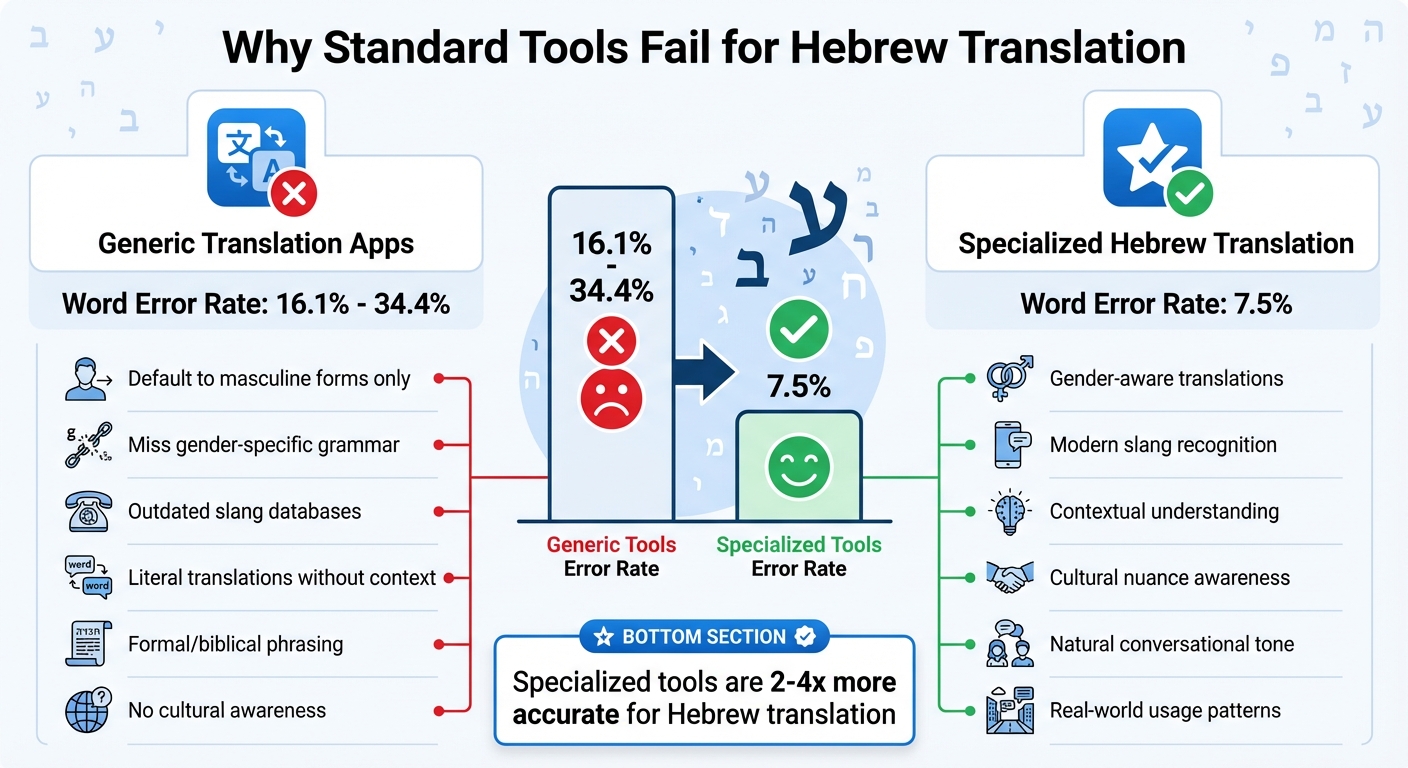
baba is an AI-driven translation app designed specifically to tackle the unique challenges of Hebrew communication. Unlike generic translation tools, which often stumble over Hebrew’s complexities, baba excels by addressing gender grammar, modern slang, and subtle cultural nuances that other translators frequently miss. Available on iOS and Android, baba has already handled over 30,000 translations and boasts a perfect 5.0-star rating[3].
At the heart of baba is its HebrewCore™ AI engine and groundbreaking Gender Intelligence™ system. These technologies ensure translations are not just accurate but also feel natural and appropriate for the context. It’s more than just translating words - it’s about making your Hebrew sound effortless and contextually correct.
Gender-Aware Translations That Adapt to Your Needs
One of baba’s standout features is its ability to tailor translations based on the gender of both the speaker and the recipient[1]. Hebrew grammar changes depending on these factors, and default masculine forms can sometimes feel clunky or even inappropriate. With baba, you can select from 11 different gender-aware variations, ensuring your translation fits whether you’re addressing a woman, a man, a group of men, a group of women, or a mixed audience[1].
For example, baba adjusts verbs, adjectives, and pronouns to match the social context, whether you’re in a casual conversation or a professional setting. This feature ensures your communication is not only grammatically correct but also socially apt.
Slang Mode with Contextual Explanations
Hebrew slang is vibrant and ever-changing, and baba reflects this by offering more than literal translations. Instead, it provides explanations about when and how to use certain phrases, helping you understand the differences between slang and formal Hebrew and whether an expression is casual, formal, or somewhere in between[1].
The app even includes specialized tools like "Hebrew Slang for Tech Professionals", which covers industry-specific jargon often overlooked by traditional translators. Whether you’re a learner or an expat, this feature bridges the gap between understanding local expressions and confidently using them in real-life situations.
To make Hebrew even more accessible, baba also focuses on pronunciation.
Hebrew Transliteration for Easy Pronunciation
For those new to Hebrew, baba offers Latin transliterations alongside instant audio playback[1]. This feature allows you to hear how native speakers pronounce each phrase, making it easier to start speaking Hebrew right away.
baba is completely free to use, with no sign-ups or tracking required. You can download baba now and start translating in seconds - no barriers, just clear and immediate Hebrew translations.
Using baba for Hebrew Speaking in Common Situations
baba's advanced translation tools make it a perfect companion for handling Hebrew in everyday scenarios. Whether you're exploring Tel Aviv, conducting business, or catching up with friends over coffee, the app tailors its features to the context, ensuring smooth and accurate communication.
Travel: Navigating and Connecting with Locals
Traveling in Israel? baba's camera feature is a lifesaver. Just point your phone at Hebrew street signs, bus schedules, or menus, and you'll get instant translations. Plus, with its Gender Intelligence™, baba ensures you're using the correct forms of verbs and adjectives when speaking with locals - no awkward language mishaps here.
Want to nail your pronunciation before asking for directions or ordering food? baba offers transliteration and instant audio playback, so you can practice phrases like "Where is the train station?" or "I would like to order." You'll sound clear and confident, making interactions more natural. Its quick processing keeps up with real-time conversations, and the gender settings add a personal touch that generic tools often lack.
And these features aren’t just for casual travel - they’re just as handy in professional environments.
Work: Hebrew for Business Success
In the workplace, baba helps you navigate the nuances of professional Hebrew. It adapts its tone for different scenarios, distinguishing between casual chats and formal business communication. Need to translate a long email or document? Summary Mode condenses lengthy Hebrew texts, saving you time when preparing for meetings or conducting research.
For more in-depth tasks, baba Pro's extended character limits allow you to translate entire presentations or emails without any hassle. And if you're prepping for a big meeting, the app's pronunciation tools will help you master professional terms with the right emphasis and intonation.
But it’s not all about work - baba also shines in casual conversations.
Social Conversations and Everyday Hebrew
Whether you’re chatting with friends or navigating informal settings, baba helps you sound natural. Its advanced tools accurately translate Israeli slang, giving you not just the meaning but also the context. For example, you'll know when a phrase fits a casual bar setting versus a family dinner.
Voice Mode makes casual conversations even easier. Speak into the app, and it provides instant feedback to refine your pronunciation. It even handles slang-heavy WhatsApp messages or social media posts that other translators might struggle with. With voice input and playback, you can practice the rhythm and tone of native speakers, making your Hebrew feel effortless and authentic.
baba ensures you're prepared for any situation, from business meetings to casual chats, all while helping you sound like a local.
How to Learn Hebrew Faster Using baba Daily
Incorporating baba into your daily routine can transform the way you learn Hebrew. Its tools are designed to help you master speaking, grow your vocabulary, and build the confidence to communicate effectively in everyday situations.
Speaking aloud every day is a game-changer for improving pronunciation. With baba's Voice Mode, you can say a phrase in English and instantly hear the Hebrew translation. Want to refine your skills further? Try the shadowing technique: listen to baba's pronunciation, then repeat the phrase using Voice Mode. The app even transcribes your speech so you can see how accurate your pronunciation is.
For those just starting out, the transliteration feature is a helpful addition. It displays Hebrew words in Latin characters, making early pronunciation practice much easier.
"I've tried other translation apps, but nothing made me feel confident speaking on the street like this. The audio breakdowns are incredible."
– Sarah Mitchell, Expat in Tel Aviv [1]
Once you're comfortable with speaking, you can save key phrases to ensure they stick in your memory.
Save and Review Common Phrases
Don't let useful translations slip away. baba lets you save frequently used phrases so you can revisit and practice them regularly. Speaking and reviewing these phrases helps you build a vocabulary tailored to your daily life. Plus, the app allows you to toggle between gender variations, ensuring you're practicing the correct grammatical forms for any context.
Switch Between Speed Modes for Different Practice Types
Adapt your learning sessions to your specific needs with baba's flexible speed modes. For quick, real-time translations, the Pashut Fast Model is perfect - great for on-the-go conversations. When preparing for more detailed situations, like professional meetings, the Standard Model ensures every nuance is captured.
Chen Wei, a business developer, shared how baba has helped him professionally:
"My business meetings are so much smoother now."
– Chen Wei, Business Developer [1]
Pair any speed mode with Instant Playback and transliteration to practice pronunciation at your own pace. With over 30,000 translations processed and a 5.0 rating, baba has become a trusted companion for learners - whether you're navigating a busy street or drafting a business email [1][3].
Conclusion: Start Speaking Hebrew Confidently with baba
Learning Hebrew doesn't have to feel stiff or overly academic. baba tackles the common hurdles of Hebrew - like tricky gendered grammar, ever-changing slang, and those subtle cultural nuances.
With more than 30,000 translations under its belt and a perfect 5.0 rating[3], baba has become a favorite for learners aiming to speak naturally. Features like Gender Intelligence™, Slang Mode, and instant transliteration help you sound fluent and comfortable in any situation. Plus, each translation comes with transliteration and audio playback, so you can nail your pronunciation every time.
These tools are versatile enough for any scenario - whether you're exploring Tel Aviv, preparing for business meetings, or just catching up with Israeli friends. The app is completely free, with no login required, giving you instant access to translations that respect the intricacies of Hebrew. For those ready to take their skills further, the Pro version unlocks perks like voice input, all three speed modes, and unlimited usage - ideal for consistent practice.
Ready to dive in? Download baba on iOS or Android and start speaking Hebrew effortlessly today at get.itsbaba.com/blog.
FAQs
How does baba ensure accurate gender-specific grammar in Hebrew translations?
Baba leverages its advanced AI technology, HebrewCore™, to tackle the complexities of gender-specific grammar in Hebrew with remarkable accuracy. It automatically identifies the speaker's gender and the audience's context, ensuring that translations use the correct masculine or feminine forms.
For instance, Baba knows how to translate "I am tired" appropriately: ani ayef (אני עייף) for a male speaker or ani ayefa (אני עייפה) for a female speaker. This nuanced understanding ensures that translations feel natural and fit seamlessly into everyday conversations.
Thanks to this feature, users can express themselves comfortably and accurately in Hebrew, making Baba a dependable choice for gender-sensitive translations and interactions.
Baba's slang mode is a game-changer for anyone dealing with Hebrew. It’s tailored to handle Hebrew slang, idioms, and casual expressions within context. Unlike standard translation tools, it picks up on the subtleties of everyday speech, delivering translations that sound natural and fit seamlessly into conversation.
This feature is perfect for grasping and using authentic Hebrew - whether you’re chatting with locals, scrolling through social media, or picking up everyday phrases to navigate daily life more smoothly.
Can baba help with translating Hebrew street signs and menus instantly?
Baba can instantly translate Hebrew street signs and menus, offering accurate interpretations of everyday Hebrew. Its context-aware AI handles casual phrases and regional nuances, making it ideal for practical situations like finding your way around or ordering food at a restaurant.
Frequently Asked Questions
Why does Hebrew grammar change depending on who I'm talking to?
Hebrew assigns grammatical gender not just to nouns but to verbs, adjectives, and pronouns — and those forms shift based on both the speaker's gender and the listener's gender. So the same sentence like 'I'm tired' takes a different form depending on who's saying it and who's in the room, which is why tools that default to masculine forms often sound off to native speakers.
What's the difference between modern Israeli Hebrew and the Hebrew taught in textbooks?
Textbook Hebrew tends to lean formal or even biblical, while everyday Israeli conversation is packed with slang, borrowed words, and casual constructions that evolve constantly. Phrases common in a Tel Aviv café or a WhatsApp chat rarely appear in a grammar course, so learners trained on formal Hebrew can sound stiff or outdated in real interactions.
How do I practice Hebrew pronunciation if I can't read the script yet?
Transliteration — writing Hebrew sounds in Latin characters — lets you follow along and practice speaking before you've mastered the Hebrew alphabet. Pairing transliteration with audio playback of native pronunciation helps you build accurate speaking habits from day one, without getting stuck on the script.
Is there a fast way to translate Hebrew text I come across in real life, like signs or menus?
Pointing your phone camera at Hebrew text and getting an instant translation is the most practical approach for real-world situations like reading street signs, bus schedules, or restaurant menus — no typing required and no need to recognize the Hebrew characters first.
How do I know whether to use formal or casual Hebrew in a given situation?
Context cues like setting, relationship, and even the platform matter — Hebrew used in a business email differs significantly from a group chat or a market conversation. Tools that flag whether a phrase is casual, formal, or somewhere in between help you calibrate your tone so you don't accidentally sound like you're filing a legal document when you're just grabbing coffee.