Gender Rules in Polite Speech
Hebrew politeness is deeply tied to gender, influencing how speakers address others in both formal and casual interactions. Understanding these rules is crucial for respectful communication in Hebrew.
In Hebrew, the formality of speech changes based on the gender of both the speaker and the listener. The formal way to say "you" depends on who you're addressing:
| Addressing |
Formal Form |
Pronunciation |
When to Use |
| Male |
אדוני |
adoni |
Professional settings, addressing older men, or authority figures |
| Female |
גברתי |
gvirti |
Professional settings, addressing older women, or authority figures |
| Mixed Group |
גבירותיי ורבותיי |
gvirotai v'rabotai |
Formal events or public speaking |
Verb forms and adjectives in formal speech also need to match the gender of the person you're speaking to. For example:
- Speaking to a male supervisor: "האם תרצה לראות את הדוח?" (Ha'im tirtzeh lir'ot et ha'doach? - Would you like to see the report?)
- Speaking to a female supervisor: "האם תרצי לראות את הדוח?" (Ha'im tirtzi lir'ot et ha'doach? - Would you like to see the report?)
Now, let’s look at how verb conjugations reflect these gender differences in polite expressions.
Polite speech in Hebrew requires careful attention to verb conjugations based on gender. Here’s how some common polite expressions adapt:
-
Requests and Questions
For general requests or inquiries, the phrase "אפשר לבקש?" (efshar levakesh? - May I ask?) works for everyone, regardless of gender.
-
Thanking
- To a male: "תודה רבה לך" (todah rabah lecha)
- To a female: "תודה רבה לך" (todah rabah lach)
To communicate effectively and respectfully in Hebrew, it's essential to apply these gender-based distinctions consistently. Whether you're in a business meeting, a social setting, or a formal event, using the correct forms shows respect and cultural understanding.
Get on the waitlist for our mobile app at www.itsbaba.com
sbb-itb-7e51dcc
Gender in Business Hebrew
In Israeli business communication, using precise gender-specific language is crucial.
Speaking to Mixed Groups
In business settings, Hebrew requires careful attention to gender when addressing groups. Here's a quick guide for different group compositions:
| Group Composition |
Formal Address |
Pronunciation |
Usage Context |
| All Male |
עמיתים יקרים |
amitim yekarim |
Board meetings, male-only teams |
| All Female |
עמיתות יקרות |
amitot yekarot |
Female leadership forums |
| Mixed Gender |
עמיתים ועמיתות יקרים |
amitim ve'amitot yekarim |
General business meetings |
| General Audience |
קהל נכבד |
kahal nichbad |
Conferences, large presentations |
For company-wide emails, use inclusive phrases like 'עובדים ועובדות יקרים' (ovdim ve'ovdot yekarim – dear employees).
Professional Titles
Professional titles in Hebrew also require gender-specific forms. Here's how they are typically used:
| Position |
Male Form |
Female Form |
Usage |
| CEO |
מנכ"ל |
מנכ"לית |
Official documents, introductions |
| Manager |
מנהל |
מנהלת |
Daily workplace communication |
| Director |
דירקטור |
דירקטורית |
Board communications |
| Supervisor |
מפקח |
מפקחת |
Team management |
Always match the title's gender with the individual. For example, address a female CEO as "מנכ"לית" (mankalit) rather than "מנכ"ל."
In tech and international companies, English titles often appear alongside Hebrew ones in written formats. However, when speaking Hebrew, gender-specific titles are essential. During presentations, address the highest-ranking person first, using their correct title, and proceed in order of seniority. Proper gender usage in titles demonstrates professionalism and ensures clarity in business interactions.
Get on the waitlist for our mobile app at www.itsbaba.com
Modern Gender-Neutral Hebrew
Modern Hebrew, traditionally built on a gendered system, is adapting to reflect changing social norms. These shifts have led to creative ways of making the language more inclusive. Here are some of the approaches being used today:
| Approach |
Example |
Context |
How It Works |
| Slash Method |
סטודנט/ית |
Academic settings |
Adds a feminine suffix separated by a slash |
| Double Forms |
תלמידים ותלמידות |
Educational materials |
Uses both masculine and feminine forms together |
| Neutral Terms |
צוות (team) |
Workplace communication |
Replaces gendered terms with neutral ones |
| Point System |
תלמיד·ה |
Online |
Uses a middle dot to show both gender options |
Institutions are actively updating their language practices to promote inclusivity. From official communications to academic materials and digital platforms, gender-neutral terms are becoming more common. When neutrality isn't possible, organizations often alternate between masculine and feminine forms to ensure balanced representation. These efforts highlight a broader societal push to make Hebrew more inclusive, marking a noticeable shift in how the language is used today.
Get on the waitlist for our mobile app at www.itsbaba.com
Summary
In Hebrew, politeness is closely tied to gender distinctions. Speakers need to match their language - like forms of address and verb conjugations - to their own gender and that of the person they’re speaking to.
- Formal Communication: Choosing gender-specific words plays a key role in determining the level of formality in both social and professional interactions.
- Professional Settings: In business, using the correct gendered language is essential. While masculine defaults were once the norm, more inclusive forms are becoming common.
- Modern Adaptations: Contemporary Hebrew has introduced methods like the slash format (e.g., סטודנט/ית) and gender-neutral terms to address changing social expectations.
These aspects highlight how language reflects gender dynamics in daily life and professional communication.
Baba's smart translation system ensures users can navigate these nuances effortlessly, maintaining politeness and clarity in any context.
Want to stay updated? Join the waitlist for our mobile app at www.itsbaba.com.
Join baba's App Waitlist
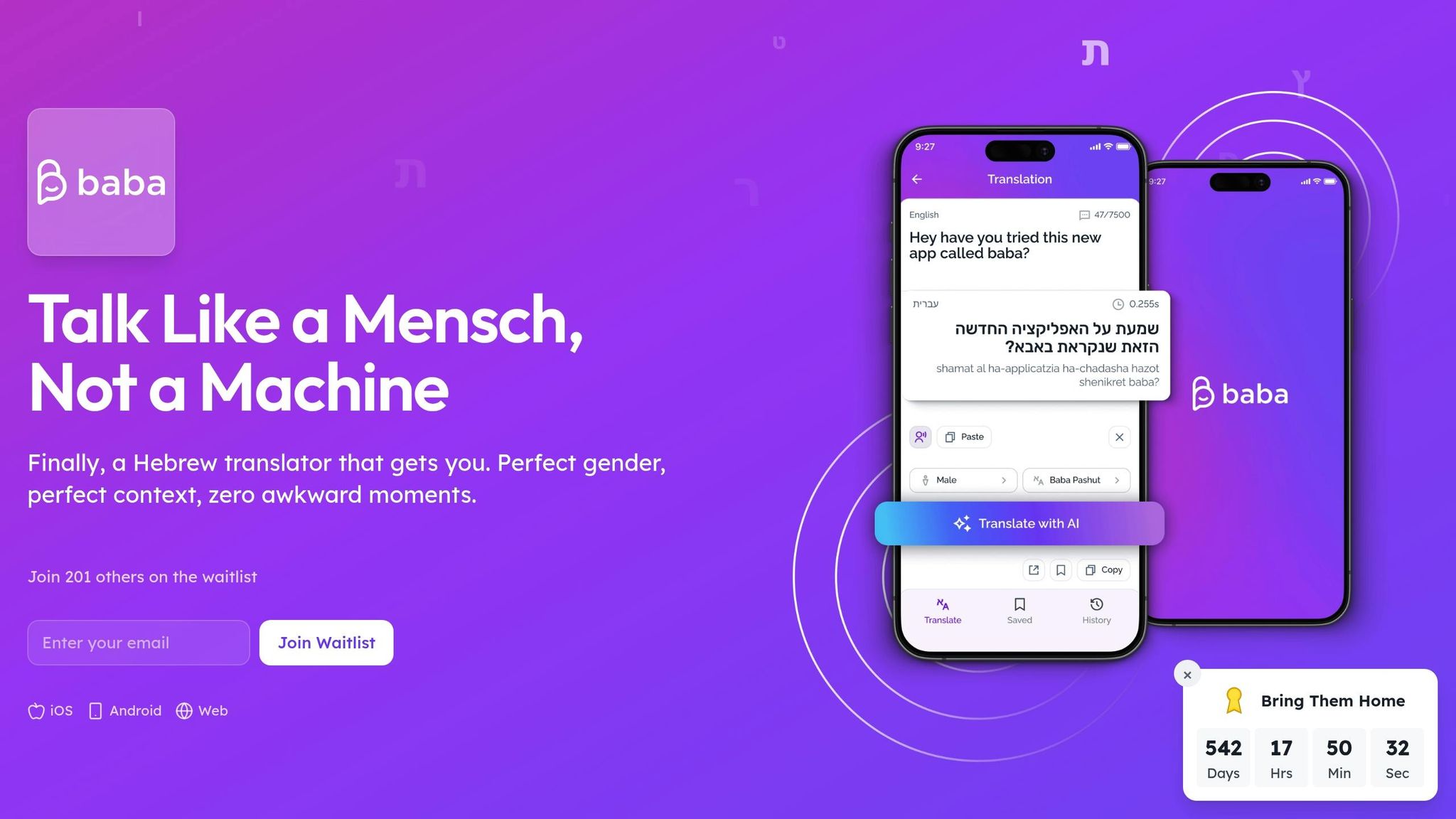
Learn to navigate Hebrew's gendered language with baba's AI-driven translation system. Whether you're in a meeting, chatting with friends, or engaging in cross-cultural conversations, our system ensures translations use the correct gender forms automatically and fit the context perfectly.
Here’s what you’ll get:
- Smart Gender Detection: Automatically recognizes and applies the appropriate gender forms based on the context of both the speaker and the listener.
- Real-time Translation: Delivers smooth, natural translations that respect Hebrew's gendered structure.
- Professional Accuracy: Maintains precise gender usage in all business and professional interactions.
Upgrade how you communicate in Hebrew with these tools. Be part of the change - join the waitlist for our mobile app at www.itsbaba.com.
Frequently Asked Questions
How do I know if a Hebrew noun is masculine or feminine?
A reliable starting point is the ending: nouns ending in ה (ah) or ת (et) are usually feminine, while nouns ending in a consonant are often masculine — but there are exceptions, so learning words alongside their gender is the safest habit to build.
Do I have to use different Hebrew words depending on whether I'm talking to a man or a woman?
Yes — verbs, pronouns, adjectives, and even some courtesy phrases shift based on the listener's gender. For example, asking a male supervisor if he'd like to see a report uses a different verb form than asking a female supervisor the exact same question.
What's the best way to address a mixed-gender group in Hebrew at work?
The standard professional approach is to use both masculine and feminine forms together — for example, 'עמיתים ועמיתות יקרים' in a company-wide email — so that everyone in the group is directly addressed and no one is defaulted out.
Is gender-neutral Hebrew actually used, or is it just a niche thing?
It's increasingly mainstream — universities, tech companies, and government communications are adopting approaches like the slash format (סטודנט/ית), double forms, and neutral collective words like צוות (team) to be more inclusive in everyday writing.
Will an AI translator automatically get Hebrew gender right?
Most generic translators default to masculine forms or guess inconsistently, which produces technically readable but socially awkward Hebrew. A Hebrew-first tool that tracks the gender context of both the speaker and the listener will produce output that sounds natural rather than robotic.