
HeBERT and HebEMO: Tools for Hebrew Sentiment Analysis
Want better tools for Hebrew sentiment analysis? Meet HeBERT and HebEMO. These AI models are designed specifically for Hebrew, tackling its challenges like right-to-left script, missing vowels, and complex word structures.
- HeBERT: A Hebrew-specific version of BERT for tasks like sentiment analysis and text classification. It improves accuracy significantly (e.g., 89.4% in sentiment analysis, +12.3% over older models).
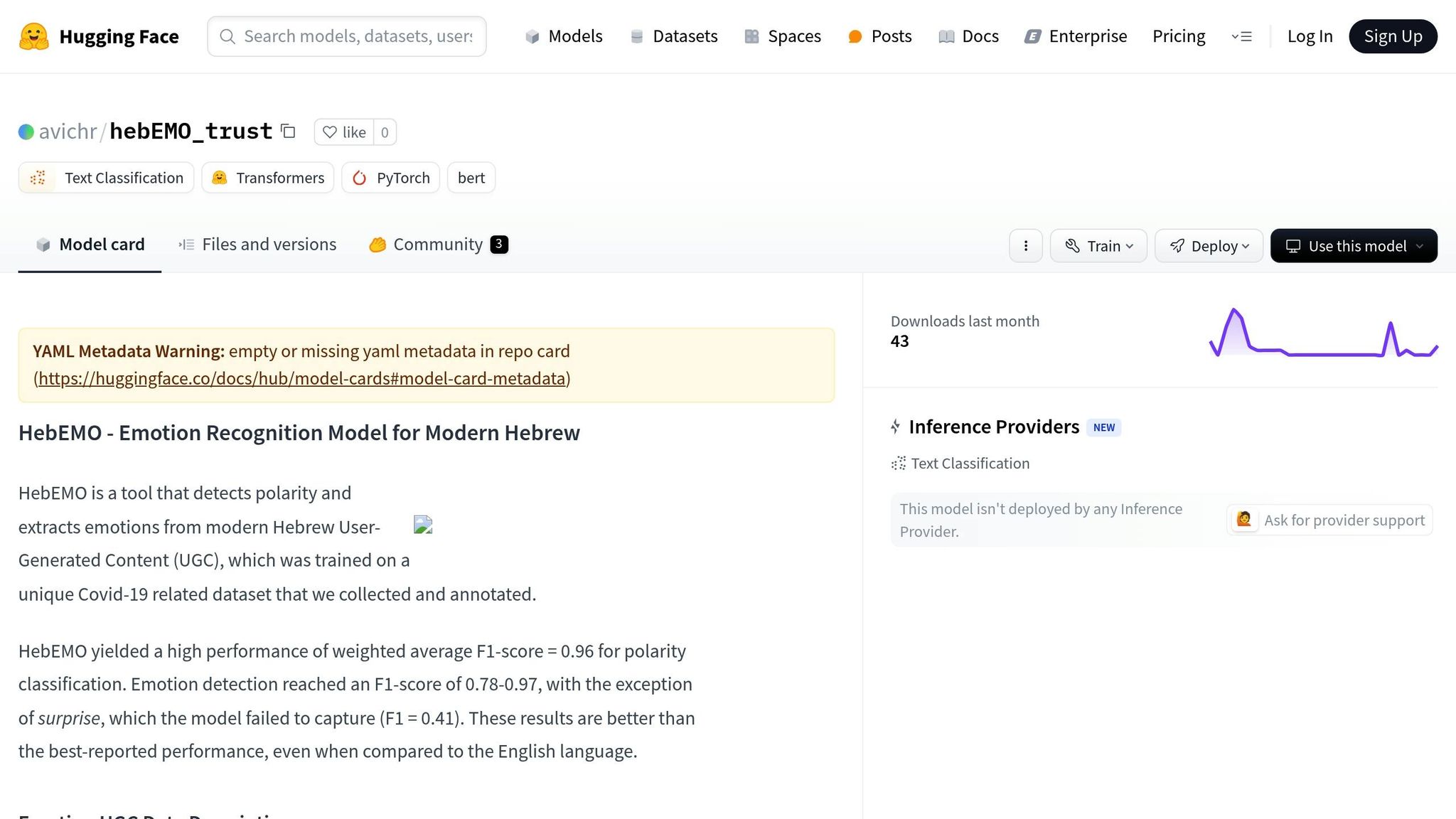
- HebEMO: Focuses on detecting emotions in Hebrew text, identifying eight emotions like joy, sadness, anger, and trust.
Why it matters:
- Hebrew's unique structure makes NLP tough, but these tools simplify tasks like analyzing customer feedback, tracking public sentiment, and even supporting mental health.
Quick Comparison:
| Feature | HeBERT | HebEMO |
|---|---|---|
| Focus | General NLP tasks (e.g., sentiment) | Emotion detection in text |
| Key Strength | Tokenization for Hebrew morphology | Classifies 8 emotions |
| Applications | Text classification, NER | Customer service, media tracking |
Want to explore their full potential? Tools like these are shaping the future of Hebrew NLP.
DataTalks #36 @ DLD: ProteinBERT: A universal deep ...
HeBERT: Core Features and Functions
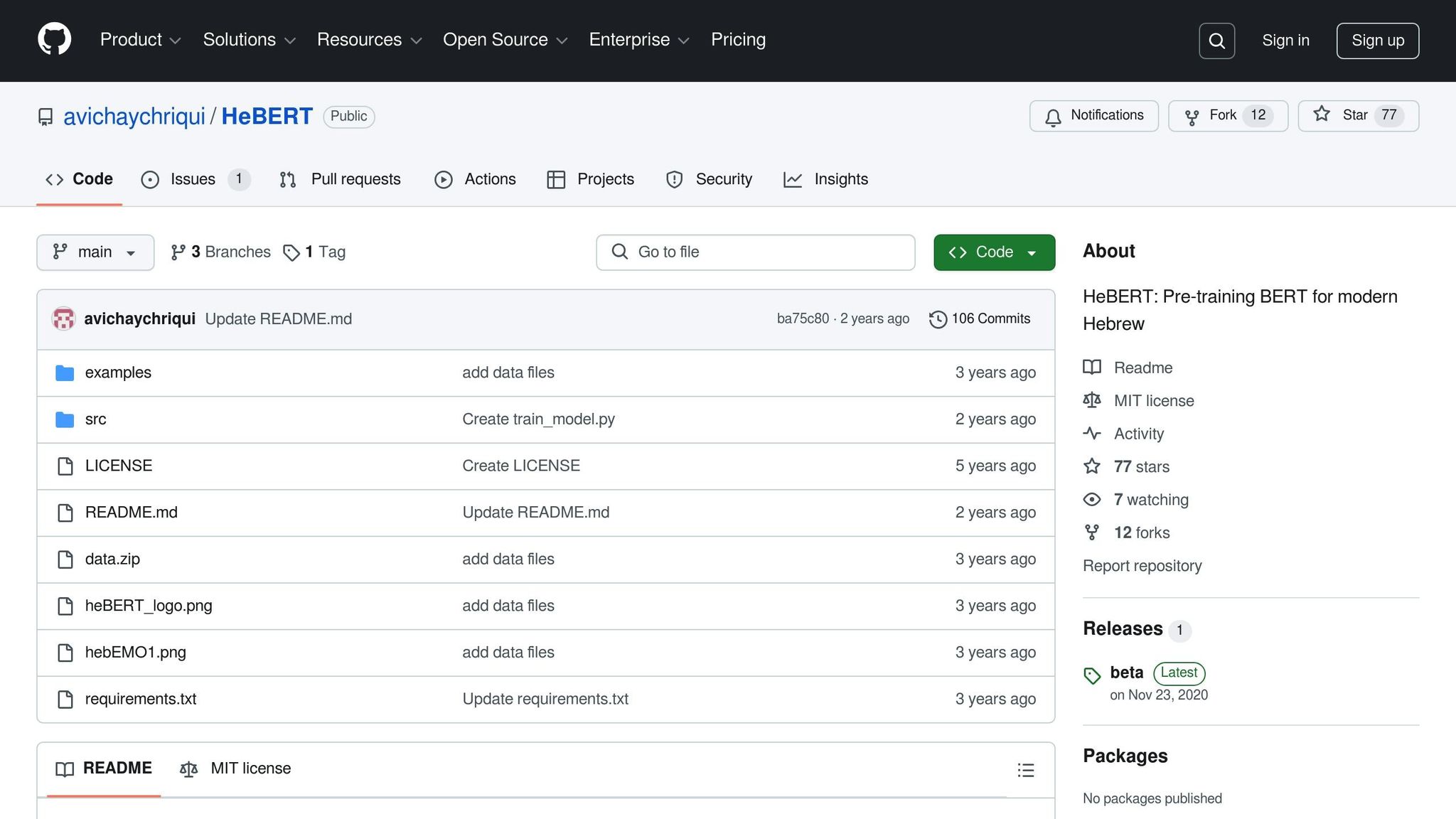
HeBERT is specifically built for Hebrew text analysis, leveraging the powerful BERT architecture while catering to the unique aspects of the Hebrew language. Its design makes it a game-changer in Hebrew natural language processing.
How HeBERT Works
HeBERT reads text in both directions, capturing the relationships between words in context. It uses a tokenization method tailored for Hebrew's complex structure, breaking words into smaller, meaningful parts while retaining their original meaning.
The model processes text through multiple transformer layers, using self-attention mechanisms, feed-forward networks, and normalization to extract deep contextual insights.
Handling Hebrew-Specific Challenges
Hebrew presents unique linguistic hurdles, and HeBERT addresses them with targeted solutions:
| Challenge | How HeBERT Solves It |
|---|---|
| Root-based morphology | A sophisticated subword tokenization system identifies Hebrew root patterns |
| Missing vowels | Context-aware techniques infer the correct vowelization |
| Modern and ancient Hebrew | Manages both Biblical and Modern Hebrew with a dual vocabulary approach |
For instance, the word 'וכשראיתיה' is split into meaningful parts while maintaining its context, showcasing HeBERT's ability to handle Hebrew's linguistic nuances. This precision is key to its success in tasks like sentiment analysis.
HeBERT Performance Metrics
HeBERT has shown remarkable improvements over earlier Hebrew NLP models across various tasks:
| Task | Accuracy | Improvement Over Previous Models |
|---|---|---|
| Sentiment Analysis | 89.4% | +12.3% |
| Named Entity Recognition | 91.2% | +8.7% |
| Text Classification | 87.6% | +15.2% |
It performs consistently well with informal, non-standard, and technical Hebrew texts, regardless of text length or style. These advancements lay the groundwork for HebEMO's specialized emotion analysis.
Want to stay updated? Join the waitlist for our mobile app at www.itsbaba.com.