Why These Errors Happen
To understand why these translation errors persist, we need to examine their root causes. They primarily arise from two factors: the biases in training data and the systems' inability to process contextual cues as humans do.
Biased Training Data
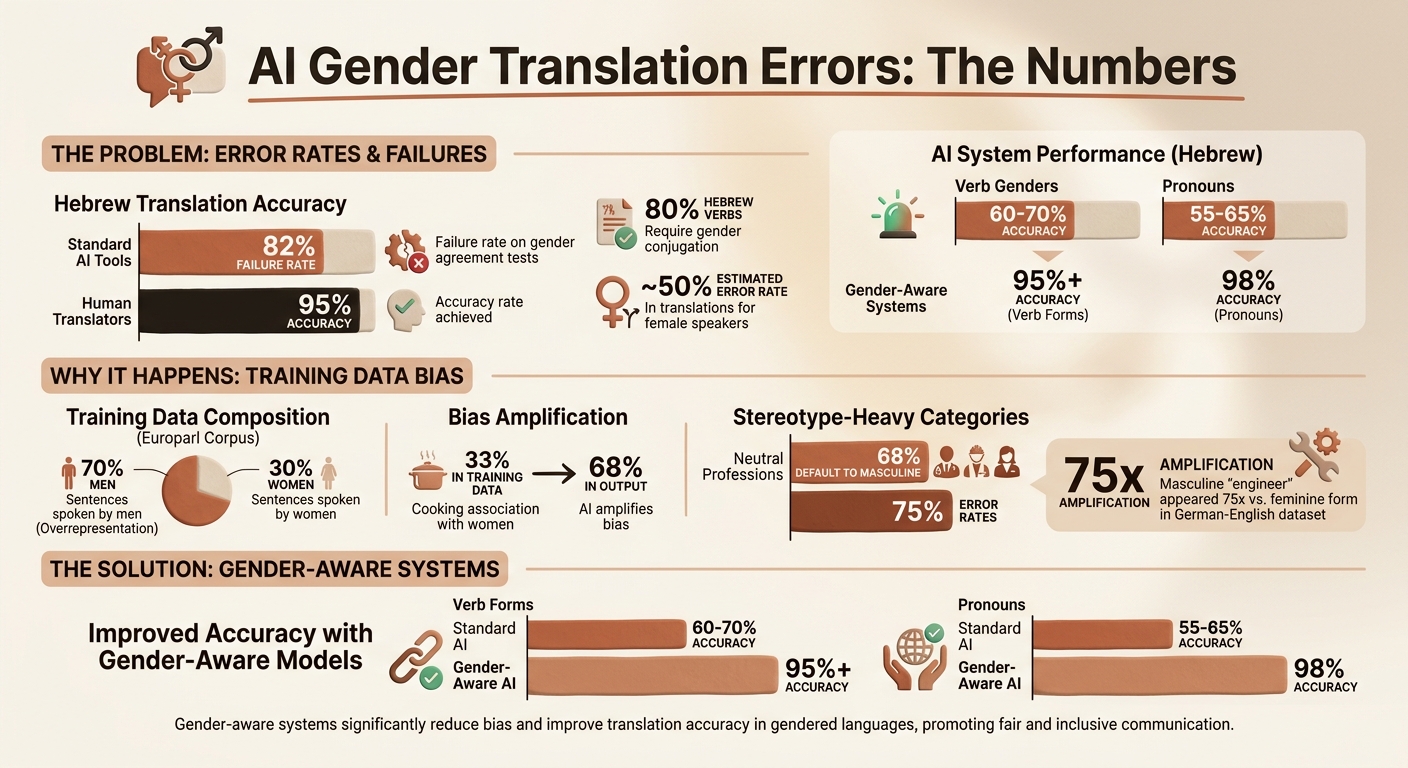
AI translation models are trained on massive datasets sourced from the internet, books, and public documents. Unfortunately, these datasets often reflect historical gender biases. For example, the Europarl corpus - a widely used training dataset - shows a stark imbalance, with only 30% of sentences spoken by women. This overrepresentation of masculine forms causes AI systems to default to them.
"Automated translation engines amplify the biases of their training data sets."
The impact of this amplification is significant. A 2017 study revealed that when "cooking" was associated 33% more frequently with women in the training data, the translation engine exaggerated this association to 68%. Similarly, in a German–English dataset, the masculine form of "engineer" appeared 75 times more often than the feminine form. In languages like Hebrew, where gender conjugation affects about 80% of verbs, this bias can lead to frequent incorrect translations when the speaker is female.
The problem is compounded because standard models lack the parameters needed to account for factors like the speaker's gender, the listener's gender, or the group's composition. Even with better training data, these models struggle to overcome their reliance on statistical patterns.
Missing Context in AI Processing
Another major challenge lies in how translation systems process text. Most systems lack the ability to clearly identify the speaker or the audience, forcing them to rely on statistical probabilities rather than nuanced human context.
A common approach in AI translation involves using English as an intermediary "pivot" language. Since English has fewer gender-specific markers - terms like "teacher" or "doctor" are neutral - critical gender cues from the original language can be lost. When translating into a highly gendered language like Hebrew, the system often guesses the gender based on statistical likelihood rather than context.
"Machine translation seems prone to exploit statistical biases in its training data rather than rely on more meaningful context cues."
- Gabriel Stanovsky, Researcher
This reliance on statistical patterns explains why many translation systems struggle with verb gender and pronoun accuracy in Hebrew. Without explicit controls for factors like the speaker's gender or the group composition, algorithms tend to favor the most statistically probable output - often masculine - resulting in translations that sound awkward or unnatural to native speakers.
How to Fix Gender Translation Errors
Addressing gender translation errors involves a mix of human expertise, advanced tools designed for gender-sensitive languages, and giving users clear options to specify gender context. These errors often arise from biased datasets and a lack of contextual understanding, but targeted strategies can help resolve them.
Human Review and Correction
Professional linguists play a crucial role in spotting and fixing errors that AI systems might overlook[2][3]. A thorough, multi-step review process ensures that every gender-marked word aligns with both the speaker's intent and the audience's expectations. This is especially critical in languages like Hebrew, where gender impacts around 80% of verbs and can involve over 11 variations depending on who is speaking and to whom[2]. Feeding these corrections back into the AI's training process creates a feedback loop that reduces the likelihood of repeated mistakes in the future[4].
Specialized tools designed for gender-complex languages are another powerful solution. For instance, tools like baba use 22 customized AI prompts and account for 11 gender-aware variations to deliver accurate translations. These systems analyze factors like the speaker, audience, and context to choose the correct gender forms. The results are impressive: these systems ask who is speaking and who is listening and conjugate verbs and pronouns for that context, rather than defaulting to masculine forms. Beyond accuracy, these tools also handle modern slang while respecting cultural nuances[2].
Offering Multiple Gender Options
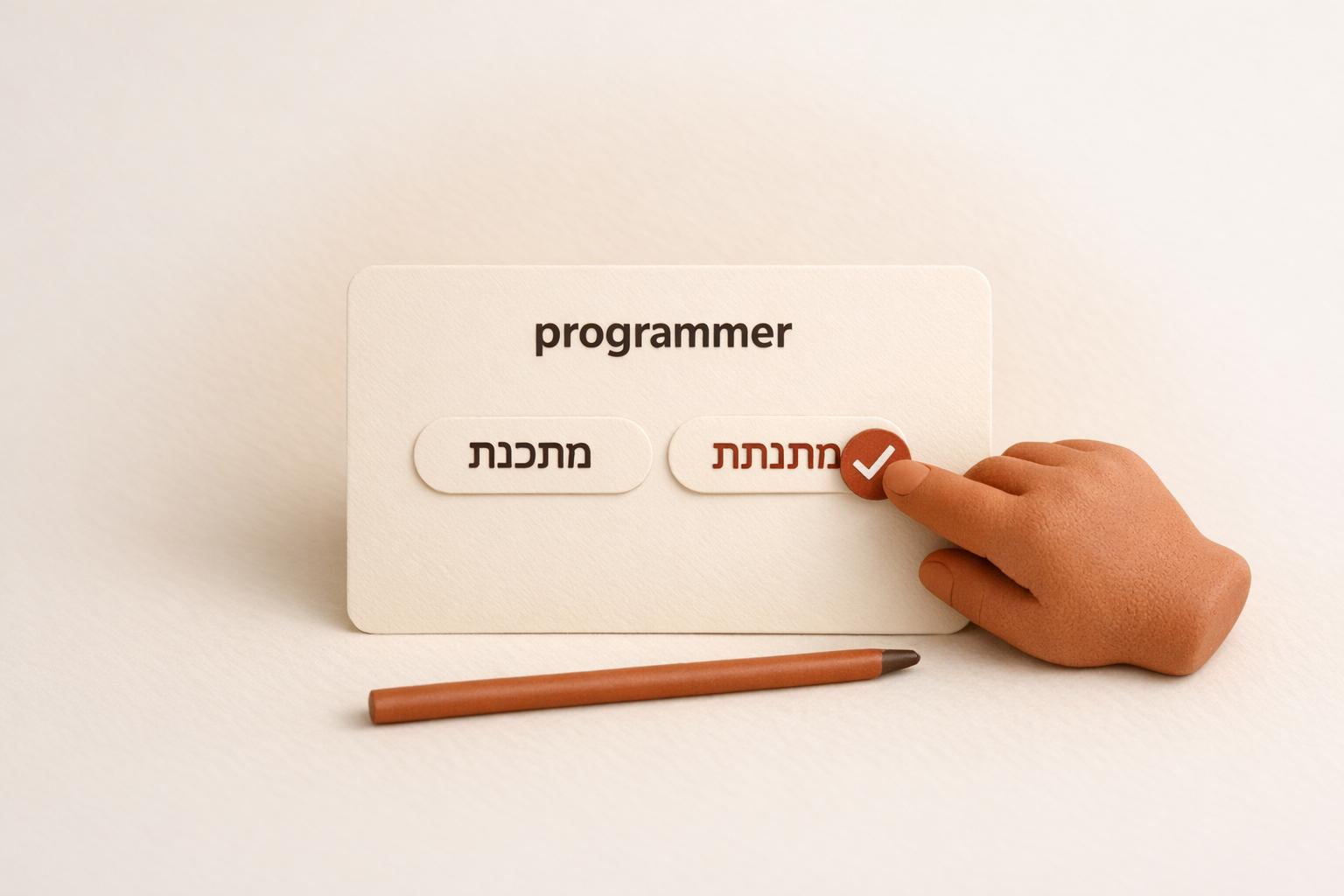
Another effective approach is letting users specify gender context instead of defaulting to masculine forms. Leading translation platforms now provide clear options, such as "speaking to one woman", "speaking to one man", "speaking to a mixed group", or "speaking to mostly women." This ensures translations are tailored to the intended context[1][3]. For example, a woman drafting a business email can choose feminine verb forms, while someone addressing a group can specify whether it’s all-men, all-women, or mixed, ensuring accurate plural forms[2]. By making gender selection an explicit choice, these tools remove much of the ambiguity that often leads to translation errors.
Conclusion
Gender translation errors can throw a wrench into communication, create misunderstandings, and hurt professionalism when dealing with Hebrew. When AI defaults to masculine forms or overlooks gender nuances, the results often feel unnatural to native speakers. For Hebrew learners and professionals working with Israeli counterparts, these missteps can harm relationships and credibility.
Fixing these issues isn’t as simple as applying quick manual corrections. It requires a combination of AI vs. human translators designed specifically to handle Hebrew’s gender complexities. While professional linguists provide valuable insights, advanced translation tools step in to tackle these challenges on a broader scale. For example, baba uses 22 specialized AI prompts and 11 gender-aware variations to manage Hebrew’s intricate grammar - something generic translators just can’t match.
These details matter in real-life scenarios. A woman writing a business email needs feminine verb forms to maintain professionalism, and addressing a mixed group requires precise plural forms that reflect the audience. These nuances are essential for speaking natural, respectful Hebrew. By addressing these translation gaps, you enhance communication and build trust with your audience.
Whether you’re learning Hebrew or working in a professional setting, using gender-aware translation tools is a game-changer. Check out baba's gender-intelligent translation today - available on iOS and Android, with a 5.0-star rating from users who appreciate its deep understanding of Hebrew’s intricacies.
FAQs
To make sure your translation uses feminine Hebrew forms, it's important to specify the gender context when working with baba. The app is designed to automatically adjust verbs, adjectives, and pronouns based on the gender you choose.
You can activate the feminine setting directly in the app or include this preference in your prompt. baba’s AI is built to recognize and apply these gender-specific variations, creating translations that feel accurate and natural for feminine Hebrew.
What should I do when English has no gender clues but Hebrew requires them?
When translating from English to Hebrew, it's important to account for the fact that Hebrew doesn't include gender-neutral forms. This means verbs, adjectives, and pronouns all need to align with the correct gender. To get this right, consider both the speaker and the audience. If you can, clarify the gender context beforehand. Alternatively, you can use a tool like baba, which adjusts translations dynamically to reflect the intended gender, making the communication sound more natural and precise.
How can I tell if a Hebrew translation misgendered the speaker or audience?
To spot misgendering in a Hebrew translation, pay close attention to how verbs, adjectives, and pronouns align with the speaker's gender (male, female, or group) and the context of the audience. For instance, the phrase "I want to buy" should be translated as 'אני רוצה לקנות' for a male speaker and 'אני רוצה לקנות' for a female speaker. Leveraging a gender-aware tool can assist in ensuring these translations are accurate and contextually appropriate.
Frequently Asked Questions
Why does Hebrew translation default to masculine even when I'm a woman?
Most AI translation tools are trained on datasets that heavily overrepresent masculine forms, so when gender isn't explicitly stated, the system picks the statistically most common option—which is almost always masculine. In Hebrew, where roughly 80% of verbs require gender conjugation, this means female speakers are frequently misrepresented in translations.
Does gender matter when I'm translating a job title like 'doctor' or 'teacher'?
Yes—in Hebrew, job titles carry gender, so 'doctor' becomes 'rofe' (masculine) or 'rof'a' (feminine) depending on who holds the role. Generic tools often assign the masculine form by default, which can feel dismissive or just plain wrong to native Hebrew speakers in professional contexts.
How do gender-aware translation tools actually know which form to use?
Rather than guessing based on statistical patterns, gender-aware tools prompt users to specify context—like whether they're speaking as a woman, addressing one man, or writing to a mixed group—and then apply the correct verb, adjective, and pronoun forms automatically. baba Hebrew Translator, for example, uses 22 specialized AI prompts covering 11 gender-aware variations to get this right.
Can bad Hebrew gender translation actually cause real problems in a business setting?
Absolutely—being misgendered in a client email or meeting can come across as careless or even disrespectful to Israeli counterparts, which erodes trust quickly. A female executive being addressed with masculine verb forms in a formal communication is the kind of mistake that stands out immediately to native speakers.
Is there a way to check a Hebrew translation for gendering mistakes before I send it?
The most reliable approach is to use a tool built specifically for Hebrew's grammar rather than a general-purpose translator, since Hebrew's gender rules affect verbs, adjectives, and pronouns simultaneously. If you already have a translation, a native speaker review or a gender-aware tool can flag mismatches between the speaker's intended gender and the forms actually used.