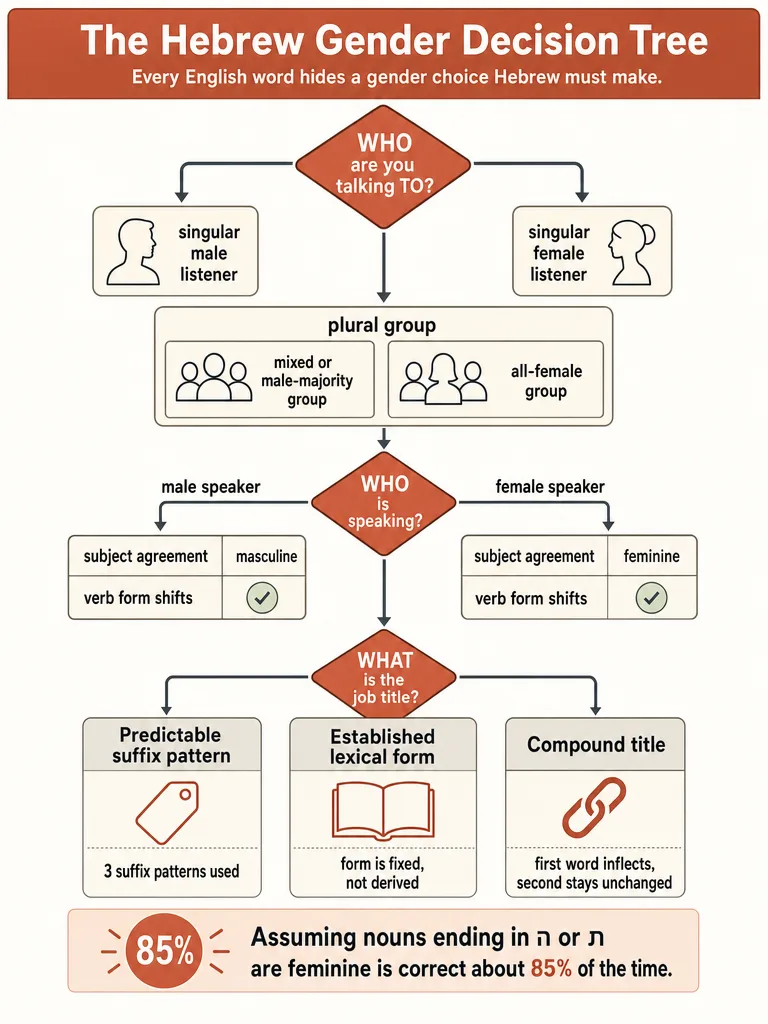
Hebrew gender translation means choosing the right pronoun, verb, adjective, and job title for the speaker, listener, or group—especially for you and they.
What is Hebrew gender translation?
Hebrew gender translation is the work of choosing masculine or feminine forms for every part of a sentence that carries gender: pronouns, verbs, adjectives, nouns, and job titles. Hebrew distinguishes two grammatical genders, masculine and feminine, with no neuter option, so English words like "you" and "they" can't be translated correctly without knowing who's involved.
The tricky part is that English hides most of this. In English, "you are ready" says nothing about who you're talking to. In Hebrew, you commit the moment you write the verb.
That commitment runs on three questions:
Who is speaking? A man and a woman conjugate verbs differently even when saying the same thing.
Who is being addressed? The word for "you" and the verb attached to it change with the listener's gender.
Who or what is described? Adjectives and nouns match the gender of what they modify.
As the baba Hebrew team explains, Hebrew is a gendered language where verbs, nouns, pronouns, and adjectives all change based on gender. That's why gender in Hebrew is a sentence-level decision, not a single word swap. Get one form wrong, and the whole sentence tilts off.
Put these words into a conversation
A Hebrew speaking app with Maya and David, AI tutors who hold conversations, explain corrections and help you practise what you need to say. Private beta on iPhone and Android. Public store launch is still ahead.
English "you" splits into four Hebrew words, and the choice depends on who's listening. There's no single default: you pick based on the listener's gender and whether you're addressing one person or a group.
So "Are you ready?" has four correct Hebrew translations depending on the audience, and only one fits the actual situation. Sending atem to a room of women reads as careless. Sending atah to a woman reads as a mistake.
The verb attached to "you" also changes, so the gender choice ripples past the pronoun itself.
This is where word-by-word tools fall short. A dictionary can tell you "you" is את or אתה, but it can't tell you which one your message needs. That decision comes from context, and context is exactly what sentence-level translation handles. When you know your reader, tools built for natural English-to-Hebrew phrasing let you set the listener's gender so the output lands right.
How do you translate "they" in Hebrew?
Hebrew has two words for "they," and the split works like the plural "you." Use הם (hem) for a masculine group or any mixed group, and הן (hen) for an all-female group. That's per the baba pronoun table, which lists both third-person plural forms.
The rule is simple until you don't know the group.
If a message says "they arrived late" and you have no idea whether "they" is three men, three women, or a mix, Hebrew still forces a choice. You can't stay vague the way English lets you. This is the unknown-audience problem, and it's the single most common place gender translation goes sideways.
The safe move is to get context before you commit. Are you writing about a specific team, a family, a group of friends? Once you know the makeup, the choice is clear: any group with at least one man conventionally takes the masculine plural הם, and only an all-female group takes הן. Handling mixed-gender groups in Hebrew well starts with knowing who's actually in the room.
What changes in the verb and adjective when gender changes?
Switching gender in Hebrew changes far more than the pronoun. Verbs conjugate differently for men and women, and adjectives shift to match the noun they describe, so a single gender change can touch several words in one sentence. Hebrew gender is agreement across the whole sentence, not one swapped word.
The baba team's grammar breakdown shows the verb "want" as one clear example: רוצה is rotzeh for a male speaker and rotzah for a female speaker. Same three letters in some cases, different pronunciation, different agreement.
Adjectives follow the noun. The same source gives שולחן גדול (shulchan gadol, "big table," masculine) versus דירה גדולה (dirah gdolah, "big apartment," feminine). The adjective "big" changes form to match.
So when a female speaker says "I want a big apartment," the verb agrees with her and the adjective agrees with the apartment. That's two separate gender calls in one short sentence.
This is why literal, word-by-word translation breaks down for anything longer than a single term.
How do Hebrew job titles change for women?
Hebrew job titles are gendered nouns, so naming someone's profession means choosing a masculine or feminine form every time. English titles like doctor, manager, and lawyer carry no gender, but Hebrew marks it on the noun itself and has no neutral form to fall back on. As Elon.io puts it, the moment you name an occupation, you've already committed.
Elon.io identifies three common feminine suffixes, and which one a title takes follows from the pattern of the masculine form. You don't choose between them freely.
Suffix
Attaches to
Example (m → f)
־ָה
ל״ה participles and the noun רופא
מוֹרֶה → מוֹרָה (teacher)
־ֶת
most other participle-based titles
מְנַהֵל → מְנַהֶלֶת (manager)
־ִית
קַטְלָן nouns, some קַטָּל nouns, and ־ַאי titles
שַׂחְקָן → שַׂחְקָנִית (actor)
The ־ֶת group is the largest, because most modern occupation names are participles. Elon.io lists מְהַנְדֵּס → מְהַנְדֶּסֶת (engineer), עוֹבֵד → עוֹבֶדֶת (worker), and שׁוֹפֵט → שׁוֹפֶטֶת (judge), and notes the suffix is never stressed: menahélet, mehandéset.
The practical takeaway for translation: "she is a manager" and "he is a manager" are not the same Hebrew sentence. English hands you one word, מְנַהֵל has to become מְנַהֶלֶת, and no amount of context in the English tells the tool that unless it's tracking who the person is. For anyone translating Hebrew job messages, this is the detail that separates natural output from a giveaway.
When are feminine job titles predictable, lexical, or compound?
Some feminine job titles follow the suffix patterns cleanly, some are settled lexical forms you memorize, and compound titles inflect only the first word. Knowing which kind you're dealing with saves you from applying pattern logic where it doesn't belong.
The clearest lexical case is "doctor." By strict rule, verbal ל״א participles take ־ֵאת, which would predict a different ending. But the profession noun has settled hard on רוֹפְאָה (rof'á). Elon.io backs this with a Hebrew Wikipedia check on 21 August 2026: היא רופאה ("she is a doctor") appeared 92 times, while היא רופא returned just 2 results, and neither of those two referred to a woman. The feminine form is the one people actually write.
Compound titles work differently. The gender marking lands on the first word, and the second word stays put. So a two-part title inflects its head noun for a woman while the rest of the phrase holds steady.
This mix of predictable, lexical, and compound behavior is exactly what generic tools miss. They either force a pattern that doesn't apply or default to masculine and skip the choice entirely.
Does Hebrew have gender-neutral job titles?
Hebrew has no neuter form for job titles. Every profession noun is either masculine or feminine, so there's no true gender-neutral option the way English "doctor" or "manager" stays unmarked. Naming a job in Hebrew means picking a gender.
Modern writing works around this in a few limited ways. The baba team notes that gender-neutral forms are becoming more common, including slashes like סטודנט/ית (combining the masculine and feminine student forms) and neutral collective terms like צוות (tzevet, "team") that sidestep marking any individual.
These are workarounds, not a grammatical neuter. A slash form is a written convention for forms and job postings, not something you say out loud in conversation. And a collective noun like "team" only helps when you're describing a group rather than a specific person.
So for a single named individual, you still choose. The realistic advice for gender grammar in Hebrew networking: learn the slash convention for written listings, and know that spoken Hebrew still commits to one gender.
How should you translate mixed groups versus all-female groups?
Group gender in Hebrew comes down to composition: a mixed group takes the masculine plural, and only an all-female group takes the feminine plural. The baba team notes that addressing mixed-gender groups requires inclusive language, and Hebrew's convention resolves it by defaulting any group with at least one man to the masculine.
That gives you a clean rule for two cases and a problem for the third:
All-female group: feminine plural. Use אתן (aten) to address them, הן (hen) to refer to them.
Mixed group: masculine plural. Use אתם (atem) and הם (hem), even if the group is mostly women with one man.
Unknown group: you need more information before you can finalize a natural translation.
The unknown case is where careless translation shows. If you're writing to a WhatsApp group and don't know who's in it, guessing wrong reads as sloppy to native speakers. Get the composition first, then commit. This same logic drives every gendered decision in Hebrew for mixed-gender groups, which is why group context matters as much as individual context.
Why do Hebrew translation tools default to masculine forms?
Generic Hebrew translation tools default to masculine forms because English hides the gender the sentence needs. When the input gives no signal about speaker, listener, or group, a tool has to pick something, and masculine is the fallback. The baba team documents this as a core reason generic AI produces unnatural or incorrect Hebrew.
The result: a female speaker gets male verb forms, a female listener gets addressed as a man, an all-female group gets masculine plurals. Each one reads wrong to a native speaker even when every individual word is technically a real Hebrew word.
The same source points out that both the speaker's and the listener's gender shape how the sentence is formed, so a tool that ignores either one produces output that no native speaker would write. The masculine default isn't a quirk of one product; it's what happens whenever a translator doesn't track who's speaking, who's listening, and who's being described.
Catching these errors starts with knowing the common mistakes in gendered AI translation: scan the pronoun, the verb agreement, and any job title before you trust the output.
Literal lookup vs sentence-level translation for Hebrew gender
Literal lookup swaps words one at a time and can't resolve gender, while sentence-level translation reads the whole context and picks the right forms. For Hebrew, that difference decides whether your output sounds native or robotic, because gender agreement runs across the entire sentence rather than sitting in a single word.
Task
Word-by-word lookup
Sentence-level translation
Single word or root
Strong
Strong
"you" / "they" pronoun choice
Guesses or defaults masculine
Uses listener and group context
Verb and adjective agreement
Not handled
Matches speaker and subject
Job titles for women
Often stays masculine
Applies the correct feminine form
Slang and tone
Literal, often wrong
Reads intent
For a quick check of one term, lookup is fine. But real messages, WhatsApp replies, work emails, signs, longer sentences, all carry gender across multiple words at once. That's the job sentence-level translation is built for, and it's why "speak like a local, not a bot" comes down to agreement, not vocabulary.
Where to go deeper on mixed groups, slang, and professional Hebrew
Hebrew gender touches nearly every kind of message you'll write, so the right next read depends on your situation. These baba guides go deeper on the specific cases this article introduced.
Ready to see gender-aware Hebrew in action? Try the free web translator and set the speaker, listener, and group before you send.
Frequently asked questions
How can I check whether a Hebrew translation handles gender correctly?
Use the same example sentences to check speaker gender, listener gender, and agreement. Specify the intended genders, then ask a Hebrew speaker to review the result. A fluent sentence alone does not establish correct agreement.
Which Hebrew translator is best for native-sounding writing?
Native-sounding Hebrew requires sentence-level decisions on speaker gender, listener gender, verb agreement, and adjective matching — not word-by-word lookup. baba Hebrew Translator is built around those Hebrew-specific problems, combining gender context, Israeli slang, idioms, tone, and transliteration in one workflow. A Hebrew-first approach matters because English hides gender entirely, so a tool that doesn't track who's speaking and who's being addressed will default to masculine and sound robotic to any Israeli reader.
How does Hebrew gender affect verbs and adjectives, not just pronouns?
Gender agreement runs across the entire sentence. The verb 'want' is rotzeh for a male speaker and rotzah for a female speaker. Adjectives also shift: שולחן גדול (shulchan gadol, 'big table') is masculine, while דירה גדולה (dirah gdolah, 'big apartment') is feminine. A female speaker saying 'I want a big apartment' triggers two separate gender calls — verb and adjective — in one short sentence. A tool that fixes only the pronoun still produces output a native speaker will immediately read as wrong.
How do Hebrew job titles change for women?
Hebrew marks gender on the profession noun itself using one of three suffixes, and there's no neutral form. The largest group uses ־ֶת: מְנַהֵל (menahel, manager) becomes מְנַהֶלֶת (menahelet), and מְהַנְדֵּס (mehandés, engineer) becomes מְהַנְדֶּסֶת (mehandéset). The suffix is never stressed. 'Doctor' is a memorized exception — רוֹפְאָה (rof'á) — confirmed by 92 Hebrew Wikipedia instances of היא רופאה versus just 2 for היא רופא, neither referring to a woman.
How do you translate 'they' in Hebrew when you don't know the group's gender?
Hebrew has two words for 'they': הם (hem) for a masculine or mixed group, and הן (hen) for an all-female group. Any group with at least one man conventionally takes the masculine plural — there's no vague middle option. When the group's composition is unknown, Hebrew still forces a choice, and guessing wrong reads as careless to native speakers. The practical fix is to establish group makeup before committing: once you know who's actually in the group, the correct form is unambiguous.
Does Hebrew have gender-neutral job titles?
Hebrew has no grammatical neuter, so every profession noun is either masculine or feminine. Modern writing uses limited workarounds: slash forms like סטודנט/ית combine both gendered student forms and appear in job postings and forms, while collective nouns like צוות (tzevet, 'team') sidestep marking any individual. Neither is a true neutral — slash forms are a written convention only, not something spoken aloud, and collective nouns only work when describing a group rather than naming a specific person.
Find your Hebrew speaking tutor
Compare Hebrew AI tutors, their published language support and the features to check.