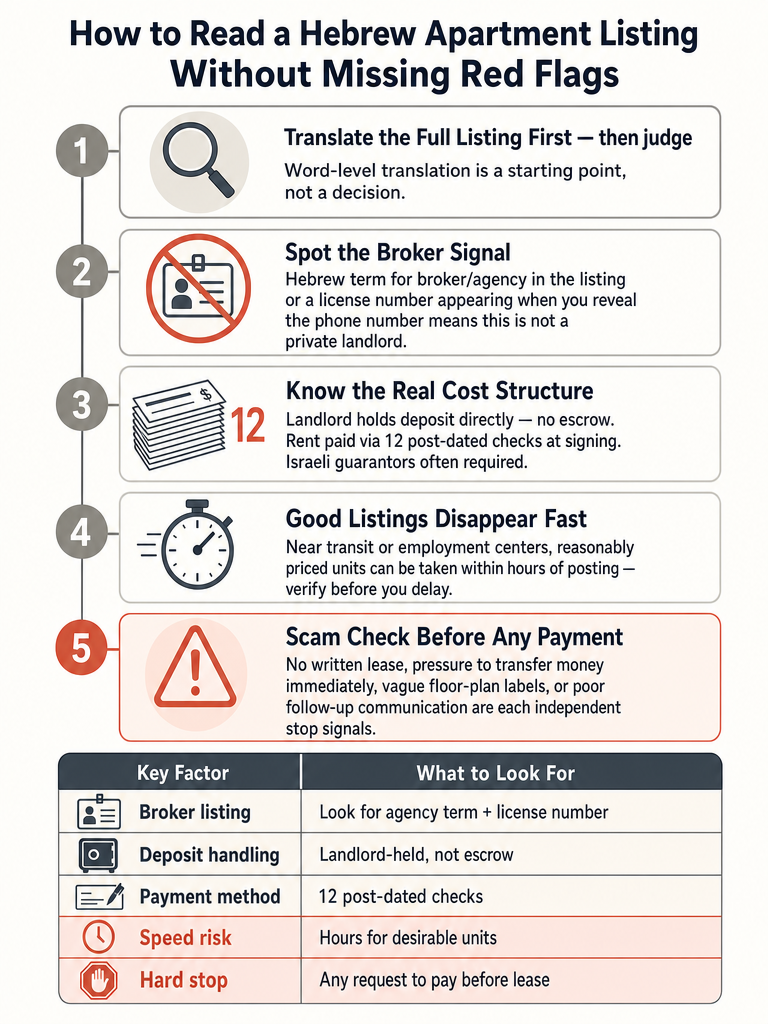
Translate Hebrew apartment listings sentence by sentence, then check תיווך, guarantors, deposits, and scam signs before you message anyone.
How do I translate Hebrew apartment listings without missing red flags?
Translate the whole listing for meaning first, then read it again hunting for money and trust signals before you ever message the poster. The order matters: comprehension, then scrutiny, then a decision to contact, verify, or skip. According to Scoutr, good apartments in Israel can be taken within hours of being posted, especially when they're reasonably priced and near the center, transit, or tech hubs—so speed and caution have to coexist.
Here's the workflow that keeps both:
Translate the full listing at the sentence level, not word by word, so tone and conditions stay readable.
Flag the cost-and-process words: who's listing it, what deposit is expected, how rent gets paid.
Cross-check the photos, address, and contact behavior against scam signals.
Only then decide: contact now, verify more, or walk away.
A listing can read perfectly clean in English and still hide a financial requirement a foreign renter never saw coming. The translation tells you what the ad says; it doesn't tell you whether the ad is honest. Keep those two jobs separate and you stop confusing "I understood it" with "I trust it."
תיווך means the property is listed by a realtor or broker, not a private landlord. According to All About Aliyah, that single word is your first clue about who you're dealing with on Yad2—Israel's largest real estate marketplace—and a company logo or a license number shown when you reveal the phone number is another broker signal. Spotting it early changes how you read the rest of the ad.
Why it matters: a broker listing often carries a fee, and you want to know that before you fall for the apartment, not after. If a listing shows תיווך, a branded logo, or a license number, treat the asking rent as one part of the cost, not the whole.
Don't assume an ad is private just because the price looks like a direct deal. Many Yad2 posts blur the line, and the Hebrew label is the most reliable tell.
How to use Yad2 to find apartments in Israel without trusting every ad?
Yad2's Additional Filters (סינונים נוספים) let you narrow listings by price, amenities, and property condition, which is the fastest way to cut a noisy feed down to real options. All About Aliyah points renters to these filters; Scoutr calls Yad2 the biggest classified listings site in Israel. Both things are true at once: it's where the volume is, and it's where you have to stay skeptical.
Scoutr is blunt about the downside—Yad2 also contains recycled listings, agent listings, and scam attempts. So filtering hard is half the job; reading carefully is the other half.
A practical pass through Yad2:
Set price, rooms, and condition in סינונים נוספים before scrolling, so you're not reacting to every post.
Watch for the same photos or wording across multiple ads—Scoutr's "recycled listings" usually look like that.
Note תיווך and logos so you know which results are agents versus private landlords.
Translate the description in full before you message, so awkward or vague phrasing stands out instead of getting glossed over.
Reading Hebrew-only descriptions and signs quickly is its own skill; our guide on reading Hebrew signs and chat messages covers the everyday cues that help.
Yad2 vs Madlan vs Facebook groups: where should a foreign renter look first?
Start on Yad2 for volume, check Madlan for richer data on the listings you like, and watch Facebook groups for direct or off-market deals. Scoutr lays out the tradeoff clearly: Yad2 has the most listings but also recycled posts, agents, and scams; Madlan offers more data per listing and more trust signals with smaller volume; Facebook real estate groups are where many landlords post directly instead of using Yad2, and where strong off-market deals can appear.
Source
Strength
Tradeoff
Yad2
Biggest classified listings site in Israel; most volume
More data per listing, more trust signals (Scoutr)
Smaller listing volume
Facebook groups
Landlords post directly; off-market deals possible (Scoutr)
Less structure; you verify everything yourself
The smart move isn't picking one. It's using them together: Yad2 to find candidates, Madlan to add context and trust signals, Facebook to catch what never hits a classifieds site.
No single platform is safe by default—your verification habit is what protects you, not the site you found the listing on.
Across all three, the language barrier is constant. Translating a full description by meaning beats decoding it word by word, and a Hebrew translator built for real life in Israel handles the slang and phrasing that classifieds are full of.
What Hebrew listing details can change the real rental cost or process?
Several Hebrew terms quietly change what you'll pay and what you'll need to qualify—long before you sign. Scoutr explains that for foreigners renting in Israel, landlords often expect Israeli guarantors (ערבים), security deposits are usually held directly by the landlord rather than in escrow, and rent is commonly paid with 12 post-dated checks issued at signing. A listing can look simple in translation and still carry all three.
That's the core mismatch: the ad describes an apartment, but the rental process has requirements the ad may barely mention.
Hebrew term
What it means
Why it affects you
ערבים (aravim)
Guarantors
Landlords often expect Israeli guarantors—hard for new arrivals to provide (Scoutr)
Deposit held by landlord
Security deposit
Held directly by the landlord, not in escrow, per Scoutr
12 post-dated checks
Year of rent checks at signing
Commonly required upfront at signing (Scoutr)
When you translate a listing, don't just capture the rent number. Capture every line about guarantors, deposits, and payment method, because those decide whether you can actually take the place.
A listing is suspicious when the basics don't add up: pressure to send money fast, no written lease, details that feel off, or contact that's vague and slow. The Instagram source on rental scams lists pressure to send money quickly and the absence of a written lease as top warning signs. Moving Help frames its guidance around 23 red flags, including suspicious detail listings and unprofessional or poor communication.
Turn that into a quick review you run on every Hebrew listing after you translate it:
Money pressure. Anyone rushing you to transfer funds before a viewing or signed lease is a red flag (Instagram source).
No written lease. If there's no real lease on offer, stop (Instagram source; Southern Management lists this among its 6 major red flags).
Suspicious details. Photos that don't match the address, a price too good for the area, recycled wording—Moving Help calls these suspicious detail listings.
Poor communication. Aloof or slow contact is a classic warning sign; one Reddit renter named "aloof contact" as their biggest red flag, where you always have to chase the landlord or agent.
Translation helps you spot some of this, because vague or copy-pasted Hebrew often reads as oddly generic once it's in plain English. But translation alone won't confirm an apartment is real. Treat a clean translation as the start of your scam check, not the end of it.
How do I understand Israeli apartment floor plans in English?
Israeli floor plans come in Hebrew, and the labels carry real layout decisions—so translate the room names before you judge the space. Semerenko Group notes that Israeli apartment plans are typically provided in Hebrew, and that the official plans submitted to municipalities are the ones used for marketing. So the plan you're shown isn't a casual sketch—it's the document the apartment was registered with.
That makes accurate label translation worth the effort. A few terms commonly appear on these plans:
ממ"ד (Mamad) — a reinforced security room
חניה (chanaya) — parking
מחסן (machsan) — storage
Each of those changes what you're actually renting. Parking and storage aren't always included the way a quick glance suggests, and a security room isn't a spare bedroom. Translate the plan label by label, then ask which of those spaces are part of the rental and which belong to the building or another unit.
A literal word swap can read fine and still mislead you on layout. Read the plan for meaning, the same way you'd read the listing.
What does ממ"ד mean on an Israeli apartment plan?
ממ"ד (Mamad) means a reinforced security room, not a standard bedroom. Semerenko Group identifies it as a reinforced security room on Israeli apartment plans—a structural room type built to a specific safety standard. That's why it deserves its own decision point when you read a layout, instead of getting flattened into "room" by a quick translation.
The practical effect: a Mamad counts toward the apartment's space, but it serves a specific purpose. Treating it as just another bedroom can change how you judge the size and usability of a place. If a plan labels a room ממ"ד, read it as a deliberate design feature and factor that into whether the layout actually fits how you'll live there.
This is exactly where word-for-word translation fails. The dictionary meaning of a label tells you less than understanding what the room is for—which is the difference between reading a plan and understanding it.
Which listing parts are safe to translate automatically, and which need human review?
Comprehension is safe to handle with a translator; legal and financial commitments are not. Translating a description, room labels, amenities, and a landlord's casual messages to understand them is low-risk. Acting on a lease, payment terms, or a contract based purely on machine output is high-risk—the rental-scams source on YouTube explicitly warns against trusting AI tools to review legal documents, calling it a simple mistake that costs people money.
Here's the split:
Low-risk: translate to understand
High-risk: verify with a human
Listing description and amenities
The lease itself before you sign
Floor-plan labels (ממ"ד, חניה, מחסן)
Payment terms and the 12 post-dated checks setup
Chat messages and follow-up questions
Guarantor (ערבים) obligations and deposit terms
General neighborhood and condition info
Anything you'd be legally or financially bound by
The line is simple: use translation to know what you're looking at, and use a qualified human to confirm what you're signing. One renter in an Olim Facebook group put the contract problem plainly, asking for a lawyer or paralegal to translate a rental contract from Hebrew to English because it was "beyond Professor Google."
Translate to understand the apartment, but bring a human in before you commit to the contract.
What should I ask when the Hebrew listing translation feels incomplete or awkward?
When a translated listing reads vague or unprofessional, ask for the specifics the ad skipped before you book a viewing. Awkward or thin phrasing isn't always a language problem—Moving Help flags unprofessional or poor communication as a scam signal, and suspicious detail listings as another. If the translation comes out generic, that's a reason to probe, not to fill in the blanks yourself.
Good follow-up questions to send before committing time:
Is this a private listing or through an agent, and is there a fee? (Confirms the תיווך question.)
What's the deposit, who holds it, and how is rent paid—checks or transfer?
Are guarantors required, and what kind?
Can you share the exact address and recent photos that match the floor plan?
When can I see it in person?
How the landlord or agent answers tells you as much as the answers themselves. Prompt, specific replies are a good sign; aloof, slow, or evasive contact is the warning the Reddit renter named. If pressure to pay fast shows up the moment you ask basic questions, that's your cue to step back.
When should you use a translator app, a dictionary, or a human for rental Hebrew?
Match the tool to the stakes: an app for full listings and chats, a dictionary for a single stubborn word, a human for the contract. A dictionary is great for one word, its root, or a conjugation, but apartment ads are full sentences, slang, and conditions—where word-by-word lookups fall apart. A translator built for sentence-level meaning handles the description, the messages, and the floor-plan labels in context, while the lease itself still belongs with a qualified human.
Full listing, chat thread, or follow-up message → a sentence-level Hebrew translator like baba Hebrew Translator, so tone, gender, and conditions stay readable.
Lease, payment terms, anything binding → a human you trust, since the YouTube source warns plainly against leaning on AI for legal documents.
Get the tool right and you move fast on real listings without mistranslating the part that costs money.
תיווך means the property is listed by a broker, not a private landlord. On Yad2, Israel's largest real estate marketplace, a company logo or license number appearing when you reveal the phone number confirms it. That distinction matters before you fall for an apartment: broker listings often carry a fee, so treat the asking rent as one part of the total cost, not the whole thing.
What Hebrew rental terms can change my real cost or process in Israel?
Three terms quietly change what you'll pay and whether you qualify. ערבים (aravim) means guarantors — landlords often require Israeli ones, which new arrivals can't easily provide. Security deposits are held directly by the landlord, not in escrow. And rent is commonly paid with 12 post-dated checks issued at signing. A listing can look simple in translation and still carry all three requirements.
How can I tell if an Israeli apartment listing is a scam?
Pressure to send money before a viewing or signed lease is the clearest warning sign, per rental scam guidance. No written lease offer means stop immediately. Moving Help catalogs 23 rental scam red flags, including suspicious detail listings and unprofessional communication. Aloof or slow contact — where you always chase the landlord — is another classic signal. A clean translation doesn't confirm an apartment is real; treat it as the start of your scam check.
Yad2 vs Madlan vs Facebook groups — where should a foreign renter look first?
Start on Yad2 for volume, check Madlan for richer trust signals on shortlisted apartments, and watch Facebook real estate groups for direct landlord posts and off-market deals. Yad2 has the most listings but also recycled posts and scam attempts. Madlan offers more data per listing with smaller volume. Facebook catches deals that never hit a classifieds site. No single platform is safe by default — your verification habit is what protects you.
What does ממ"ד mean on an Israeli apartment floor plan?
ממ"ד (Mamad) is a reinforced security room, not a standard bedroom. It's built to a specific structural safety standard and counts toward the apartment's total space — but it serves a dedicated purpose. Treating it as a spare room can distort how you judge the layout's usability. If a floor plan labels a room ממ"ד, factor that into whether the space actually fits how you plan to live there.
Which parts of a Hebrew rental listing need human review instead of a translator?
Use a translator to understand listings, floor-plan labels, and chat messages — that's low-risk. The lease itself, payment terms, guarantor obligations, and the 12 post-dated checks setup need a qualified human. A YouTube source on rental scams explicitly warns that trusting AI tools to review legal documents is a simple mistake that costs people money. One renter in an Olim Facebook group put it plainly: a rental contract in Hebrew is "beyond Professor Google."