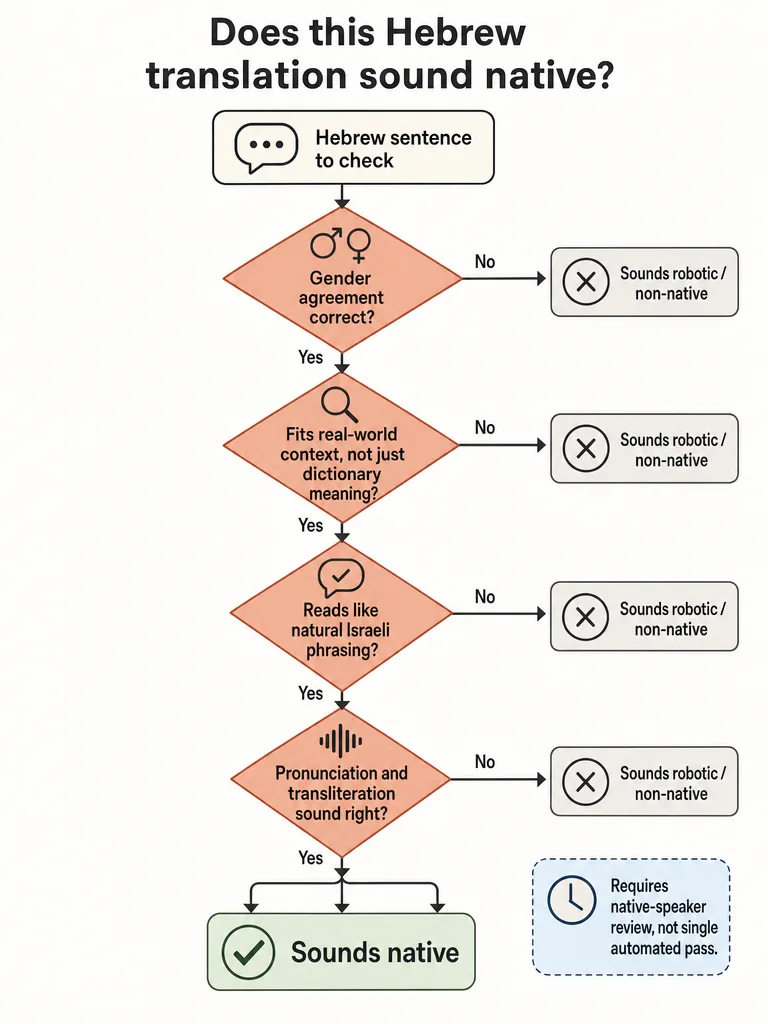
Check Hebrew translation for gender, context, phrasing, and pronunciation so it reads naturally, not like a literal word-for-word translation.
How do you know if a Hebrew translation sounds native?
Hebrew translation sounds native when four checks pass together: correct gender agreement, a fit with real-world context, natural Israeli word order, and pronunciation that holds up when read aloud. Passing a dictionary lookup only proves the words are technically right, not that an Israeli would say it that way out loud.
A native-sounding Hebrew translation is one that an Israeli reader or listener would not flag as translated at all. That's a different bar than "grammatically correct." A sentence can be free of spelling mistakes and still read like a tourist wrote it, because it ignores who is speaking, who is listening, and how the idea would actually get phrased on the street or in a WhatsApp thread.
Most guidance treats these four checks as separate topics: one piece on gender, another on slang, another on pronunciation. Reading them in isolation misses how they interact. A sentence can nail the gender agreement and still sound stiff because the word order is lifted straight from English. The sections below walk through each check on its own, then combine them into one routine you can run before sending anything in Hebrew.
What makes Hebrew translation sound robotic?
Robotic Hebrew usually comes from three structural mismatches, not one single bug. A guide to testing Hebrew translation accuracy identifies frequent vowel omission, gendered pronouns and verbs, and a Verb-Subject-Object sentence order as the features a word-by-word tool misses when it translates from English. None of these show up as a grammar error. The sentence still parses; it just isn't built the way Hebrew is actually built.
Context compounds the problem. The same guide notes that a single Hebrew word can carry multiple meanings depending on where it sits in a sentence, so a tool translating one line at a time loses the surrounding words that would normally resolve which meaning applies. It names mixed-language text, a sentence that drops an English brand name or acronym mid-Hebrew, as its own test category, because the same loss of surrounding context trips up translation there too.
None of these failures throw an error. The sentence still "works," it just doesn't sound like something a person would say. That's why robotic Hebrew is harder to catch than a typo: it takes reading for fit, not just reading for correctness.
Does the Hebrew get gender agreement right?
Wrong gender is one common tell that a Hebrew translation wasn't reviewed by anyone fluent, though it isn't the only one. Hebrew's gender rules reach past the obvious pronoun: verbs, adjectives, and job titles all shift depending on who is speaking, who is being addressed, and whether the group is mixed. A sentence can be spelled correctly and still misgender the reader, which lands worse than an awkward phrase because it reads as a mistake about the person, not the language.
Run these checks on any Hebrew sentence before trusting it:
Does the verb match the gender of the person speaking, not a generic default?
Does the verb match the gender of the person being addressed, especially in a direct message?
If the sentence names a job title, profession, or role, does it agree with the real person's gender rather than the masculine form by habit?
For a group message, does the translation handle a mixed-gender audience instead of defaulting to one gender automatically?
A guide to testing Hebrew translation accuracy specifically calls out "gender-specific terms" as one of the categories that needs its own test data, alongside idioms and mixed-language text, because these are exactly the places automated systems quietly fail.
Does the Hebrew fit the real context, not just the dictionary meaning?
Vowel omission is one of the biggest reasons a word-for-word Hebrew translation goes wrong. Written Hebrew routinely drops vowel markings, so the same consonant string can represent more than one word, and the correct reading depends entirely on the sentence around it. A tool translating one line at a time has no way to resolve that ambiguity. A guide to testing Hebrew translation accuracy names exactly this pattern, listing idioms, mixed-language text, and gender-specific terms as the real-world cases that need dedicated test data rather than generic sentence pairs judged on their own.
A phrase that translates perfectly as a standalone dictionary entry can still be wrong once it's dropped into a sentence where that same root word means something else.
Three quick context checks:
Would the sentence still make sense if you removed the vowels? If the Hebrew only works because of added vowel points a native text wouldn't normally include, it may be masking an ambiguity rather than resolving one.
Does an idiom get translated for its meaning, or word for word? Idioms are a named failure category in Hebrew translation testing, not an edge case.
Does the sentence hold up next to the one before and after it, or does it read like it was translated alone?
Does it read like real Israeli phrasing, or translated English?
Word order gives away a translated sentence before tone does. Hebrew's natural pattern leans toward a Verb-Subject-Object structure, and a sentence that keeps an English Subject-Verb-Object shape can be fully grammatical while still reading as obviously foreign to a native speaker, a pattern flagged directly in guidance on testing Hebrew translation accuracy.
Register and tone are harder to pin down from the available research. The sources behind this article cover sentence structure, context, and pronunciation in real detail, but none of them address formality or directness in Hebrew versus English specifically, so this section won't manufacture a claim about which language is more polite or more formal by default.
What the structural point does give you is a workable test: read the Hebrew sentence on its own, without the English next to it, and check whether the verb leads the way Hebrew sentences typically do, or whether it's been forced into an English-shaped order instead. If you have to mentally re-translate the Hebrew back to English to see why it's phrased that way, the word order is probably still carried over rather than native.
Which pronunciation and transliteration differences are normal, and which sound non-native?
Not every unfamiliar Hebrew sound is a mistake. Standard Israeli Hebrew has its own accepted pronunciation that differs from both older traditions and from what an English speaker expects, and mixing up the two causes false alarms. Grammar guides from Elon.io describe the Standard Israeli ר as a sound made at the back of the throat, closer to a French r than an English one, and note that ח and the undotted כ are pronounced as one raspy, throat-based sound in Standard Israeli Hebrew, even though some Mizrahi, Yemenite, Arabic-speaking, and older speakers keep the two sounds distinct. Both patterns are normal Hebrew, not errors.
Transliteration ambiguity is a separate category. A Hebrew transliteration resource notes there is no single officially correct way to write Hebrew in Roman letters, which is why different organizations land on different systems, from academic standards like ISO-259-2 to style guides used by groups such as the Society for Biblical Literature. The same source warns that transliterating Hebrew text without its vowel points first can produce unreadable consonant clusters instead of a pronounceable word, a practical failure rather than an accent choice.
What you're checking
Normal variation
Likely non-native signal
ר (resh) sound
A back-of-the-throat sound, standard in Israeli Hebrew
English-style r, pronounced toward the front of the mouth
ח / undotted כ
Merged into one raspy throat sound in Standard Israeli Hebrew
Treating the two as always distinct when standard speech calls for the merged sound
Letters with two historical sounds (ב, כ, פ)
Two pronunciations each, per Modern Israeli usage
Applying two pronunciations to letters that no longer carry that distinction in everyday speech
Romanized spelling
Differs by system (academic, religious, casual)
Assuming one spelling is "the" correct transliteration
Vowel-free source text
Normal for everyday written Hebrew
Feeding unvowelled text into a transliteration tool and getting consonant clusters back
This also matters for anything read aloud. baba's Hebrew text-to-speech feature, for example, defaults to standard Modern Israeli voices and does not currently offer separate Mizrahi, Haredi, or Yemenite-accented voices, so a sentence read there will sound like the standard Israeli accent described above, not a community-specific one. For a closer look at matching Romanization to the job at hand, see an English to Hebrew translator with transliteration built in.
How do native speakers and teams test Hebrew translations for accuracy?
Teams test Hebrew translation accuracy by combining automated scoring, native-speaker review, and repeated testing cycles, not by trusting a single pass through any one tool. A guide to testing Hebrew translation accuracy in APIs lays out a practical process built around a few habits:
Build a test set from real-world examples, including idioms, mixed-language text, gender-specific terms, and right-to-left formatting cases, rather than generic sentence pairs translated in isolation.
Score translations with more than one automated metric. Pairing a BLEU score with chrf3 and TER gives a fuller read on accuracy than any single metric alone.
Bring in native Hebrew speakers to review grammar, tone, and cultural relevance that automated metrics can't judge, especially around idioms and gendered terms.
Re-test after fixes. Treat the whole thing as a cycle: find errors, prioritize the ones that matter most, fix them, and run the same test set again.
This process exists because Hebrew's gender agreement, context-dependent meaning, and right-to-left display each introduce a failure point that no single metric catches on its own. Teams running this at scale for published content, not just app strings, can see the fuller workflow in testing Hebrew translation accuracy in APIs.
A quick checklist to run before you send a Hebrew translation
Run the four checks above as one short pass instead of four separate reviews. Each one catches a different kind of mistake, and they rarely overlap, so skipping any single step leaves a real gap.
Gender check. Does every verb, adjective, and job title match the actual speaker and listener, including a mixed-gender group if that applies?
Context check. Does the sentence make sense given what came before and after it, and does any idiom carry its real meaning rather than a literal, word-for-word version?
Phrasing check. Read the Hebrew alone, without the English next to it. Does it sound like a sentence someone would actually say, or does the word order still feel carried over from English?
Pronunciation and transliteration check. If the text will be spoken or read aloud, does the pronunciation match standard Israeli Hebrew rather than an accidental English-accented reading, and does the Romanized spelling, if there is one, follow a consistent system rather than a guess?
A one-line text message is a fast way to test all four at once: a casual chat reply has room for a gender mismatch, a missed idiom, a stiff English-style sentence, and an awkward transliteration all in the same short exchange. For more on keeping tone natural in everyday texting, see translating everyday Hebrew texts and chats.
None of these checks require fluency to run. They require knowing what to look for, which is the gap a four-point routine like this one is meant to close.
Frequently asked questions
How many Hebrew letters still have two different pronunciations in Modern Israeli Hebrew?
Three letters, bet, kaf, and pey, still carry two distinct sounds each in everyday Modern Israeli speech, according to My Jewish Learning's overview of Ashkenazic and Sephardic Hebrew. The other three letters that historically carried two sounds each have collapsed into a single sound over time. This matters for pronunciation checks: treating a collapsed letter as if it still has two sounds is one sign of a non-native reading.
What's the difference between Sephardic and Ashkenazi pronunciation of Hebrew?
Sephardic Hebrew traces back to Mediterranean Jewish communities and Ashkenazi Hebrew developed in Eastern Europe, and the two traditions pronounce some words differently, such as the Sabbath: shabbat in Sephardic pronunciation versus shabbos in Ashkenazi pronunciation. Both are correct Hebrew, reflecting different community histories rather than errors. Knowing which tradition a word or name comes from helps you judge whether a pronunciation difference is a real mistake or just a regional variant.
How natural does baba's Hebrew text-to-speech sound compared to a human voice?
baba's Hebrew text-to-speech defaults to standard Modern Israeli voices, matching the back-of-the-throat resh and the merged chet and undotted kaf sound that standard Israeli speech uses today. It does not currently offer separate Mizrahi, Haredi, or Yemenite-accented voices, so anything read aloud comes out in the standard Israeli accent rather than a community-specific one. That's a deliberate scope limit worth knowing before relying on it for accent-specific content.
Is there one official standard for transliterating Hebrew into English letters?
No, there is no single officially correct system for writing Hebrew in Roman letters. Different organizations use different standards, from academic systems like ISO-259-2 to style guides such as the one used by the Society for Biblical Literature, so the same Hebrew word can end up spelled several different ways. Feeding Hebrew text into a transliteration tool before its vowel points are added can also produce unreadable consonant clusters instead of a pronounceable word.
Why do teams pair multiple automated metrics instead of relying on one BLEU score to check Hebrew translation?
A single BLEU score misses too much of what makes Hebrew sound right, so testing guidance pairs it with metrics like chrf3 and TER for a fuller read on accuracy. Hebrew's gender agreement, dropped vowels, and context-dependent word meanings each introduce a failure point that one metric alone won't catch. Teams running this process also bring in native speakers to review grammar, tone, and cultural fit that no automated score can judge on its own.
Can a Hebrew translation be grammatically correct and still sound non-native?
Yes, a sentence can pass every grammar check and still read like it was written by a tourist. The usual giveaway is word order: Hebrew favors a Verb-Subject-Object structure, and a sentence that keeps English's Subject-Verb-Object shape stays fully grammatical while sounding obviously foreign to a native speaker. Reading the Hebrew alone, without the English sentence next to it, is the fastest way to catch this kind of mismatch.