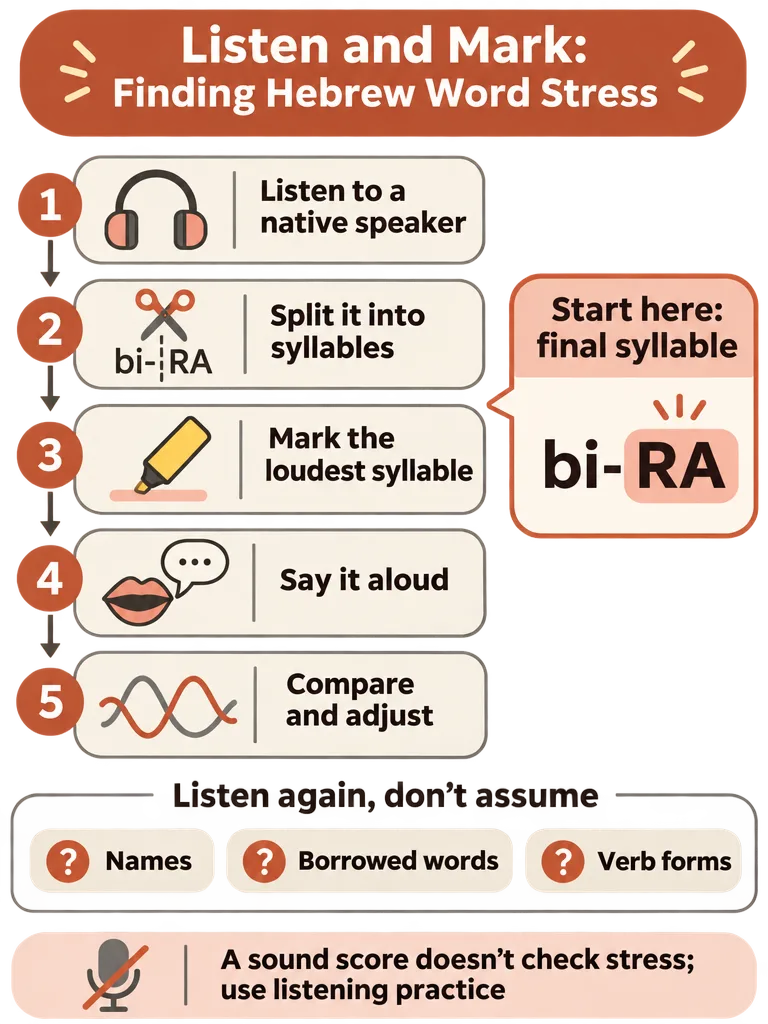
Hebrew word stress usually falls on the final syllable, called milra. Listen to a native speaker and mark exceptions with a simple exercise.
Which syllable do you stress in Hebrew?
Hebrew word stress falls on the final syllable in most words, a pattern called milra. The Hebrew Grammar page on elon.io says final stress covers the overwhelming bulk of the vocabulary, and a beki.org Point of Grammar handout agrees. Treat it as a starting rule with exceptions, not a word-by-word guide.
Try this now: pick one Hebrew word you know, play a native speaker saying it, and decide which syllable stands out most. Write down "final" or "not final." That one-line note is the output, and the full routine is in the listen-and-mark section below.
The beki.org handout appears in a discussion of Biblical text markings (meteg, maqaf, trope), so it is a grammar reference, not a description of how Israelis talk today. The supplied excerpts don't establish which of its detailed rules carry over to everyday modern Hebrew.
When you meet a new word, assume the last syllable carries the weight. Then listen to a native speaker and change your assumption only if your ears disagree.
What does stress actually do in a Hebrew word?
Hebrew stress helps make sure you say the right word. The hebrewbyinbal.com post Hebrew Syllable Stress: Why Israelis Don't Understand You says stress has two jobs and that the first is exactly that. It opens with the written word בִּירָה as its example. Stress itself is the prominence one syllable gets, which Michael Becker's research describes as a High tone on the stressed syllable.
The available excerpt doesn't show the full contrast the post draws or its second job, so this guide claims nothing beyond that. The practical takeaway is modest: stress is part of getting the intended word across, not a decoration on top of the sounds.
How do you hear and mark the stressed syllable? (a listen-and-mark exercise)
To practice Hebrew word stress by ear, spend about five minutes on one word: predict final stress, listen to a native recording, mark the syllable that stands out, say it back, and log whether it matched. The output is a short list of words that didn't follow the final-stress default. This is a suggested routine, not a validated method.
You need a recording you supply yourself, such as a teacher, an Israeli friend or a voice message. No playable reference audio is included in the supplied material. You can start with בִּירָה, the written word from the source above, or any word you use daily.
Pick one word and get a recording. Ask a native speaker to say it on its own.
Split it into syllables. If you're unsure where the breaks fall, ask the speaker or a teacher.
Predict first. The final-stress default says the last syllable. Write that guess down before you listen.
Listen two or three times. Note which syllable stands out most. If you can't tell, ask for the word again, a bit slower.
Mark it. Put the stressed syllable in capitals. Mark what you heard, not what you predicted.
Say it back and record yourself. Play your version next to the original and check whether the same syllable stands out.
Log the result. Write "final" if it matched the default, or "breaks the default" if it didn't, and keep those words on a short list.
Repeat with five or six words. The "breaks the default" list is the useful part, because it shows which words need individual attention.
Hebrew stress can also fall on the second-to-last, or penultimate, syllable. A Reddit thread in r/hebrew gives the general rule as stress on either the last or the second-to-last syllable. That is a casual forum answer, so treat it as a pointer, not a ruling.
Michael Becker's 2003 paper, Hebrew stress: Can't you hear those trochees?, states that a stressed syllable is marked by a High tone, and that the High tone appears on the stressed syllable when it is final or penultimate in the phrase. A separate paper on stress in the nominal system of Modern Hebrew describes a rhythmical default pattern for words where no morpheme carries a lexically specified accent. Its excerpt cuts off before the details.
The supplied excerpts don't list which word categories take penultimate stress, or which exceptions apply in everyday Israeli speech. Some of the material is Biblical Hebrew, which is a separate scope, and the excerpts don't establish which detailed rules transfer to modern speech. Until you have better evidence, confirm each word by ear and use your "breaks the default" list.
How do you check stress in names and loanwords?
For names and loanwords, hear the word from a speaker instead of applying the final-stress default. The supplied sources establish no verified stress patterns for personal names. For loanwords, the only evidence is a single r/hebrew comment saying stress "could be anywhere." Read that as a tentative observation, not a teaching rule.
A short checklist:
Don't apply the default to a name. Hear it from the person, or from someone who knows them, before you say it aloud.
Ask. "How do you say your name?" is a normal question to ask someone.
Use the same mark-and-compare steps. Run the name or borrowed word through the exercise above.
Copy a specific speaker for a specific word. If an Israeli colleague says a borrowed word one way, match that word, and don't carry it over to every borrowed word.
Keep a separate list. Add names and loanwords to your "breaks the default" notes so you review them one by one.
Does stress change when a Hebrew verb changes form?
Hebrew verb stress can move within a paradigm, so check the stress of each form you plan to use. The elon.io page Stress Shifts Inside a Verb Paradigm signals this in its title, and its opening describes final stress as covering the overwhelming bulk of the vocabulary.
The available excerpt names the topic but doesn't show worked examples, so this guide doesn't invent any. What it supports is a habit. When you learn a verb, don't assume the stress you heard in one form carries over to the others. Listen to each form, mark it with the steps above, and note any that differ. Give each form its own line on your list.
Should you copy it when Israelis shift stress in conversation?
In conversational Hebrew, listen first, then copy the stress of a specific word from a specific speaker. Don't build a rule from one example. The supplied excerpts do not explain conversational stress shifts or their effects on register or familiarity, and none gives verified examples, so this guide offers no pattern to imitate.
Keep two things apart. The textbook default, final stress, is your baseline when you have no other information. What you hear in real speech is evidence about a particular word. When the two disagree, trust your ears on that word and log it.
A practical test is to hear the same word from two different people. If both say it the same way, copy it. If they differ, pick one speaker as your model for now. For common spoken words to listen to, see sababa, yalla and nu in real use.
Can a pronunciation app check your Hebrew word stress?
baba Learn provides sound-level pronunciation practice but does not score word stress, so a good pronunciation result doesn't confirm you stressed the right syllable. Baba's own guidance is to practice stress by listening instead. Keep the two jobs separate: sounds get sound-level feedback, and stress gets listening practice.
For stress, use the listen-and-mark routine above with real audio from native speakers. Baba's published guidance also notes that feedback can be wrong, so check anything surprising with a teacher or a native speaker. For more on pronunciation apps in general, see Hebrew pronunciation apps.
Frequently asked questions
What does milra mean in Hebrew?
Milra (מלרע) is the Hebrew term for stress on the last syllable of a word. A grammar handout from beki.org says most Hebrew words are stressed this way, and elon.io says it covers the overwhelming bulk of the vocabulary. Treat it as a starting default for new words, then confirm by listening, because exceptions exist.
Can Hebrew words be stressed on the second-to-last syllable?
Yes. A casual r/hebrew thread gives the general rule as stress on either the last or the second-to-last syllable. Michael Becker's 2003 paper describes a High tone on the stressed syllable when it is final or penultimate in the phrase. The sources reviewed don't list which word types take second-to-last stress, so check each word by ear.
Can the wrong stress make Israelis misunderstand me?
It can. One Hebrew teaching post says stress has two jobs, and the first is making sure you say the right word, using the written word בִּירָה as its example. The excerpt reviewed doesn't show the full contrast, so don't assume every stress slip changes the meaning of a word.
How can I practice Hebrew word stress by ear?
Pick one word, predict final stress, then listen to a native speaker say it and mark the syllable that stands out. Say it back, record yourself, and log whether it matched the default. About five minutes per word works. This is a suggested routine, not a validated method, and it needs a recording from a teacher, friend, or voice message.
Do names and borrowed words follow the same stress rule in Hebrew?
Don't assume so. The sources reviewed give no verified stress patterns for names, and one r/hebrew comment says stress in loanwords could be anywhere. Hear the word from a speaker, or ask a person how they say their own name, and keep a separate list of words that break the final-stress default.
Does stress stay in the same place when a Hebrew verb is conjugated?
Not necessarily. An elon.io grammar page titled "Stress Shifts Inside a Verb Paradigm" signals that stress can move between forms of the same verb, while describing final stress as the norm for the bulk of the vocabulary. Listen to each form you plan to use instead of carrying over the stress you heard in one.