How to Translate Hebrew Holiday Greetings Step-by-Step
Translating Hebrew holiday greetings requires careful attention to the language's unique structure and cultural nuances. Here’s a simple three-step guide to ensure your translations are accurate and meaningful.
Step 1: Identify the Holiday and Base Greeting
Start by determining the holiday and its traditional greeting. Since Hebrew holidays follow the lunar calendar, their dates shift each year. For example, Rosh Hashanah might fall in September or October. Use a Jewish calendar tool to confirm the exact date.
Once you know the holiday, identify its standard greeting. For Rosh Hashanah, common phrases include "Shanah Tovah" (literally "Good Year") or the more formal "L'Shanah Tovah Tikateivu" ("May you be inscribed for a good year"). For Hanukkah, typical greetings are "Chag Hanukkah Sameach" ("Happy Hanukkah Festival") or "Chag Urim Sameach" ("Happy Festival of Lights"). Passover greetings often include "Chag Pesach Sameach" ("Happy Passover Festival") or the simpler "Chag Sameach" ("Happy Holiday") [1].
These base greetings are gender-neutral, making them suitable for most situations. However, adjustments may be needed depending on the context - whether formal, traditional, or secular.
Step 2: Adjust for Gender and Audience
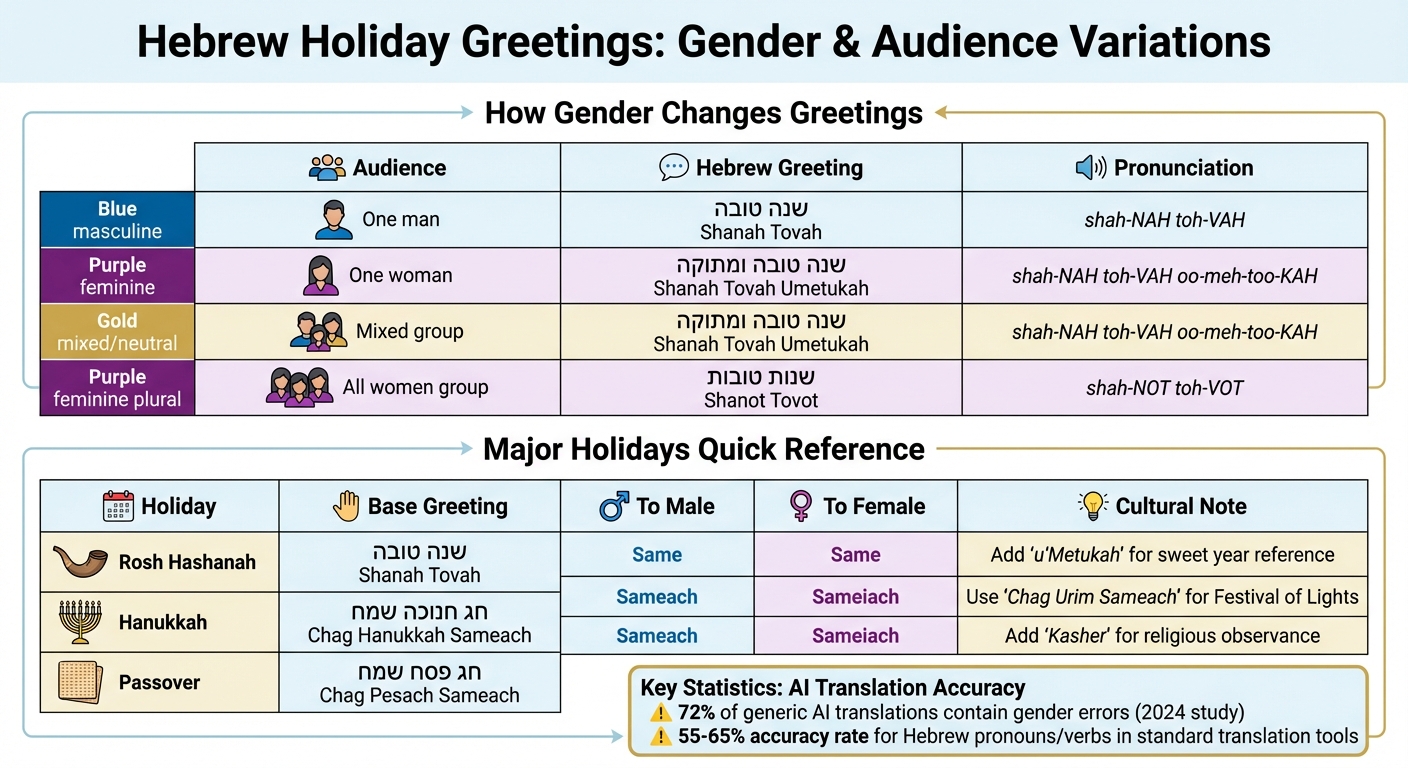
Hebrew grammar often changes based on the recipient's gender, so it’s crucial to modify greetings accordingly. For example:
- "Chag Sameach lecha" (to a man)
- "Chag Sameach lach" (to a woman)
- "Chag Sameach lachem" (to a group)
For Rosh Hashanah, if you want to personalize the greeting by saying, "May you have a good year", the verb must also match the recipient's gender. Use "Yihiye lecha shanah tovah" for a man and "Yihiye lach shanah tovah" for a woman. Without these adjustments, your greeting might sound awkward or even incorrect.
Interestingly, translation tools often default to masculine forms for Hebrew pronouns and verbs rather than adapting to context. This highlights the importance of manual adjustments for gender and audience to ensure your greeting feels natural.
Step 3: Add Cultural Context for Natural Phrasing
Once the grammar is correct, add cultural elements to make the greeting feel authentic. Israelis often mix religious and secular expressions, sometimes incorporating slang or idiomatic phrases. For instance:
- During Rosh Hashanah, "Shanah Tovah u'metuka" ("A good and sweet year") is widely used, referencing the tradition of dipping apples in honey. A casual variation might be, "Yihiye b'seder, Shanah Tovah lach!" to convey a friendly tone.
- For Hanukkah, a formal greeting like "Chag Urim Sameach" works well in religious contexts, while "Hanukkah Sameach" is common in casual settings.
- Passover greetings can range from the formal "Chag Pesach Kasher V'Sameach" ("Kosher and Joyful Passover") to the more relaxed "Mo'adim l'simcha" ("Joyful holidays").
These cultural nuances elevate a technically correct translation into one that feels warm and genuine, aligning with the spirit of the occasion.
Hebrew Holiday Greeting Translation Examples
This guide showcases examples of translating Hebrew greetings for major holidays, focusing on gender variations, pronunciation tips, and cultural insights.
Rosh Hashanah Greetings
For Rosh Hashanah, the go-to phrase is "Shanah Tovah" (שנה טובה), meaning "Good Year." It's pronounced shah-NAH toe-VAH, with an emphasis on the second syllable. This versatile greeting works for addressing men, women, or groups in most contexts.
For a more formal touch, say "L'shanah Tovah Tikateiv Veteichatem" (לשנה טובה תכתב ותחתם) when addressing a man, which translates to "May you be inscribed and sealed for good." When addressing a woman, adjust the verb endings to "L'shanah Tovah Tikateivi Veteichati" (לשנה טובה תכתבי ותחתמי). This reflects the High Holiday tradition of being inscribed in the Book of Life. Additionally, you can use "Sameach" for men or mixed groups and "Sameiach" for women.
Another popular phrase is "Shanah Tovah u'Metukah" (שנה טובה ומתוקה), meaning "A good and sweet year." This greeting ties into the custom of dipping apples in honey and remains the same regardless of the recipient's gender, making it a practical option for casual conversations.
Hanukkah Greetings
For Hanukkah, say "Chag Hanukkah Sameach" (חג חנוכה שמח) for men or mixed groups, and "Chag Hanukkah Sameiach" for women. Pronounce it as KHAHG hah-noo-KAH sah-MAY-akh.
You can also use "Chag Urim Sameach" (חג אורים שמח), which means "Happy Festival of Lights." Adjusting the gender-specific endings ensures your greeting feels personal and engaging.
Passover Greetings
During Passover, the standard greeting is "Chag Pesach Sameach" (חג פסח שמח), pronounced KHAHG PEE-sakh sah-MAY-akh. Use "Sameach" for men or mixed groups and "Sameiach" for women. For a more traditional approach, try "Chag Pesach Kasher V'Sameach" (חג פסח כשר ושמח), meaning "A kosher and happy Passover", which emphasizes religious observance.
Tailoring greetings to include gender-specific variations can make them feel more thoughtful and inclusive, especially for women who might otherwise receive masculine forms.
| Holiday |
Base Greeting |
Transliteration |
To Male |
To Female |
Cultural Note |
| Rosh Hashanah |
שנה טובה |
Shanah Tovah |
Same |
Same |
Add "u'Metukah" for a sweet year reference |
| Hanukkah |
חג חנוכה שמח |
Chag Hanukkah Sameach |
Sameach |
Sameiach |
Use "Chag Urim Sameach" for Festival of Lights |
| Passover |
חג פסח שמח |
Chag Pesach Sameach |
Sameach |
Sameiach |
Add "Kasher" for religious observance |
These examples illustrate the delicate nuances in translating Hebrew holiday greetings, offering a glimpse into how baba makes such tasks easier and more accurate.
How baba Makes Hebrew Holiday Greetings Easier
baba uses advanced AI to tackle Hebrew's tricky gender grammar, cultural subtleties, and pronunciation challenges. Available on both iOS and Android with a perfect 5.0-star rating, the app ensures that your holiday greetings sound natural and appropriate.
Gender-Aware Translation
One standout feature of baba is its ability to handle 11 gender-specific variations and 22 AI-driven prompts to tailor translations. For example, when translating "Chag Sameach" (Happy Holiday), the app knows to use "Sameach" for men or mixed groups and "Sameiach" for women. All you need to do is select the audience context - like "To One Man", "To One Woman", or "To Mixed Group" - and baba takes care of the rest. This eliminates the common gender-related mistakes that traditional translation tools often overlook.
But baba doesn't stop at grammar. It also incorporates modern slang and cultural nuances to make greetings feel authentic.
Cultural Context and Slang
Hebrew greetings can vary depending on the occasion or setting, and baba helps you navigate these differences effortlessly. For instance, during Passover, the app distinguishes between formal phrases like "Chag Pesach Kasher V'Sameach" (highlighting kosher observance) and casual expressions such as "Pesach Sameach, yalla!" It even explains slang like "yalla", which means "let's go", so you understand when to use it - whether you're in a religious setting or chatting informally with friends.
By blending cultural insight with precise grammar, baba ensures your greetings hit the right tone every time. And for those new to Hebrew, pronunciation help is just a tap away.
Transliteration for Beginners
For users who can't read Hebrew script, baba provides Latin-character pronunciation guides alongside every translation. For example, when translating "Chag Chanukah Sameach", the app displays "CHAG cha-noo-KAH sa-MAY-ach" so you can confidently pronounce it. These guides automatically adapt to gender-specific forms, ensuring accuracy. Plus, the app includes an instant playback feature that lets you hear native pronunciation while following along with the transliteration.
With its focus on grammar, cultural context, and pronunciation, baba makes sharing Hebrew holiday greetings easy and meaningful for everyone.
Conclusion
Translating Hebrew holiday greetings accurately requires more than just knowing the words - it’s about understanding the language’s gendered grammar (where verbs, adjectives, and pronouns change based on who’s speaking and listening), the cultural layers (religious versus secular tones), and how phrases are naturally used. Generic translation tools often fall short, defaulting to masculine forms and missing the subtle cultural elements that make greetings feel genuine. Whether it’s saying “Shanah Tovah” for Rosh Hashanah or “Chag Chanukah Sameach” during Hanukkah, these nuances matter.
Luckily, there’s a tool built to handle Hebrew’s unique challenges. baba offers a tailored solution with 11 gender-aware variations and specialized AI prompts designed specifically for Hebrew. It ensures that your greetings are appropriate for any audience - whether you’re addressing a single woman, a mixed group, or crafting a formal message. Plus, its transliteration feature helps even beginners pronounce greetings correctly without needing to read Hebrew script.
For those looking to improve year-round, the guide’s approach is simple: start by identifying the holiday and its traditional greeting, adjust for gender and audience, and then fine-tune the phrasing to match the cultural context. With baba available on iOS and Android and boasting a perfect 5.0-star rating, you have a dependable tool to help you connect meaningfully during every celebration.
FAQs
How do I know if a Hebrew holiday greeting should be masculine or feminine?
Hebrew holiday greetings adapt depending on the gender of both the speaker and the recipient. For instance, if you're greeting a man, you'd use the masculine form, such as "Chag Sameach" (חג שמח). To greet a woman, you'd tweak the wording to the feminine form, modifying the adjectives or endings accordingly. When addressing a group, the gender composition of the group determines the appropriate form, ensuring the greeting aligns with cultural norms.
What’s the difference between religious and secular Hebrew holiday greetings?
Religious Hebrew holiday greetings often focus on spiritual and divine blessings. For instance, during Rosh Hashanah, people say "Shanah Tovah Umtukah", which means "may you have a good and sweet year." On the other hand, secular greetings like "Chag Sameach" (translated as "happy holiday") are more general, emphasizing joy and togetherness. While religious greetings highlight the sacred elements of the occasion, secular ones work well in cultural or non-religious settings.
How can I double-check pronunciation if I can’t read Hebrew letters?
If you’re unfamiliar with Hebrew letters, tools with transliteration or audio features can be incredibly helpful. For example, the baba app offers Hebrew transliteration using Latin characters, making it easier to understand pronunciation. It also includes audio recordings of native speakers, allowing you to hear how words are pronounced. This mix of visual and auditory learning ensures you can practice and verify accurate Hebrew pronunciation, even if you can’t read the script.
Frequently Asked Questions
How do I know if a Hebrew holiday greeting should be masculine or feminine?
Hebrew holiday greetings adapt depending on the gender of both the speaker and the recipient. For instance, if you're greeting a man, you'd use the masculine form, such as "Chag Sameach" (חג שמח). To greet a woman, you'd tweak the wording to the feminine form, modifying the adjectives or endings accordingly. When addressing a group, the gender composition of the group determines the appropriate form, ensuring the greeting aligns with cultural norms.
What's the difference between religious and secular Hebrew holiday greetings?
Religious Hebrew holiday greetings often focus on spiritual and divine blessings. For instance, during Rosh Hashanah, people say "Shanah Tovah Umtukah", which means "may you have a good and sweet year." On the other hand, secular greetings like "Chag Sameach" are more general, emphasizing joy and togetherness. While religious greetings highlight the sacred elements of the occasion, secular ones work well in cultural or non-religious settings.
How can I double-check pronunciation if I can't read Hebrew letters?
Tools with transliteration or audio features are incredibly helpful here. The baba app offers Hebrew transliteration using Latin characters alongside audio from native speakers, so you can both see and hear how each greeting should sound — no need to read Hebrew script at all.
Is "Chag Sameach" appropriate for every Jewish holiday?
"Chag Sameach" works as a general Happy Holiday greeting for most celebratory occasions, but more specific greetings are often more fitting — like "Shanah Tovah" for Rosh Hashanah or "Pesach Kasher V'Sameach" for Passover. Using the holiday-specific phrase shows cultural awareness and feels more personal to native Hebrew speakers.
Why do so many translation tools get Hebrew holiday greetings wrong?
Most general translation tools are built for languages like English or Spanish that don't require gender agreement on every word, so they default to masculine Hebrew forms and miss context-specific phrasing entirely. Hebrew requires adjusting verbs, adjectives, and pronouns based on who you're addressing, which demands a translator built with Hebrew grammar at its core rather than adapted from a generic model.
Can I use the same Hebrew holiday greeting in both formal and casual settings?
Not always — tone matters as much as grammar. A phrase like "Pesach Kasher V'Sameach" fits a formal or religious context, while "Chag Sameach" or even a slang-inflected version like "Pesach Sameach, yalla!" feels more natural among friends. Matching the register to the setting is what makes a greeting land the right way.