
Navigating Israeli Work Culture: Language Insights
Want to succeed in Israeli workplaces? Mastering communication is key. Here’s what you need to know:
- Direct Communication: Israelis value straightforwardness. Say what you mean without sugarcoating - it’s seen as efficient and respectful.
- Casual Hierarchy: First names are the norm, even for senior leaders. Relationships often feel informal and personal.
- Language Balance: Hebrew dominates internal communication, while English is used for international dealings. Learn basic Hebrew phrases to connect better.
- Key Workplace Dynamics:
- Meetings: Hebrew for internal, English for international.
- Feedback: Immediate and candid.
- Workweek: Sunday to Thursday, with shorter Fridays.
Quick Tip: Use tools like baba for real-time translations and apps like Duolingo for learning Hebrew. This balance of language and cultural understanding can help you thrive in Israeli offices.
Working with Israelis
Must-Know Hebrew for Work
Learning some basic Hebrew phrases can make a big difference in how you interact at work in Israel. Here’s a guide to the key phrases and terms you’ll need for smooth daily communication.
Meeting People at Work
First impressions count, and knowing the right phrases helps you connect with colleagues. Here are some common expressions you'll use often:
| Purpose | Hebrew | Pronunciation | English |
|---|---|---|---|
| Basic Greeting | שלום | Shalom | Hello |
| Greeting with Name | שלום, שמי | Shalom, shmi [name] | Hello, my name is [name] |
| Asking Name (to male) | איך קוראים לְךָ? | Eich korim lekha? | What is your name? |
| Asking Name (to female) | איך קוראים לָךְ? | Eich kor'im lakh? | What is your name? |
| Position Introduction | אני | Ani [position] | I am [position] |
Job Titles and Business Terms
To navigate the workplace, understanding job titles and business-related vocabulary is essential. Here are some terms you’ll hear frequently:
| Category | Hebrew | Pronunciation | English |
|---|---|---|---|
| Management | מנהל | Menahel | Manager |
| Department Head | ראש מחלקה | Rosh Machlaka | Department Head |
| Employee | עובד | Oved | Employee |
| Industry | תעשייה | Ta'asiya | Industry |
| Marketing | שיווק | Shivuk | Marketing |
| Economy | כלכלה | Kalkala | Economy |
Office Small Talk
Building personal relationships is an important part of Israeli workplace culture. Here are some handy phrases for casual conversations:
| Situation | Hebrew | Pronunciation | English |
|---|---|---|---|
| Good Job | כל הכבוד | Kol hakavod | Well done |
| Thank You | תודה | Toda | Thank you |
| Please | בבקשה | Bevakasha | Please |
| Everything OK? | הכל בסדר? | Hakol beseder? | Everything okay? |
Need assistance? Use this phrase: "סליחה, האם תוכל/תוכלי לעזור לי?" (Slikha, ha'im tukhal/tukhli la'azor li?) - "Excuse me, could you help me?"
Using even a few Hebrew phrases in the workplace shows respect for the culture and helps you form stronger connections with your colleagues.
Speaking Like a Local at Work
Once you've got the basic Hebrew phrases down, knowing how to use them appropriately in the workplace is just as important.
Speaking Directly
In Hebrew, being straightforward is often seen as a way to build trust. Here's how different communication styles are perceived in the workplace:
| Communication Style | Perception | Example Usage |
|---|---|---|
| Direct Questions | Seen as engaging | "Eich nitzmadim le'ze?" (How do we proceed with this?) |
| Clear Statements | Shows confidence | "Ani lo mevin" (I don't understand) |
| Indirect Hints | Can cause confusion | Avoid subtle suggestions |
| Constructive Debate | Encouraged | Share your view openly: "I think we should approach the project differently because..." |
"Israelis tend to be very direct and tell you exactly what they think. This is their way of showing you that they care – they care about what you're talking about, they care about the project you're working on, they care about you" [3]
When to Be Casual vs. Formal
The Israeli workplace is generally informal, but there are still situations where formal language is necessary.
Use Formal Hebrew For:
- Interactions with executives or clients
- Official documents
- Business negotiations
- Company-wide emails or announcements
Use Casual Hebrew For:
- Team discussions or casual breaks
- Internal messaging
- Team meetings
- Brainstorming or problem-solving
| Situation | Language Level | Addressing People |
|---|---|---|
| Formal Interactions | Formal | Use "Mar/Gveret" + last name or title |
| Team Meetings | Casual | First names are fine |
| Office Chatter | Very Casual | First names + informal greetings |
Pairing a confident tone with open gestures can make your communication even clearer [1][2]. These tips are just the start - using the right tools can help you refine your Hebrew skills further in professional settings.
sbb-itb-7e51dcc
Tools for Better Hebrew at Work
Improving your Hebrew for the workplace goes beyond memorizing phrases. The right tools can help you navigate language challenges and communicate effectively in real-time.
baba - Smart Hebrew Translation
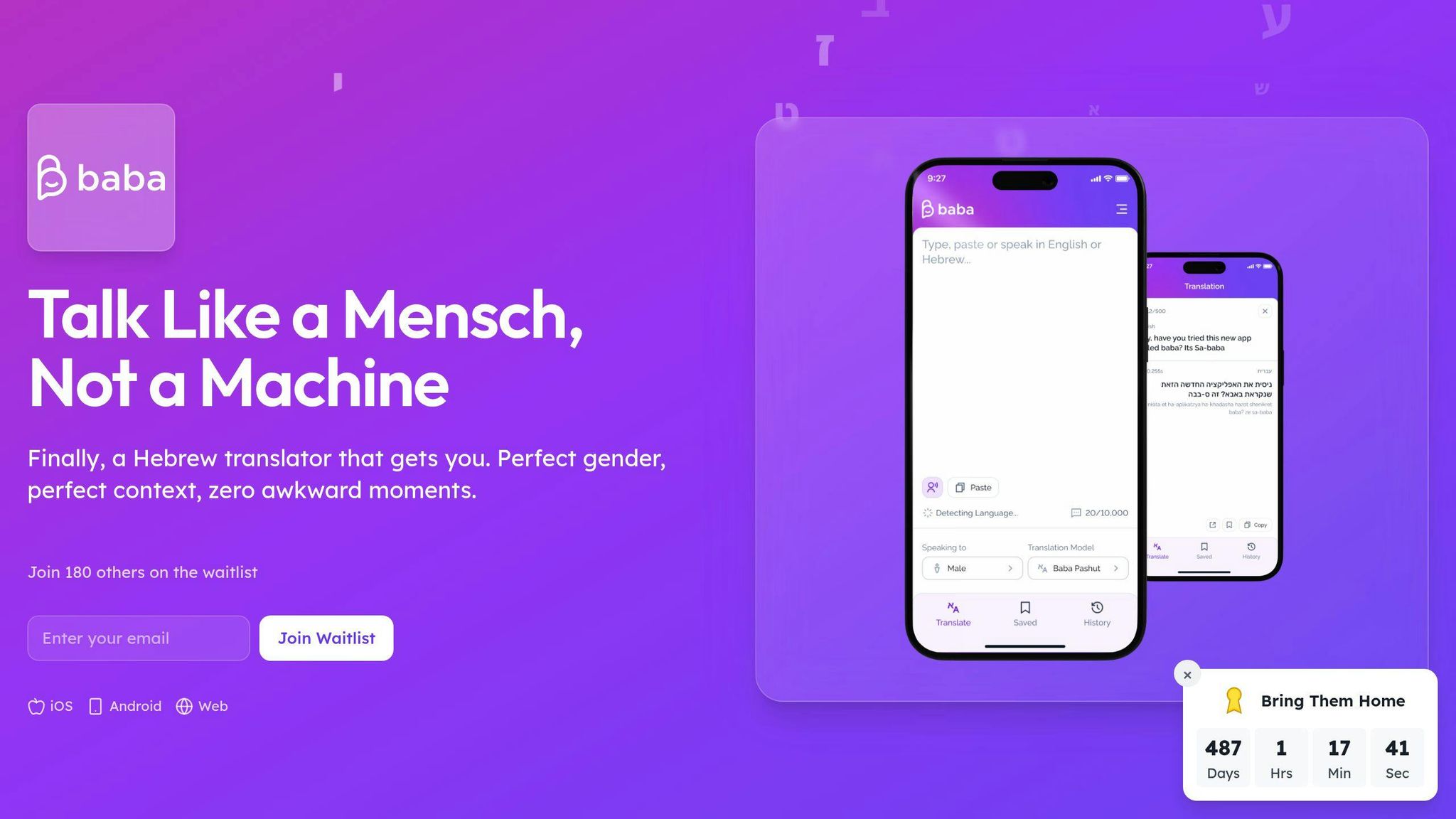
baba uses AI to tackle Hebrew's linguistic complexities, making workplace communication smoother and more accurate.
| Feature | How It Helps at Work |
|---|---|
| Smart Gender & Context | Ensures correct forms and respects cultural nuances |
| Real-time Translation | Provides instant, accurate translations for meetings and discussions |
| Professional Terms | Handles industry-specific jargon with precision |
"The use of specialized translation tools can lead to improved employee engagement and productivity, particularly in companies where accurate Hebrew communication is essential for daily operations."
Pairing baba with active learning strategies can help you improve your Hebrew skills faster.
Hebrew Learning Tools
To go beyond translation and build a solid foundation in Hebrew, structured learning resources are essential.
| Tool Type | Examples | Ideal For |
|---|---|---|
| Language Apps | Duolingo | Quick, daily practice |
| Professional Courses | Rosetta Stone | Systematic learning |
| Interactive Platforms | Babbel | Expanding business vocabulary |
| Immersive Programs | Ulpan | Full immersion in the language |
Here are some practical ways to improve:
- Connect with language exchange partners through platforms like italki.
- Join Hebrew conversation groups in your area.
- Take professional courses or participate in workplace language exchanges.
- Attend cultural events with your colleagues to practice in a relaxed setting.
Some Israeli companies even offer language training programs. Check with your HR department to see if any options are available to help you sharpen your Hebrew skills at work.
