Text Analysis with Machine Learning
Machine learning is transforming the way researchers analyze historical Hebrew manuscripts. It goes beyond basic character recognition, offering a deeper look into linguistic patterns and contextual meanings.
Neural Networks for Hebrew Text
AI-powered tools like neural networks are enhancing the study of historical Hebrew texts. Here’s how different types of networks contribute:
- Convolutional Networks: Focus on visual details, identifying calligraphic differences and unique handwriting styles.
- Recurrent Networks: Analyze sequences to understand how words relate to each other in context.
- Attention Mechanisms: Pinpoint crucial text segments, simplifying the study of ancient Hebrew grammar.
By working together, these technologies provide a multi-layered analysis of historical texts, with each type of network offering unique insights.
Building Hebrew Text Datasets
Developing training datasets for Hebrew-focused AI systems comes with its own set of challenges:
- Source Material: Includes digitized manuscripts, annotated transcriptions by experts, and multiple versions of texts.
- Data Preparation: Involves segmenting characters, labeling them in context, and validating the data to fix mistakes.
The quality and variety of these datasets are critical. Researchers carefully curate content from different historical periods and writing styles to ensure balanced coverage. Once these datasets are in place, machine learning can reveal even more about text patterns and meanings.
Machine Learning Uses in Text Study
Machine learning has opened up new possibilities for analyzing Hebrew texts, including:
- Pattern Recognition: Identifying regional writing differences, unique scribal habits, and matching separate text fragments.
- Content Analysis: Reconstructing damaged portions of texts, spotting parallels between manuscripts, and tracing linguistic changes over time.
These tools not only speed up historical research but also maintain the accuracy and depth required for scholarly work. By combining traditional philological methods with machine learning, researchers gain powerful new ways to explore and understand ancient Hebrew manuscripts. As these technologies improve, they continue to offer more advanced tools for manuscript studies.
sbb-itb-7e51dcc
AI Translation of Ancient Texts
AI technology has moved beyond just recognizing ancient scripts - it’s now capable of translating them for today’s readers.
When it comes to ancient Hebrew texts, this process requires AI systems that understand both historical and modern versions of the language.
Turning Historical Hebrew into Modern Hebrew
Translating ancient Hebrew texts involves several steps:
- Digitization: Fragile manuscripts are transformed into digital formats using AI tools.
- Context Analysis: AI evaluates how words were used and understood in their historical context.
- Semantic Mapping: Neural networks link ancient terms to their modern counterparts.
Tackling Hebrew’s Linguistic Challenges
Hebrew’s grammar and structure bring specific hurdles for AI translation. Here’s how AI addresses them:
| Feature |
How AI Handles It |
| Gender System |
Algorithms identify gender based on context clues. |
| Plural Forms |
Neural networks study patterns to apply correct pluralization. |
| Verb Conjugation |
Machine learning adapts historical conjugations to modern usage. |
| Root-Based Words |
AI detects root patterns to ensure accurate meaning. |
By incorporating these strategies, AI systems can retain the unique features of Hebrew while improving translation quality through expert-reviewed learning.
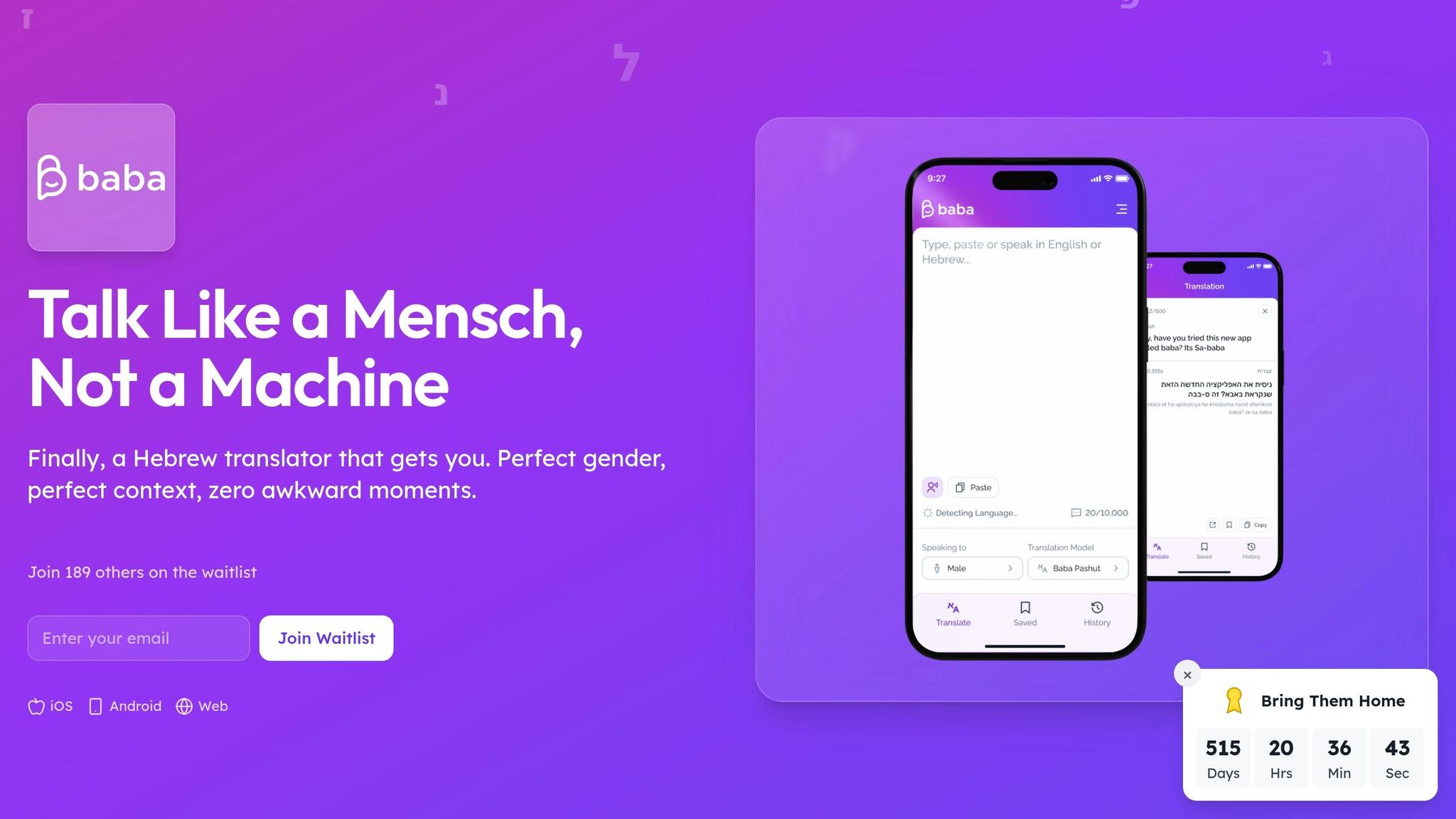
The baba platform is a standout example of AI-driven Hebrew translation. It excels in handling Hebrew’s complexities, such as gender distinctions, plural forms, and cultural nuances, while ensuring professional-level accuracy.
baba bridges the gap between ancient and modern Hebrew, making historical texts more accessible for researchers and everyday users alike. Whether you’re diving into academic studies or need reliable translations, baba showcases how AI can bring Hebrew’s rich history into the present.
Want early access? Join the waitlist for baba’s mobile app at www.itsbaba.com.
Next Steps and Ethics
Current AI Challenges
AI faces difficulties when dealing with manuscripts that are heavily damaged, missing characters, or only partially legible. Some of the main obstacles include:
- Understanding references tied to specific historical or cultural contexts.
- Deciphering regional script variations that lack standardization.
- Processing texts that mix Hebrew with Aramaic or other ancient languages.
Advances in Research
Researchers are actively working to address these limitations. Recent developments include:
- Enhanced image preprocessing techniques for handling damaged manuscripts.
- Multi-layered neural networks trained on a wide range of historical texts.
- Context-aware algorithms designed to account for conventions from specific time periods.
At the same time, ethical considerations are becoming a central focus in the field of text preservation.
Ethical Considerations in AI Text Preservation
Preserving historical Hebrew texts through AI brings up important ethical questions. Institutions are encouraged to tackle issues like:
| Ethical Concern |
Suggested Approach |
| Data Ownership |
Develop clear guidelines for manuscript rights and access. |
| Cultural Heritage |
Honor the religious and cultural importance of each manuscript. |
| Preservation |
Ensure original documents are preserved alongside their digital counterparts. |
| Access Rights |
Find a balance between academic access and respect for community sensitivities. |
As AI continues to transform the study of Hebrew texts, it's essential to combine technological progress with thoughtful ethical practices.
Conclusion: AI's Impact on Hebrew Studies
Key Takeaways
AI has transformed how historical Hebrew manuscripts are preserved and studied. With advanced OCR systems achieving high accuracy for well-preserved texts and neural networks handling complex Hebrew scripts, AI has made text preservation and analysis more efficient.
Here’s how AI has made a difference in Hebrew studies:
| Area |
Contribution |
| Text Recognition |
Better processing of damaged or faded manuscripts |
| Language Processing |
Improved insights into historical Hebrew language variants |
| Preservation |
Digital archiving with detailed character-level accuracy |
From analyzing ancient manuscripts to enabling modern translation, AI's role in Hebrew textual studies continues to grow.
baba and Modern Translation
Modern tools like baba are taking these advancements further. baba leverages AI to tackle Hebrew's gender rules, ensure culturally relevant translations, and preserve context in both professional and casual settings. This is a prime example of how AI bridges historical scholarship with modern communication needs.
Want to explore the latest in AI-powered Hebrew translation? Join the waitlist for baba's mobile app at www.itsbaba.com.
Frequently Asked Questions
How does AI handle Hebrew's missing vowels when reading ancient texts?
Because many historical Hebrew manuscripts were written without niqqud (vowel markings), AI systems rely on contextual analysis—looking at surrounding words and grammar patterns to infer the correct pronunciation and meaning. This is similar to how a fluent reader fills in gaps from experience, but applied at scale across thousands of manuscript pages.
Can AI accurately read damaged or incomplete Hebrew manuscripts?
AI can reconstruct partially legible texts using enhanced image preprocessing and context-aware neural networks trained on a wide range of historical documents, but heavily damaged manuscripts still present real limits—missing characters and obscure cultural references remain the hardest cases to crack.
Why is Hebrew so difficult for standard OCR tools to process?
Hebrew reads right-to-left, uses a root-based word system, and has centuries of regional calligraphic variation—all of which trip up OCR systems built for Latin-script languages. Historical texts add another layer of complexity because script styles, abbreviations, and mixed-language passages (like Hebrew mixed with Aramaic) don't follow modern conventions.
How does AI translate ancient Hebrew into a form modern readers can understand?
AI systems use semantic mapping—neural networks that link archaic terms to their modern Hebrew equivalents—alongside context analysis that accounts for how words were used in their original historical setting, not just their dictionary definitions.
What ethical issues come up when AI is used to digitize sacred or culturally sensitive Hebrew manuscripts?
Key concerns include who holds rights to digitized manuscripts, how to honor the religious significance of texts like Torah scrolls or Dead Sea fragments, and how to balance open academic access with the expectations of Jewish communities who consider these documents part of living heritage—not just historical artifacts.