
Hebrew AI Research: Academia Meets Industry
Israel is leading the way in Hebrew AI research, combining academic expertise and industry innovation to tackle unique challenges like Hebrew's complex language structure. Here's a quick overview:
- Academic Contributions: Institutions like the Technion and Hebrew University are producing cutting-edge AI research, with thousands of patents and spin-offs.
- Industry Partnerships: Companies like Meta and IBM are collaborating with universities to advance natural language processing (NLP), drug development, and cloud infrastructure.
- Major Projects: Initiatives include Hebrew NLP tools, medical language models, and advanced translation systems like baba, which addresses Hebrew's gender and context nuances.
- Economic Impact: AI startups now make up 25% of Israel's tech market, with a projected market size of $4.6 billion by 2030.
- Future Directions: Efforts focus on improving Hebrew language models, restoring ancient texts, and developing efficient AI applications.
These collaborations are transforming industries like healthcare, finance, and public services while solidifying Israel's global standing in AI innovation.
AI R&D in Various National Programs – A World Review
Major Research Projects
Israeli academia and industry partnerships are advancing Hebrew AI research, addressing the language's unique complexities.
Hebrew NLP Progress
Researchers in Israel are tackling the intricate challenges of Hebrew natural language processing (NLP), particularly its morphologically rich structure. Tools like the ONLPsuite - a morpho-syntactic parsing framework - help decode Hebrew's complexities. For instance, a single token like 'הקפה' can have multiple meanings depending on context.
The Israel Innovation Authority has allocated 30 million NIS ($8.2 million) to support 17 projects focusing on Hebrew and Arabic language models [3]. Key initiatives include:
- Verbit's Clinical AI: Designed for transcription and summarization in medical settings.
- Briya's Medical Language Model: Built in collaboration with Assuta Ashdod Hospital and Sourasky Medical Center Tel Aviv.
- Sheba Impact's Clinical BERT: A language model trained on over 100 million medical records [3].
These efforts are paving the way for advancements in voice recognition and translation systems.
Voice and Translation Systems
Progress in Hebrew voice and translation technology highlights the practical applications of academic research.
Prof. Sara Cohen, dean of the Hebrew University's School of Computer Science and Engineering, explains the dual benefits of these developments:
"This partnership offers our students a unique opportunity to experience the world of research and development from two perspectives: a research perspective that enables experimentation, innovation, and breakthroughs, and an implementation perspective, which will give them an understanding of the real-world impact of their research." [2]
These advancements are making an impact across industries:
| Industry | Application | Impact |
|---|---|---|
| Healthcare | Semantic analysis | Enhanced patient experiences |
| Finance | Market sentiment analysis | Real-time investment insights |
| Public Services | Feedback analysis | Better service delivery |
In translation, innovative solutions are addressing Hebrew's complex gender system and contextual nuances. For example, baba uses advanced gender detection and context awareness to provide culturally accurate translations. Interested users can join the waitlist for their mobile app at www.itsbaba.com.
As Prof. Koby Rubinstein, Executive Vice President for Research at the Technion, highlights:
"In recent years, the Technion has been conducting in-depth and extensive activity in AI in a variety of fields. The collaboration with IBM, which will be led by researchers engaged in the field, will be a force multiplier for research and development in the field." [1]
baba Translation System Overview
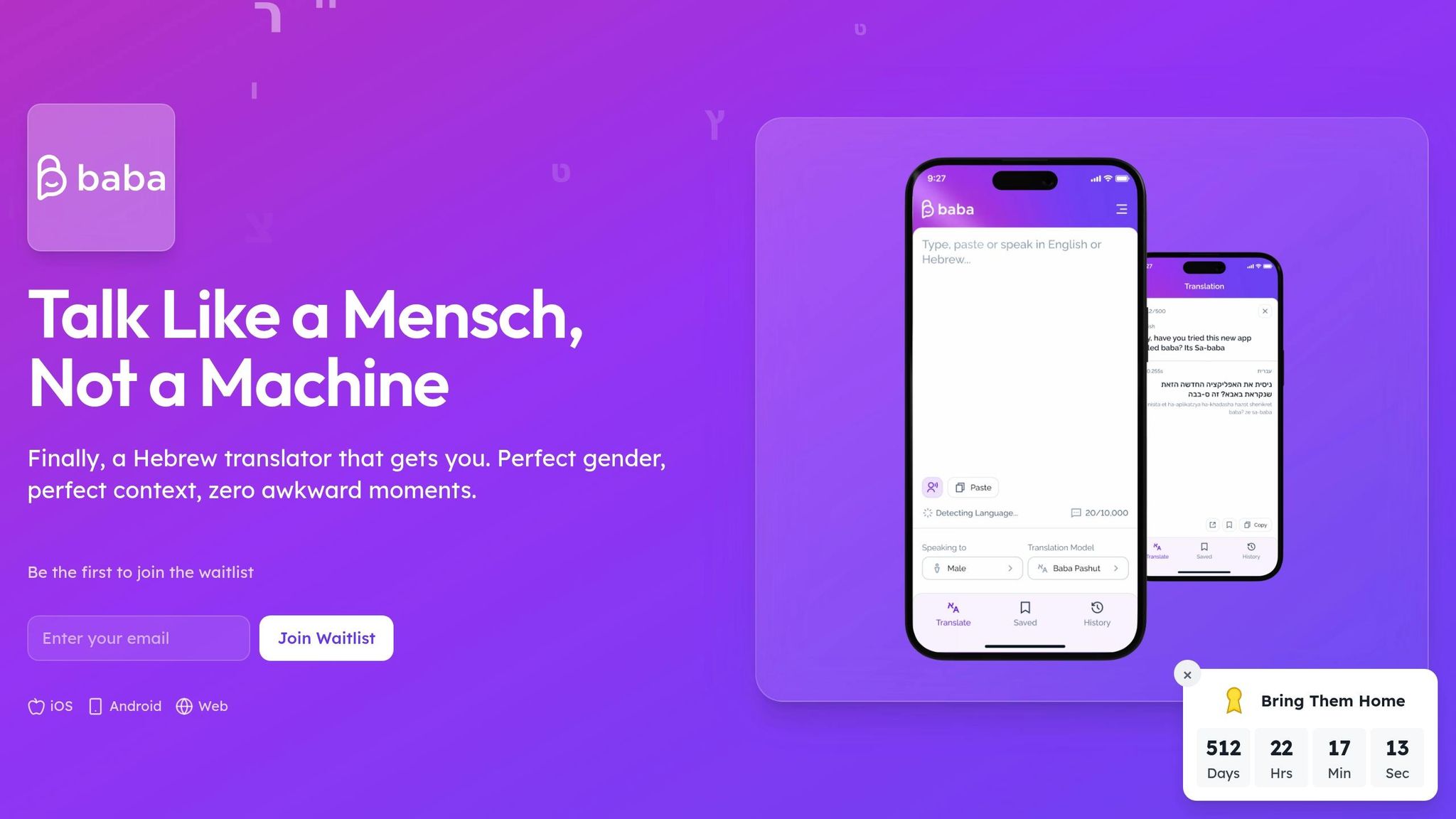
baba tackles the unique challenges of Hebrew translation by combining AI and advancements in Hebrew natural language processing (NLP).
Core Technology
baba's translation engine blends advanced linguistic models with insights into Israeli culture. Its proprietary algorithm is tailored to handle Hebrew's gender system [5]. Key features include:
| Feature | Technical Capability | Research Application |
|---|---|---|
| Smart Gender Recognition | Analyzes speaker and recipient gender in real-time | Improves morphological parsing |
| Context Awareness | Adjusts to formal and informal contexts | Advances semantic understanding |
| Cultural Intelligence | Incorporates Israeli social norms | Supports studies in cross-cultural communication |
The system is built to handle Hebrew's intricate morphology, achieving accuracy where traditional tokenization often fails. These capabilities make it suitable for various practical applications, as outlined below.
Usage Examples
baba serves a wide range of needs across different fields:
-
Business Communication
- Real-time translations for international meetings
- Localization of professional documents
- Context-sensitive customer support
-
Educational Settings
- Language learning tools with personalized feedback
- Accurate translations for academic materials
- Support for cultural exchange programs
-
Personal Communication
- Translations for social interactions with attention to gender and plurality
Mobile App Registration
baba is launching a mobile app to bring its advanced features - such as real-time translation, gender detection, and professional communication tools - directly to users' devices. Be among the first to experience it by joining the waitlist at www.itsbaba.com.
sbb-itb-7e51dcc
Research Effects on Tech Sector
Collaboration between academia and the tech industry in Hebrew AI has fueled rapid expansion in Israel's tech sector. AI startups now account for 25% of the market and draw in 47% of all tech-related investments [6].
Business Growth Data
Hebrew AI research has driven economic growth across several key areas:
| Metric | Current Value | Projected Growth |
|---|---|---|
| Market Size (2026) | US$1.36 billion | US$4.60 billion by 2030 |
| Annual Growth Rate | 27.63% CAGR | Through 2030 |
| AI Companies | 850 active firms | 47 successful exits in 2026 |
| Investment Share | 47% of tech funding | Ranked 4th globally |
One standout example is Nvidia's 2026 acquisition of Run:AI for US$700 million [7]. Additionally, the government's National AI Program, launched in summer 2023 with a ₪500 million (around US$133 million) budget, aims to modernize operations across multiple ministries [8]. These figures highlight how Hebrew AI is reshaping Israel's tech landscape.
International Standing
Backed by these strong economic indicators, Israel has secured a top spot in applied AI innovation globally. Industry experts point to the country's unique advantages:
"Israel's tech advantage lies in its roots in the military, where young engineers are imbued with the culture of doing more with less… Faced with immediate threats to their family and community, they learn to cut corners and move fast because the stakes are so high… Israeli startups have started to figure out significant optimization and cost efficiencies, with major price reductions that will allow AI to scale and reach its promise."
– Jonathan Medved, CEO of OurCrowd [9]
Israel's global standing is further reinforced by:
- Global Rankings: As of 2026, Israel ranks first worldwide in AI talent concentration [9].
- Acquisition Trends: From 2014 to 2023, multinational corporations acquired one Israeli AI startup for every four U.S. acquisitions [9].
- Skill Development: Between 2015 and 2023, Israel's AI skill penetration rate was 1.63 times the global average [9].
"Israel's AI ecosystem stands out as a global innovator with its unique combination of applied AI focus, cross-industry expertise, and a thriving network of academia, startups, and multinational corporations."
– Arik Kol, Head of Nvidia Inception Startups Program at Nvidia Israel [9]
The success of Mobileye, founded by Prof. Amnon Shashua, underscores the impactful results of academic and industry partnerships [6].
