Ultimate Guide to Conversational Hebrew for Travelers
Planning a trip to Israel? Even though many Israelis speak English, learning basic Hebrew can make your experience smoother and more enjoyable. Here's why:
- Connect with locals: Simple phrases like "Shalom" (Hello) or "Toda" (Thank you) show effort and can spark friendly interactions.
- Navigate easily: Understand street signs, bus routes, and menus in Hebrew.
- Order food confidently: Tackle local restaurants and markets without hesitation.
- Handle emergencies: Essential phrases can be lifesavers.
Quick Tips:
- Hebrew reads right to left.
- Words often skip written vowels.
- Politeness matters: Start with "Slicha" (Excuse me) when asking for help.
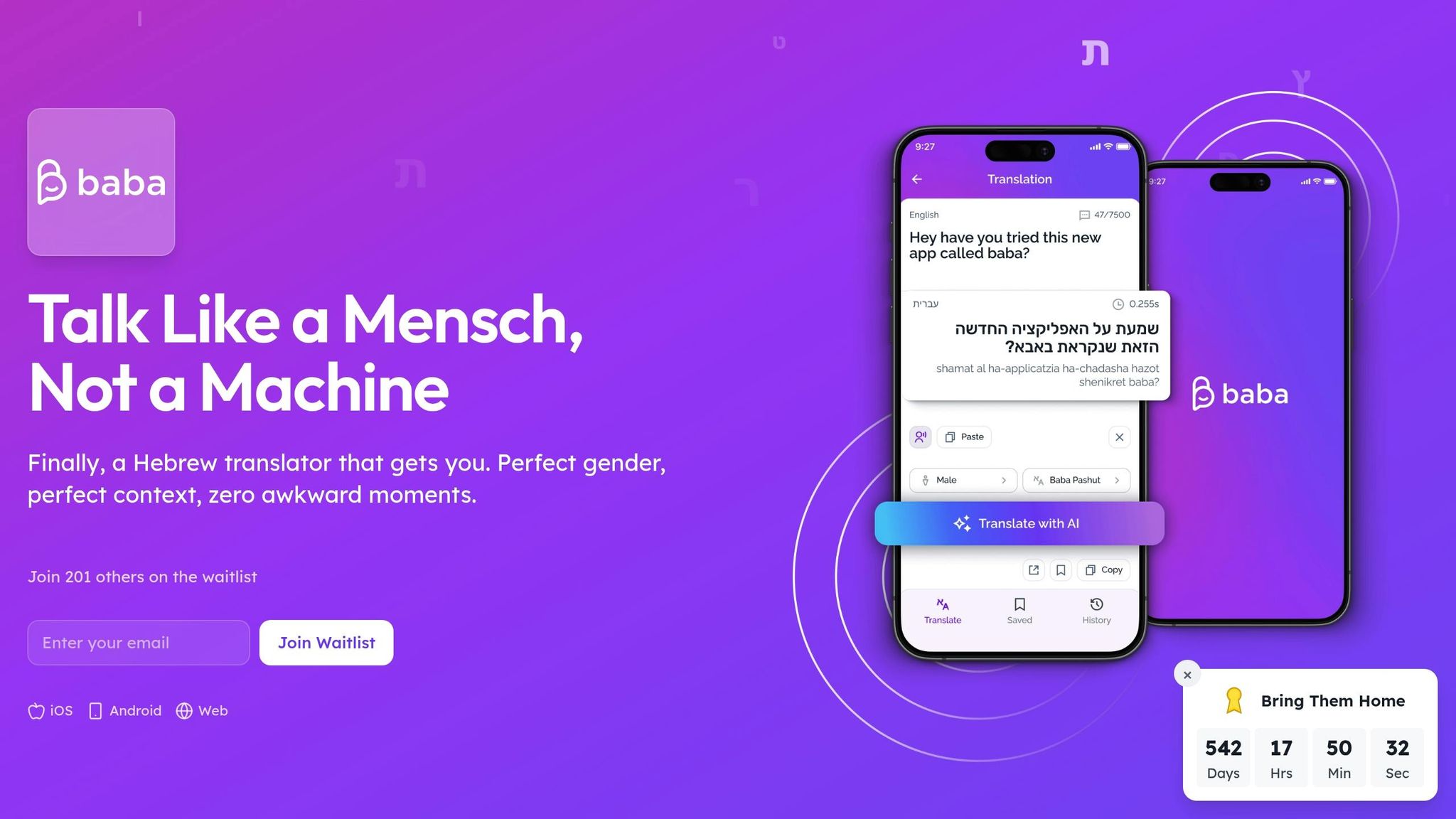
Learn greetings, navigation phrases, and restaurant terms to make your trip stress-free. Practice daily and use tools like the baba app for real-time translation and pronunciation help. Sign up at www.itsbaba.com to get started!
Hebrew for Travelers: Essential Phrases for Your Israel Trip
Must-Know Hebrew Phrases
Learn these handy Hebrew phrases to navigate everyday travel situations with ease.
Basic Greetings
Start off on the right foot with these useful greetings:
| Hebrew | Pronunciation | English | Notes |
|---|---|---|---|
| שלום | sha-LOM | Hello/Goodbye | A universal greeting |
| בוקר טוב | BO-ker tov | Good morning | Used until around noon |
| ערב טוב | E-rev tov | Good evening | Used after sunset |
| תודה | to-DA | Thank you | Add רבה (ra-BA) for "thank you very much" |
| סליחה | sli-CHA | Excuse me/Sorry | Great for getting attention or apologizing |
| מה שלומך | ma shlo-MECH (f) / ma shlo-MHA (m) | How are you? | Adjust based on the person’s gender |
Now, let's move on to phrases that will help you find your way.
Navigation Phrases
- איפה...? (EY-fo) – "Where is…?"
- לאן...? (le-AN) – "To where…?"
- ישר (ya-SHAR) – "Straight ahead"
- ימינה (ya-MI-na) – "Right"
- שמאלה (SMO-la) – "Left"
- כמה זה עולה? (ka-MA ze o-LE) – "How much does it cost?"
When asking for directions, it’s polite to start with סליחה (sli-CHA).
Restaurant Hebrew
Dining out? These phrases will come in handy:
| Situation | Hebrew | Pronunciation | English |
|---|---|---|---|
| Ordering | אני רוצה | a-NI ro-TSE | I want |
| Asking for a menu | תפריט בבקשה | taf-RIT be-va-ka-SHA | Menu, please |
| Dietary needs | אני צמחוני/ת | a-NI tzim-cho-NI/NIT | I'm vegetarian |
| Asking for the bill | חשבון בבקשה | chesh-BON be-va-ka-SHA | Check, please |
| Water | מים | MA-yim | Water |
| Without | בלי | bli | Without |
Before eating, say בתיאבון (be-te-a-VON) to wish everyone a good meal. These phrases will make your dining experience smoother and more enjoyable.
Want more? Join the waitlist for our mobile app at www.itsbaba.com.
Hebrew Pronunciation Guide
Once you've learned some basic phrases, improving your pronunciation takes your Hebrew skills to the next level. Clear pronunciation helps you connect and communicate more effectively. Let’s break it down.
Hebrew Letters and Sounds
The Hebrew alphabet has 22 letters and is read from right to left. Each letter represents a consonant sound. Here are a few key examples:
| Letter | Name | Sound | Example |
|---|---|---|---|
| א | Alef | Silent | אבא (a-BA) - father |
| ב | Bet | B/V | בוקר (BO-ker) - morning |
| ל | Lamed | L | לילה (LAI-la) - night |
| מ | Mem | M | מים (MA-yim) - water |
| ר | Resh | R | רחוב (re-CHOV) - street |
Hebrew vowels are shown as dots or lines placed around the letters. In modern Hebrew, these markings are often left out, and readers rely on context to figure out the vowel sounds.
Now, let’s look at some sounds that might be tricky for beginners.
Tricky Sounds in Hebrew
Here are a few sounds that can be challenging for English speakers:
Guttural Sounds
- ח (chet): Similar to the "ch" in Bach.
- ע (ayin): A deeper sound from the throat.
- ר (resh): A rolled R, similar to the French R.
Stress and Emphasis
Hebrew typically emphasizes the final syllable of a word. For example, sha-LOM (peace).
Understanding these nuances will help you sound more natural when speaking Hebrew.
Speaking Practice
Here’s how to practice:
- Start with short, simple words like שָׁלוֹם (sha-LOM). Gradually move on to longer ones like לְהִתְרָאוֹת (le-hit-ra-OT).
- Practice distinguishing similar sounds, such as כ/ח (khet/khaf) and ב/ו (bet/vet).
- Listen to native speakers and imitate their intonation and rhythm.
Ready to refine your Hebrew pronunciation even further? Join the waitlist for our mobile app at www.itsbaba.com to access interactive exercises and get real-time feedback!