Cited pages document speaking practice for three Hebrew AI tutor apps, but not 2026 launches. Test corrections and check cost before paying.
Which new Hebrew AI tutors are worth trying?
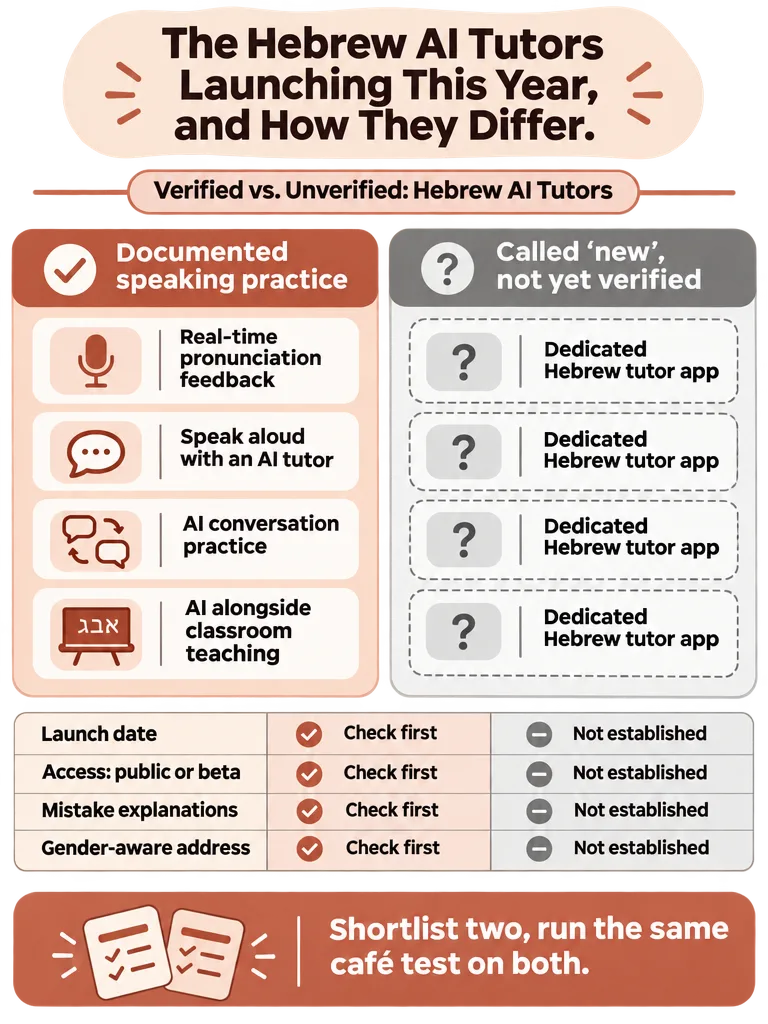
Rehearse a café order aloud with Leyo, Fluently, or Memrise, using phrases from your own lessons, and see which one keeps the conversation going. All three have documented speaking practice, but none of the cited pages confirms a 2026 launch, so the label "new Hebrew AI tutor apps" is unconfirmed for each. Test before paying.
Here is what the pages say. Leyo's Hebrew page advertises an AI tutor with real-time pronunciation feedback. Fluently's Hebrew page describes a speaking app where you talk aloud with an AI tutor in modern Israeli Hebrew and get a response. Memrise's Hebrew page advertises unlimited AI conversation practice. None of these pages states how accurate the feedback is or what a paid plan costs. Judge each on three things: the speaking practice itself, how mistakes are handled, and cost.
Which Hebrew AI tutors are actually new this year?
No cited page gives a verified 2026 launch date for Israelingo, Ivritly, Safa, Naama, Leyo, Fluently, or Memrise. The table separates what the pages document from what they leave open. This guide is published November 23, 2026, and the cited pages do not confirm whether each tutor is public or in beta.
Tutor
What the cited pages document
Verified 2026 launch date
Access status
Israelingo
Listed as a dedicated Hebrew tutor; no features documented
Unverified
Unconfirmed
Ivritly
Listed as a dedicated Hebrew tutor; no features documented
Unverified
Unconfirmed
Safa
Listed as a dedicated Hebrew tutor; no features documented
Unverified
Unconfirmed
Naama
Listed as a dedicated Hebrew tutor; no features documented
Unverified
Unconfirmed
Leyo
AI tutor with real-time pronunciation feedback, per its Hebrew page
Unverified
Public page exists; access unconfirmed
Fluently
Speaking app: talk aloud with an AI tutor in modern Israeli Hebrew
Unverified
Unconfirmed
Memrise
AI conversation practice, per its Hebrew page
Unverified
Public page exists; access unconfirmed
The four dedicated tutors have no official page or store listing among the cited sources, so a name alone is not evidence of a launch. Before spending time on any of them, look for a release date and whether the app is open to everyone or in beta on the app's own site or store listing. For more detail on individual apps, see this comparison of Hebrew AI tutors.
How do the Hebrew AI tutors differ in approach?
Leyo, Fluently, Memrise, and Ulpan Integraliah all advertise AI for Hebrew learning, and their advertised features overlap more than they separate. Three are speaking tools, and one is a ulpan that adds AI to conventional teaching. The table lists what each page says, not how well it works.
Tutor
What its page advertises
Worth checking
Leyo
AI tutor with real-time pronunciation feedback
Whether the feedback holds up; accuracy is not established
Fluently
Speaking aloud with an AI tutor in modern Israeli Hebrew, with a response
How the AI fits into the course; the page excerpt gives no format details
Ulpan Integraliah is a different kind of option from the three tutor apps, so compare it on how AI is added to teaching, not as a standalone tutor.
The cited pages say nothing comparable about correction explanations, grammatical gender handling, or reviewing mistakes later. Check those yourself in any tool, whether a dedicated tutor or a general assistant. Look for a lesson structure, explanations when you're corrected, and a way to review mistakes. One guide on learning Hebrew with a general assistant compares an assistant, a tutor app, and a teacher on the same café scene.
How can you test a Hebrew AI tutor in five minutes?
A five-minute test of any Hebrew AI tutor runs one café scene and checks five things: unscripted replies, grammatical gender, correction explanations, mistake review, and pronunciation feedback. Order a coffee, ask for something to be repeated, then go off script. Use phrases from your own lessons or a teacher, and run the identical scene in every app you shortlist.
Try an unscripted reply. Say something the lesson didn't prompt. This shows whether the tutor responds to what you said or only to a fixed line, which matters if you freeze in open conversation.
Check grammatical-gender handling. Tell the tutor who you are and who you're addressing, then see whether its Hebrew matches those genders. This shows whether gender is handled in context or ignored.
Review a deliberate mistake. Make an error on purpose. The tutor either explains the correction or just supplies the right sentence, and you can see which.
Look for a way to save it. Check whether you can save the mistake and come back to it tomorrow. This shows whether review is built in.
Run a pronunciation consistency check. Say a phrase once carefully and once sloppily, then compare the feedback. This is exploratory only, and a changing score is not proof of accuracy. Check any disputed feedback with a qualified teacher or a trusted speaker.
Pay for a Hebrew AI tutor app only after a free trial or speaking allowance, if one exists, shows it does something your current routine doesn't. Check what the trial includes, then compare usage allowances and cancellation terms on the app's own page. The cited pages give no dated prices, caps, or cancellation terms, so this guide quotes no figures.
A thread in r/hebrew asks the same question: has anyone recently tried AI language apps that include Hebrew and found them worth the money?
Use this rule:
Check whether the app offers a free trial or speaking allowance, and what it includes, before running the five-minute test. A roundup of free Hebrew apps compares free tiers for listening, vocabulary, and conversation.
Before subscribing, read the current allowance and cancellation terms, and write down the date.
Pay for one app at a time, and only if it fixes a problem you can name, such as freezing or never reviewing mistakes.
Where does baba Learn fit, and what should you know before trying it?
baba Learn is a speaking app for adults learning modern Israeli Hebrew, aimed at people who know words from reading or flashcards but freeze when talking. It is in private beta as of November 23, 2026, so it is not open to everyone.
Maya and David are the AI tutors, and the interface is in English. The app includes role-plays, Read and Talk, and Free Talk. Hebrew appears with nikud and optional English or transliteration. The app addresses you by grammatical gender, explains corrections, and offers sound-level pronunciation practice. You can save mistakes to My Cards for review. A related guide covers rehearsing a conversation before you need it with role-play.
On eligibility and privacy, Baba states that the app is for adults 18 and older and that recordings are kept for 30 days to check a score, then deleted. These are Baba's own statements, not an independently checked store age rating or privacy policy.
Know the limits. Feedback can be wrong, and word stress is not scored. It is not a complete accredited course and does not guarantee fluency.
How do you choose between Hebrew AI tutors?
Choose a Hebrew AI tutor by matching your main need to a documented feature, then testing two apps the same way: pronunciation feedback (Leyo), back-and-forth conversation (Fluently, Memrise), or AI alongside a class (Ulpan Integraliah). The cited pages support no single winner, so the decision comes from your own trial. Use this checklist:
Main need. Pronunciation feedback points to Leyo. Spoken conversation points to Fluently or Memrise. AI alongside a class or teacher points to Ulpan Integraliah.
What you can test free. If you can't try the speaking practice before paying, weigh that against the cost.
Privacy and age terms. baba Learn states 18+ and 30-day recording retention. The cited pages say nothing on competitors' retention or deletion, so read each app's terms.
Verified availability today. Confirm the app is open to the public on your device and in your country, not just announced or in beta.
Mistake handling. Prefer a tutor that explains corrections and lets you save and revisit them.
Frequently asked questions
What is the best AI for learning Hebrew?
No single AI tutor comes out as the best, so match one to your main need and test two the same way. Leyo advertises real-time pronunciation feedback, Fluently and Memrise advertise spoken conversation practice, and Ulpan Integraliah blends AI into conventional teaching. Run the same café scene in each before paying.
How do I avoid wasting money on an AI Hebrew learning app?
Use the free trial or speaking allowance first, if the app offers one, and pay only if it fixes a problem you can name, such as freezing mid-conversation or never reviewing mistakes. The Leyo, Fluently, and Memrise pages state no prices, so read the current allowance and cancellation terms and note the date.
How can I tell if an AI Hebrew tutor uses the right grammatical gender?
Tell the tutor who you are and who you're speaking to, then check whether its Hebrew verbs and adjectives match those genders. Hebrew changes these forms depending on who is speaking and who is listening. The cited Leyo, Fluently, and Memrise pages say nothing about gender handling, so test each app yourself.
Can I trust an AI Hebrew tutor's pronunciation feedback?
Treat it as a prompt to double-check, not a verdict. Leyo's page advertises real-time pronunciation feedback but does not say how accurate it is. Say a phrase once carefully and once sloppily and compare the results. A changing score is not proof of accuracy, so confirm disputed corrections with a qualified teacher or trusted speaker.
Is baba Learn open to everyone yet?
No. baba Learn is in private beta as of November 23, 2026, so you can join the waitlist rather than download it freely. The app is for adults 18 and older, the interface is English only, and recordings are kept for 30 days to check a score, then deleted.
Can an AI tutor replace a Hebrew class?
The cited pages show no learning results for any AI Hebrew tutor, so none of them supports that claim. Ulpan Integraliah blends conventional teaching with AI rather than replacing the class. baba Learn is not a complete accredited course and does not guarantee fluency, so treat an AI tutor as speaking practice.