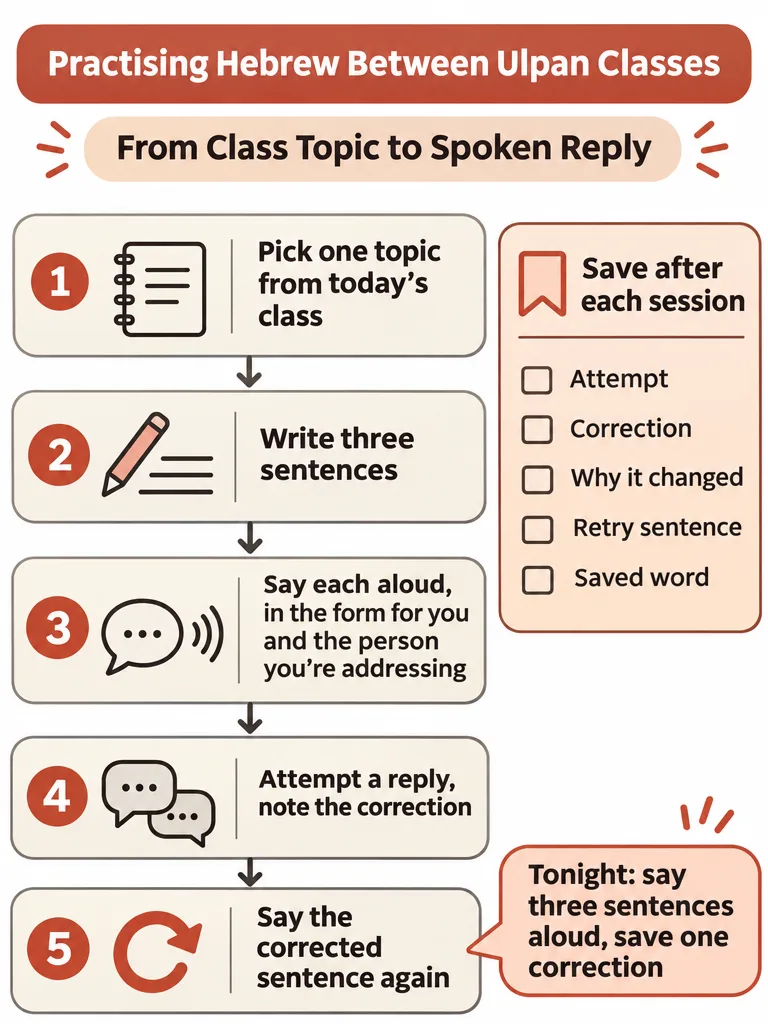
For ulpan speaking practice, say three sentences from class aloud, try a reply, then log and repeat the correction. Keep a small word bank.
How do I get more speaking practice outside ulpan?
For ulpan speaking practice between classes, reuse today's topic in short spoken exchanges, review every mistake you make, and keep a small bank of saved words. Ulpan is structured teaching, and the Peace Corps recommends pairing structured study with real conversation. Treat the extra practice as an extension of class.
Class already includes speaking. Tel Aviv University's ulpan says its courses emphasize practical communication alongside reading, writing, listening and speaking. Practice between classes extends that work by giving the Hebrew you met today more chances to be said aloud.
How can I turn today's ulpan topic into something I can say out loud?
Pick one topic from today's class, write three sentences about it, say them aloud, attempt a reply, log the correction, and say the corrected sentence again. This loop is an editorial suggestion, not a research finding. It ends with a corrected sentence you have already spoken, ready to use in class tomorrow.
Pick one topic. Choose a single thing from class, such as introducing yourself, asking for repetition, or a verb you kept missing.
Write three sentences you could use. Short is fine. Draw on the classroom Hebrew in Baba's ulpan guide. For "introducing yourself":
- אני בן / בת שלושים. ani ben / bat shloshim. (I'm thirty.)
- אני מוכן / מוכנה. ani muchan / muchana. (I'm ready.)
- לא הבנתי. lo hevanti. (I didn't understand.)
Say each one aloud in the form that matches you.Muchan is the masculine form and muchana the feminine. If a sentence is addressed to someone, use the form that fits the listener too.
Attempt a reply. Answer a question from a partner, a tutor, or yourself, then write down whatever gets corrected.
Say the corrected sentence again. Say it out loud before you move on.
Here is the loop run once. It is an illustrative exercise, not an observed learner result.
Step
Example
Prompt
Someone asks, in English, "How old are you?"
Attempt (a man speaking)
אני שלושים. ani shloshim.
Correction
אני בן שלושים. ani ben shloshim. (A woman says אני בת שלושים. ani bat shloshim.)
Why it changed
Age takes ben or bat, literally "a son of thirty" or "a daughter of thirty"
Spoken retry
Say ani ben shloshim (or ani bat shloshim) aloud, once slowly and once at talking speed
Reuse tomorrow
Put the saved word in a new sentence: היא בת שלושים. hi bat shloshim. (She's thirty.)
What can I do when I know the words but freeze when I have to answer?
Make the practice short, repeatable and out loud. Shotef's guide to practicing Hebrew speaking recommends short conversations you can repeat every day, noting that after you've said the same phrase many times, it stops feeling like a performance.
Use this checklist:
Repeat the same mini-conversations. Shotef suggests daily situations such as greeting a cashier, ordering coffee, or asking for directions. Try efshar kafe, bevakasha? (אפשר קפה, בבקשה?), "A coffee, please?"
Say it out loud, not in your head. Shotef notes that many learners understand Hebrew when reading but freeze when speaking, and its fix is to say the words aloud.
Keep rescue phrases ready. Baba's ulpan guide lists lo hevanti (לא הבנתי), "I didn't understand," and efshar lachzor al ze? (אפשר לחזור על זה?), "Could you repeat that?" Either one buys you a second try.
Stay in the conversation when a word escapes you. Shotef's advice is to use a simpler sentence, point, or describe the thing another way.
Try a retell-and-keep-going drill. This is an editorial suggestion. Read one short Hebrew paragraph, retell it in your own words, and keep talking when you stall instead of restarting.
How do I practice speaking Hebrew when I don't have a partner nearby?
Two options travel with you: an AI tutor for rehearsal and, for some learners, an online teacher. Local groups and classmates help only if they exist where you live. The Peace Corps lists meetups, conversation groups and campus language exchanges as places to make mistakes, and calls AI chat tools a low-pressure way to build confidence before talking with native speakers.
Option
Helps when no partner is nearby?
Honest trade-off
Conversation groups, meetups, language exchanges
Only if one exists near you
Real people and room to make mistakes (Peace Corps), but this article can't promise availability anywhere
Teacher or tutor
Sometimes
The Peace Corps notes volunteers often keep studying with a tutor. Baba's ulpan guide says some private ulpanim teach on Zoom, but you'll need to schedule and pay for it
AI tutor
Yes, you can speak aloud and rehearse on your own
Not a person, so feedback can be wrong. Check anything surprising with your teacher
Ulpan classmates
Only if you can meet them
Same topic, same week, but often the same level, so errors can go uncorrected
baba Learn is one AI-tutor option: a speaking app in private beta for iPhone and Android, for adults 18+, where you can bring a phrase from class into a conversation with Maya or David and get explanations, corrections and saved practice. It supplements a course or teacher and doesn't replace one.
What should I save after each practice session?
Save two things: a correction log and a small vocabulary bank. The log holds your attempt, the correction, why it changed, and a retry sentence you say aloud. The bank holds each new word with a context sentence, a pronunciation note and its gender form, following the Peace Corps advice to record new words, context and pronunciation.
Correction log
Attempt
Correction
Why it changed
Retry sentence
אני שלושים. ani shloshim.
אני בן / בת שלושים. ani ben / bat shloshim.
Age takes ben or bat
אני בן שלושים. ani ben shloshim. (a woman: ani bat shloshim)
אני יש מכונית. ani yesh mechonit.
יש לי מכונית. yesh li mechonit.
Hebrew says "there is to me" here
יש לי שיעורי בית. yesh li shiurei bayit.
Vocabulary bank, one filled entry
Word
Context sentence
Pronunciation note
Gender form
בן / בת ben / bat
אני בן שלושים. / אני בת שלושים.
Say it from the transliteration, then jot down any sound your teacher corrects
ben (masculine), bat (feminine)
Shotef's "speaking bank" keeps the list small and personal: phrases you actually use, such as ani lo mevin / mevina (אני לא מבין / מבינה), "I don't understand." Read each retry sentence aloud before your next session, and use each saved word in one new sentence, as with hi bat shloshim above.
How do I practice masculine and feminine forms when I speak?
Hebrew grammatical gender changes forms such as "I'm ready" and "I'm thirty," so say each sentence in the form that matches you as the speaker and, where it applies, the person you're addressing. Baba's ulpan guide lists the male form first and the female second wherever they differ. Baba's learning hub frames the habit as noticing who is speaking, and to whom.
English
Hebrew
Say it
I'm ready.
אני מוכן / מוכנה
ani muchan / muchana
I'm thirty.
אני בן / בת שלושים
ani ben / bat shloshim
Is it masculine or feminine?
זה זכר או נקבה?
ze zachar o nekeva?
Teacher
מורה
more (man) / mora (woman), same spelling
Drill each row three times: the masculine form, the feminine form, then the one that is true for you. Ask ze zachar o nekeva? about a new word you've just learned, which is also a question you can put to your teacher. When your teacher corrects a gender form, add it to the correction log from the previous section, with the form that fits you as the retry sentence.
How much extra speaking practice is enough between classes?
Extra Hebrew speaking practice can be short. The Peace Corps says consistency trumps intensity and that even 20 to 30 minutes a day builds fluency more effectively than marathon study sessions. That is general language-learning advice, not a validated Hebrew dose, and no source gives a guaranteed proficiency timeline.
Here is one light weekly rhythm. It's an editorial suggestion, not a research finding:
A few days a week: say three sentences from that day's class aloud.
Once or twice a week: do one retell or mini-conversation with a person, tutor or app.
Once a week: reread your correction log and say each retry sentence again.
Shotef publishes a heavier example, with Hebrew sentences daily and a short real conversation three times a week, if you want something more intense.
Ulpan formats vary. Baba's ulpan guide describes a standard subsidized public course as five months, five days a week, five hours a day, while Tel Aviv University runs four-week intensive programs. Either way, extra practice adds speaking repetitions on top of class. Baba's learning hub puts it plainly: progress depends on your starting point, the skills you practice and the support you use.
Tonight, save one correction. At your next class, say the corrected sentence aloud to your teacher or a classmate.
Frequently asked questions
How long does it take to learn Hebrew?
There is no reliable fixed timeline, because progress depends on your starting point, the skills you practice and the support you use. Pick a concrete next goal, such as reading a menu or holding a short conversation, and let it decide what you study next. The Peace Corps advises that consistency trumps intensity, with even 20 to 30 minutes a day helping.
How long does ulpan last?
A standard subsidized ulpan for new immigrants runs about five months, five days a week, five hours a day. Formats vary: Tel Aviv University runs four-week intensive Hebrew programs in summer and winter, plus semester-long courses in fall and spring that meet Monday through Thursday, 8:30 to 10:00 a.m.
Is ulpan free for olim?
Yes. Nefesh B'Nefesh lists a free Hebrew ulpan as one of the core aliyah benefits, and you get your place through Misrad HaKlita, where an absorption counselor gives you a referral or voucher. The window for starting depends on your status and the rules in force when you made aliyah, so confirm it with your counselor.
Can I study ulpan online?
Yes. Some private ulpanim approved for Misrad HaKlita vouchers teach on Zoom, and Hebrewbyte is an online ulpan subsidized by Misrad HaKlita that you can take alongside a classroom course. Olim in their first two years can ask for a voucher for a private course after finishing a public ulpan.
Do I need to read Hebrew before I start speaking?
No. You can begin with useful spoken phrases and transliteration while you learn the alphabet. Learning the letters gives you another way to understand and remember what you hear. A good first spoken phrase is אפשר קפה, בבקשה? (efshar kafe, bevakasha?), meaning "A coffee, please?", said out loud before you need it.
Can an AI tutor replace ulpan?
No. An AI tutor gives you someone to answer when no partner is nearby, but it supplements a course or teacher rather than replacing one. AI feedback can be wrong, so check anything surprising with your teacher. baba Learn, a speaking app in private beta for adults 18+, lets you bring a phrase from class into a conversation with Maya or David.