Learn the key grammar, pronunciation, and vocabulary differences between Modern Hebrew and Classical Hebrew for clearer reading and translation.
Modern vs Classical Hebrew: Key Differences
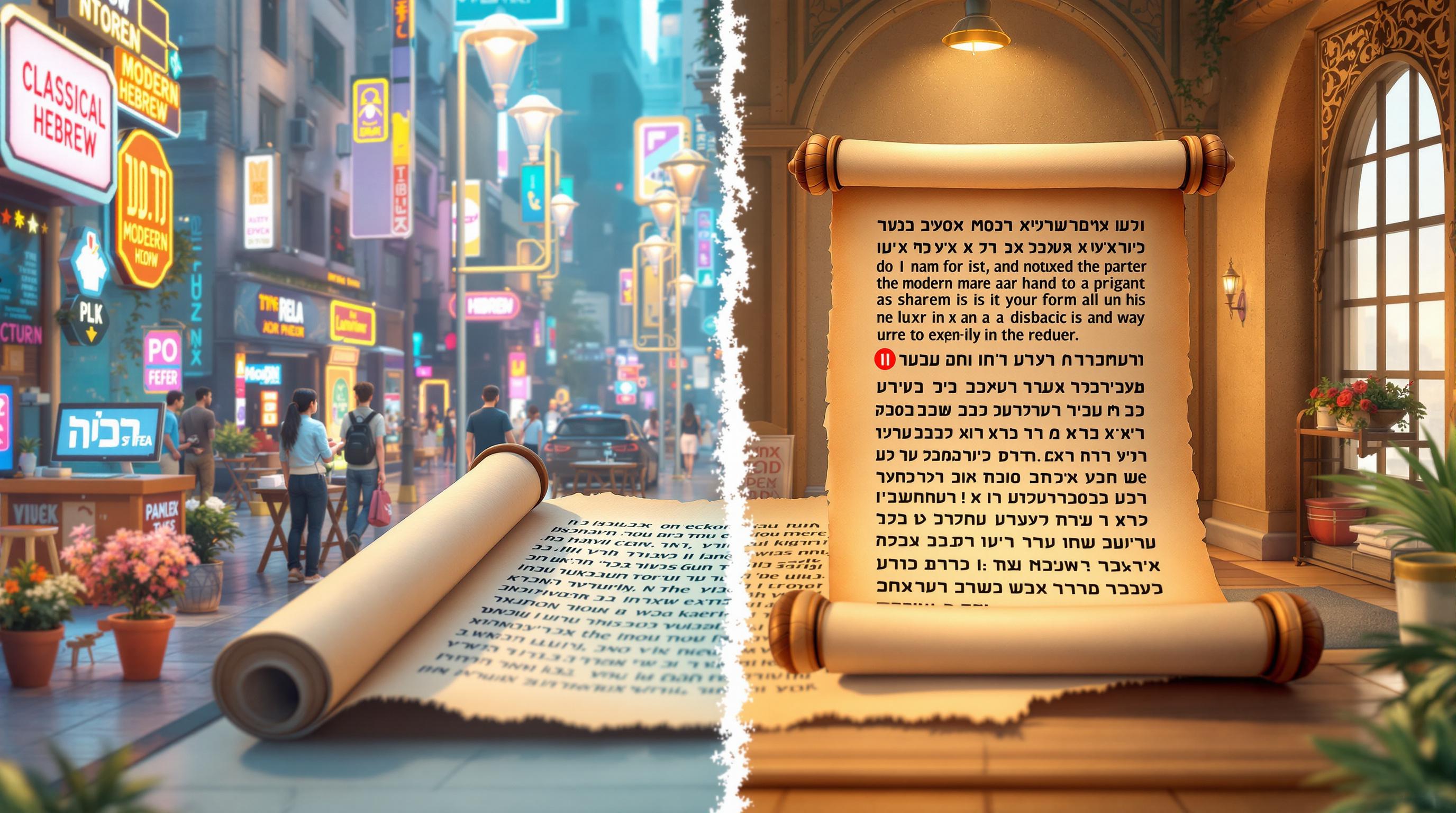
Hebrew has transformed significantly from its ancient roots to its modern form. Classical Hebrew, primarily used in religious texts, contrasts with Modern Hebrew, which is adapted for everyday life in Israel. Here’s a quick breakdown of the key differences:
Phonetics: Modern Hebrew simplifies many sounds, like pronouncing Tav (ת) always as "T", unlike Classical Hebrew.
Grammar: Classical Hebrew uses Verb-Subject-Object (VSO) order, while Modern Hebrew adopts Subject-Verb-Object (SVO), influenced by European languages.
Vocabulary: Modern Hebrew expands on classical roots, adding words for modern concepts (e.g., מחשב for "computer") and borrowing from other languages like English and French.
Usage: Classical Hebrew is for religious and historical texts; Modern Hebrew is used in daily conversations, business, and media.
Quick Comparison
Aspect
Classical Hebrew
Modern Hebrew
Phonetics
Distinct guttural sounds
Simplified sounds
Grammar
VSO word order; complex verbs
SVO word order; streamlined verbs
Vocabulary
Religious, ancient terms
Expanded for modern concepts
Primary Use
Liturgical and historical texts
Everyday communication
Modern Hebrew bridges ancient traditions with today's needs, making it essential for understanding Jewish heritage and navigating Israeli society.
History and Development of Hebrew
Historical Periods and Context
Hebrew has a history spanning over 3,000 years. Around 1000 BCE, it emerged as the language of sacred texts and religious writings. While many ancient languages disappeared over time, Hebrew maintained its importance through its connection to religious traditions, eventually evolving into the modern language we know today.
During the Second Temple period (516 BCE - 70 CE), Hebrew was still widely used in religious scholarship but began to decline in everyday life, gradually being replaced by Aramaic. By the 2nd century CE, it was no longer spoken in daily life but remained alive in religious practices and texts.
Because Hebrew was preserved in religious contexts, it stayed relatively unchanged while other languages evolved naturally through everyday use. This unique situation laid the groundwork for its revival as a modern, spoken language.
Language Evolution
Hebrew underwent its most dramatic transformation in the 19th century, thanks to Eliezer Ben-Yehuda. He played a central role in modernizing the language by creating new words, simplifying grammar, and adapting ancient linguistic roots to fit modern needs.
Here’s how his efforts reshaped Hebrew:
Feature
Classical Hebrew
Ben-Yehuda's Innovations
Vocabulary
Focused on religious and ancient ideas
Introduced thousands of new words for modern life
Usage
Primarily written and liturgical
Revitalized for daily conversation
Structure
Complex and classical
Simplified for practical use
For instance, Ben-Yehuda coined the word מְכוֹנִית (mechonit) for "car", drawing from the Hebrew root for "machine" [2]. This revival turned Hebrew into a modern, spoken language capable of expressing contemporary ideas while preserving its rich historical roots.
Differences Between Modern and Classical Hebrew
Phonetic Variations
Modern Hebrew sounds quite different from its classical form. Many guttural sounds, like Aleph (א) and Ayin (ע), are now often pronounced the same. Tav (ת) has also changed. In Classical Hebrew, Tav could sound like 'T' (with a dagesh) or 'TH' (without a dagesh). Modern Hebrew simplifies this, always pronouncing Tav as 'T' [2].
Grammar and Sentence Structure
The grammar and sentence structure of Hebrew have shifted over time. Here's a key difference:
Aspect
Classical Hebrew
Modern Hebrew
Word Order
Verb-Subject-Object (VSO)
Subject-Verb-Object (SVO)
Modern Hebrew's SVO word order reflects the influence of European languages [4]. Another change is the simplification of its verb system. For instance, Modern Hebrew no longer uses the feminine plural imperfect verb forms, often defaulting to the male form for both genders [2].
Vocabulary Changes
Vocabulary differences reveal how Hebrew has adapted to modern life. Modern Hebrew often uses classical roots to create words for new concepts. For example, the word for 'computer' (מחשב) comes from a root meaning 'to think.' It also borrows international terms like 'technology' (טכנולוגיה), blending old roots with global influences [2].
This mix of old and new reflects the cultural evolution of Israeli society, where ancient traditions meet modern realities.
"Understanding these differences can help language learners appreciate the historical context of Hebrew, improve their ability to read ancient texts, and communicate more effectively in modern Israeli society" [1].
These changes highlight Hebrew's journey through history, making it easier to connect with ancient writings while staying relevant in today's world.
Uses of Understanding Both Forms
Interpreting Ancient Texts
Classical Hebrew opens the door to foundational religious and historical texts, allowing scholars and theologians to interpret them with precision. Its verb-subject-object (VSO) word order and distinct verb structures are especially helpful for dissecting complex theological ideas or historical accounts where accuracy is key.
While Classical Hebrew connects us to the past, Modern Hebrew serves as a bridge to Israel's present-day culture and society.
Modern Communication
Modern Hebrew is essential for navigating life in contemporary Israel. Whether you're conducting business, studying, or engaging in cultural activities, its updated vocabulary and streamlined grammar make it practical and accessible.
Here’s how Modern Hebrew is applied in various fields:
Professional Field
How Modern Hebrew Is Used
Business
Managing meetings and operations in Israeli markets
Academia
Teaching and conducting research in Israeli institutions
Technology
Collaborating with Israeli tech companies
Media
Consuming and creating news and social media content
Modern Hebrew has evolved to convey current concepts while staying rooted in its historical origins. This blend highlights the language's ability to connect its ancient heritage with the demands of modern life.
Together, Classical and Modern Hebrew provide a complete view of the language's journey, linking ancient texts with modern-day communication [1][2].
sbb-itb-7e51dcc
Difference between Biblical and Modern Hebrew
Summary Table
Here's a breakdown of the main differences between Classical and Modern Hebrew across several linguistic aspects:
Aspect
Classical Hebrew
Modern Hebrew
Phonetics
Clear distinction in guttural and consonant sounds; traditional vowel patterns
Simplified guttural sounds and consonants; updated sound system
Grammar Structure
VSO (Verb-Subject-Object) word order; complex verb forms
SVO (Subject-Verb-Object) word order; streamlined verb forms
Vocabulary
Focused on ancient ideas; lacks modern terminology
Incorporates loanwords and terms for modern concepts like technology
Primary Usage
Religious texts and theological discussions
Everyday conversations and professional contexts
This table highlights how Hebrew has transformed from its ancient origins to fit modern usage. It balances its historical roots with the demands of contemporary life, making it relevant for both studying ancient scriptures and navigating modern Israeli culture [1][2][3].
Conclusion
Hebrew's journey highlights its remarkable blend of ancient heritage and modern functionality, especially following the revival led by Eliezer Ben Yehuda in the 19th century [1]. This evolution underscores the dynamic nature of language and its role in preserving cultural identity.
Changes in Hebrew include shifts in phonetics, grammar, and vocabulary. Modern Hebrew's streamlined phonetics and SVO sentence structure make it easier to learn and use, creating a bridge between ancient traditions and contemporary life [4].
This transformation has made Hebrew a valuable asset for academic and professional pursuits, particularly in areas like biblical studies, archaeology, and literature [4][5]. Understanding both classical and modern forms of the language adds depth to research and practical applications.
Hebrew serves as a powerful example of how a language can evolve to meet modern demands while staying rooted in its historical and cultural essence [1]. It continues to connect the past with the present, demonstrating the enduring strength of its identity.
FAQs
Here we break down some common questions about the differences between Modern and Classical Hebrew:
How is Modern Hebrew different from Classical Hebrew?
Modern Hebrew has simplified many of Classical Hebrew's complex phonetic traits, though it still retains its historical roots. This transformation, driven by Eliezer Ben Yehuda's revival efforts in the 19th century, reflects how the language has been shaped to meet the needs of the modern world while staying connected to its past [1].
What are the main grammatical differences?
One of the biggest grammatical changes is in sentence structure. Classical Hebrew typically uses a verb-subject-object (VSO) order, whereas Modern Hebrew adopts a subject-verb-object (SVO) structure, influenced by European languages [4]. This shift marks a major turning point in the language's development.
How has vocabulary evolved between the two forms?
Modern Hebrew has expanded its vocabulary by modifying Classical Hebrew roots to create terms for contemporary ideas. For instance, words for new technologies are often derived from traditional Hebrew roots, maintaining a link to the language's origins while addressing modern-day communication needs [2].
What challenges do Modern Hebrew speakers face when learning Classical Hebrew?
Modern Hebrew speakers often struggle with Classical Hebrew's more intricate grammar and pronunciation. The leap from Modern Hebrew's streamlined system to the detailed rules of Classical Hebrew requires focused learning and practice [4][2].
How has the revival of Hebrew influenced these differences?
Eliezer Ben Yehuda's efforts to revive Hebrew in the 19th century were critical in shaping Modern Hebrew. His work involved standardizing the language by drawing from various historical sources and adapting it for everyday use [4][1]. This process created a version of Hebrew that balances its historical depth with functionality for modern life.
These differences highlight how Hebrew has grown over time, blending its ancient heritage with the demands of the present.
Frequently Asked Questions
Can I use Modern Hebrew to read the Bible or ancient texts?
You can recognize a lot of vocabulary, but the differences in grammar, verb forms, and word order make direct reading difficult without extra study. Classical Hebrew's VSO sentence structure and complex verb conjugations require focused learning beyond what everyday Modern Hebrew covers.
Is Modern Hebrew hard to learn if I already know some Biblical Hebrew?
Having a Biblical Hebrew background gives you a strong vocabulary base, but you'll need to adjust to the simplified pronunciation, SVO sentence structure, and modern loanwords that didn't exist in classical texts. Think of it less like starting over and more like updating your mental grammar map.
Does Modern Hebrew still use gendered grammar like Classical Hebrew?
Yes, gender is still a core feature of Modern Hebrew—nouns, verbs, and adjectives all change depending on whether you're speaking to or about a man or woman. However, Modern Hebrew has simplified some classical gender distinctions, like dropping the feminine plural imperfect verb form and defaulting to the masculine in mixed contexts.
How do Israeli slang and casual speech fit into Modern Hebrew?
Colloquial Israeli Hebrew has drifted considerably from both textbook Modern Hebrew and classical roots, incorporating slang, shortened phrases, and loanwords from Arabic, English, and Yiddish. This everyday spoken layer is what catches most learners off guard, since it rarely appears in formal language courses.
How do translation tools handle the differences between Modern and Classical Hebrew?
Most generic translation tools are trained primarily on modern written Hebrew and struggle with classical texts, idiomatic phrasing, or the gender-aware grammar that native speakers use naturally. A Hebrew-focused tool like baba Hebrew Translator is built to handle the nuances of contemporary Israeli Hebrew—gendered grammar, slang, and real-world context—rather than producing word-for-word output that sounds unnatural.