Hebrew Conjugation Patterns Every Student Should Memorize
Understanding Hebrew verb conjugation comes down to mastering seven patterns, or binyanim. These patterns simplify conjugation by grouping verbs into templates. Here’s the key takeaway:
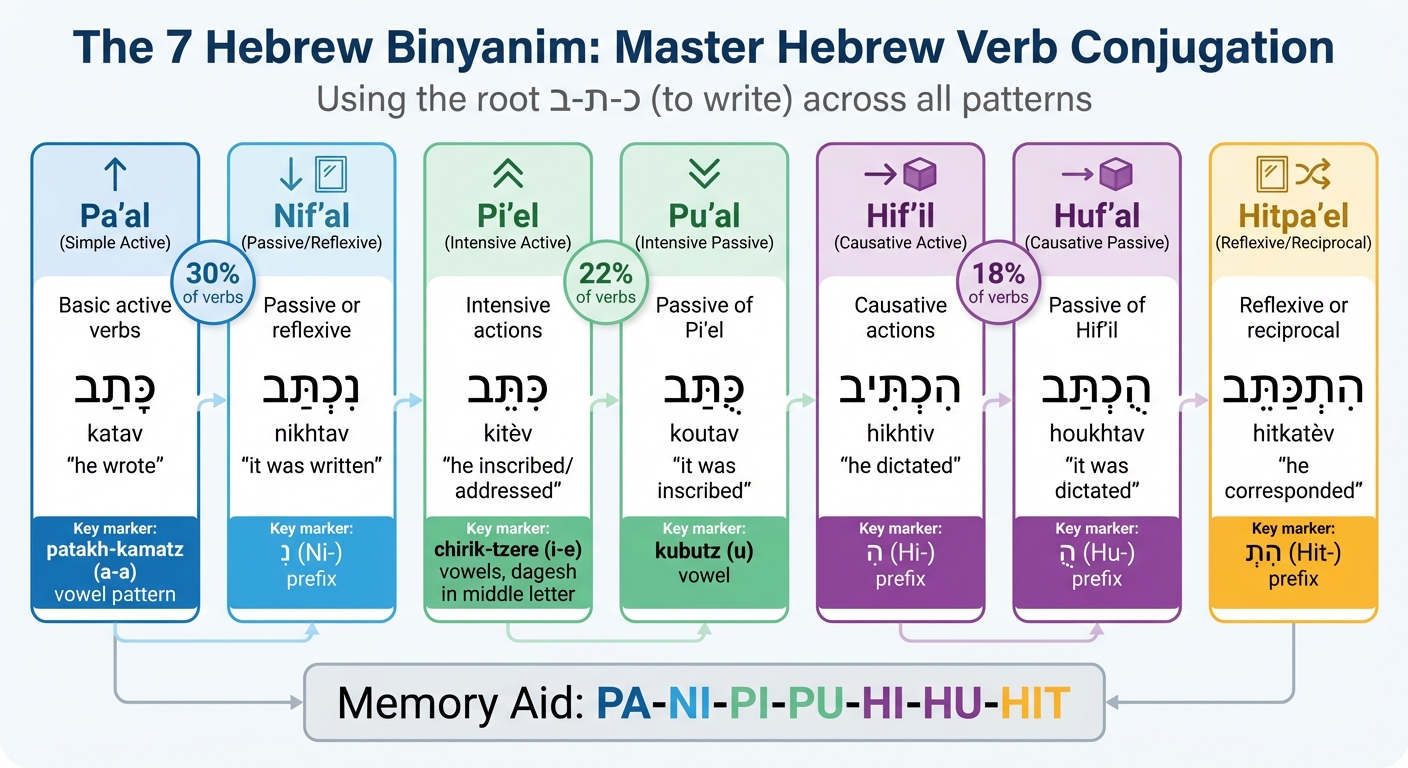
- Focus on the most common binyanim first: Pa’al (30% of verbs), Pi’el (22%), and Hif’il (18%).
- Each binyan has a specific purpose:
- Pa’al: Basic active verbs like "he wrote" (katav).
- Nif’al: Passive or reflexive forms, e.g., "it was written" (nikhtav).
- Pi’el: Intensive actions, e.g., "he inscribed" (kitèv).
- Pu’al: Passive of Pi’el, e.g., "it was inscribed" (koutav).
- Hif’il: Causative actions, e.g., "he dictated" (hikhtiv).
- Huf’al: Passive of Hif’il, e.g., "it was dictated" (houkhtav).
- Hitpa’el: Reflexive or reciprocal actions, e.g., "he corresponded" (hitkatèv).
Tips for Memorization:
- Use mnemonics like "PA-NI-PI-PU-HI-HU-HIT" to remember the binyanim order.
- Recognize key prefixes and vowel patterns (e.g., נִ (Ni-) for Nif’al, הִ (Hi-) for Hif’il).
- Practice with roots like כ-ת-ב ("to write") across all patterns.
Pro Tip: Apps like baba can help you practice conjugations with gender-specific prompts, transliterations, and examples of modern Hebrew usage.
Learning these patterns turns Hebrew verbs into a logical system, making conjugation manageable and practical for daily use.
The 7 Hebrew Binyanim Verb Patterns with Examples
Understanding Hebrew Verbs - The Binyanim explained visually!
sbb-itb-7e51dcc
The 7 Hebrew Binyanim Explained
Using the root כ-ת-ב (to write) as our example, let’s dive into the seven Hebrew binyanim. These verb patterns help learners grasp Hebrew verbs by presenting them in consistent and memorable forms. While it’s rare for one root to naturally occur in all seven binyanim, כ-ת-ב is a common teaching tool to demonstrate how each pattern shapes meaning and usage.
Qal: The Basic Active Form
Pa'al (or Qal) represents the most straightforward action. For instance, כָּתַב (katav) means "he wrote." In the present tense, it shifts to כּוֹתֵב (kotèv, "he writes"), and in the future, it becomes יִכְתֹּב (yikhtov, "he will write"). The past tense typically follows a patakh-kamatz (a-a) vowel sequence, making it easier to spot Pa'al verbs [1].
Next, let’s explore the passive and reflexive nuances of Nifal.
Nifal: Passive and Reflexive Verbs
Nifal is essentially the passive counterpart to Pa'al. It’s used when the subject receives the action, as in נִכְתַּב (nikhtav), which translates to "it was written." You can recognize Nifal by its נִ prefix [1]. This binyan also includes some reflexive verbs, adding flexibility to its use.
Piel and Pual: Intensive and Passive Forms
Piel amplifies the action. For example, כִּתֵּב (kitèv) can mean "he addressed" or "he inscribed", emphasizing a more intense or deliberate action. The chirik-tzere (i-e) vowel pattern and the dagesh (dot) in the middle root letter are key markers of Piel [1]. In the present tense, it becomes מְכַתֵּב (mékhatèv).
Pual, on the other hand, is the passive version of Piel. With כֻּתַּב (koutav), the meaning shifts to "it was addressed" or "it was inscribed." The kubutz (u) vowel is the telltale sign of Pual [1].
Now let’s move to causative forms: Hifil and Hufal.
Hifil and Hufal: Causative Forms
Hifil indicates causation. For instance, הִכְתִּיב (hikhtiv) means "he dictated" - essentially, causing someone else to write. Look for the הִ (Hi-) prefix and the "י" (i) sound near the end of the root to identify this pattern [1]. In the present tense, it takes the form מַכְתִּיב (makhtiv).
Hufal is the passive counterpart to Hifil. The verb הֻכְתַּב (houkhtav) translates to "it was dictated", marking a passive causative action. Its הֻ (Hu-) prefix makes it easy to spot.
Hitpael: Reflexive and Reciprocal Actions
Hitpael focuses on reflexive or reciprocal actions. For example, הִתְכַּתֵּב (hitkatèv) means "he corresponded", implying mutual or reflexive interaction. This binyan is always marked by the הִתְ (Hit-) prefix [1]. In the present tense, it becomes מִתְכַּתֵּב (mitkatèv).
These seven patterns are essential for mastering Hebrew verb conjugations. They provide a framework that simplifies learning and serves as a foundation for understanding how verbs change across contexts.
Here’s a quick reference table summarizing the binyanim:
| Binyan | Meaning Type | Past (3rd M. Sing.) | Translation |
|---|---|---|---|
| Pa'al | Simple Active | כָּתַב (katav) | He wrote |
| Nifal | Passive/Reflexive | נִכְתַּב (nikhtav) | It was written |
| Piel | Intensive Active | כִּתֵּב (kitèv) | He addressed/inscribed |
| Pual | Intensive Passive | כֻּתַּב (koutav) | It was addressed |
| Hifil | Causative Active | הִכְתִּיב (hikhtiv) | He dictated |
| Hufal | Causative Passive | הֻכְתַּב (houkhtav) | It was dictated |
| Hitpael | Reflexive/Reciprocal | הִתְכַּתֵּב (hitkatèv) | He corresponded |
How to Memorize Hebrew Conjugation Patterns
Now that the binyanim are explained, let’s dive into strategies to make memorizing these patterns less daunting and more effective.
Using Memory Tricks and Mnemonics
A handy mnemonic for the seven binyanim is the "PA-NI-PI-PU-HI-HU-HIT" chant. This rhythmically captures the first syllables of each binyan: Pa'al, Nif'al, Pi'el, Pu'al, Hif'il, Huf'al, and Hitpa'el. Saying the chant aloud helps reinforce the order in your memory [2].
Another helpful visual tool is the seven-branched candelabrum. Picture the binyanim arranged on a menorah, with active forms on one side and passive forms on the other [3].
You can also tap into color coding to strengthen your recall. For example:
- Blue for active verbs (Pa'al, Pi'el, Hif'il)
- Green for passive verbs (Nif'al, Pu'al, Huf'al)
- Yellow for reflexive verbs (Hitpa'el)
Use these colors on flashcards or charts to create vivid mental associations [2].
Recognizing and Grouping Patterns
To make things simpler, think of the binyanim as three active/passive pairs with one reflexive form:
- Simple: Pa'al (active) / Nif'al (passive)
- Intensive: Pi'el (active) / Pu'al (passive)
- Causative: Hif'il (active) / Huf'al (passive)
- Reflexive: Hitpa'el
As HebrewGlot puts it:
"Binyanim aren't seven random patterns. They're three pairs plus one rebel." [2]
Look for key prefixes to identify patterns:
- נִ (Ni-) marks Nif'al.
- הִ (Hi-) signals Hif'il.
- הִתְ (Hit-) always indicates Hitpa'el.
- מְ (Me-) in the present tense often points to Pi'el or Pu'al.
Vowel patterns can also guide you:
- Pa'al typically uses a patakh-kamatz (a–a) sequence.
- Pi'el often features a chirik-tzere (i–e) pairing.
- Pu'al is known for its kubutz (u) sound.
These clues make it easier to recognize and group verbs by their conjugation patterns.
Practice Drills and Exercises
The best way to master the binyanim is through consistent practice. Start with one anchor verb for each binyan, focusing first on common patterns like Pa'al and Pi'el. The root פ-ע-ל (P-A-L) is a great example to see how each binyan works [2].
To reinforce your learning, try keeping a Hebrew diary. Write sentences using different binyanim, such as, "I corresponded (Hitpa'el) with my friend", or "The letter was written (Nif'al) yesterday" [2].
Another practical exercise is to take a familiar root, like כ-ת-ב (write), and practice conjugating it across the binyanim:
- כָּתַב (wrote)
- נִכְתַּב (was written)
- הִכְתִּיב (dictated)
As HebrewGlot wisely points out:
"You don't learn binyanim by studying charts. You learn them by using verbs." [1]