
Cultural Context in Hebrew AI Translations
Hebrew translation is challenging for AI due to its gendered grammar and cultural nuances. Here's what you need to know:
- AI Tools: Systems like baba handle gender and context better than basic tools, improving accuracy in casual and professional settings.
- Traditional Methods: Human translators excel in cultural and legal contexts but are slower and more expensive.
- Key Trade-offs:
- AI is faster and cost-effective but struggles with complex texts.
- Human translation ensures nuance but lacks speed.
Quick Comparison
| Aspect | AI Translation | Human Translation |
|---|---|---|
| Gender Handling | Dynamic adjustments | Manual, inconsistent |
| Cultural Sensitivity | Limited | Strong |
| Speed | Instant results | Slower |
| Cost | Lower for high volumes | Higher due to expertise |
| Complex Texts | Struggles with nuances | Excels in critical contexts |
For best results, use AI for routine tasks and human translators for nuanced or sensitive content. A hybrid approach often works best.
Gender bias and artificial intelligence: What are the challenges?
1. baba - Smart Hebrew Translation
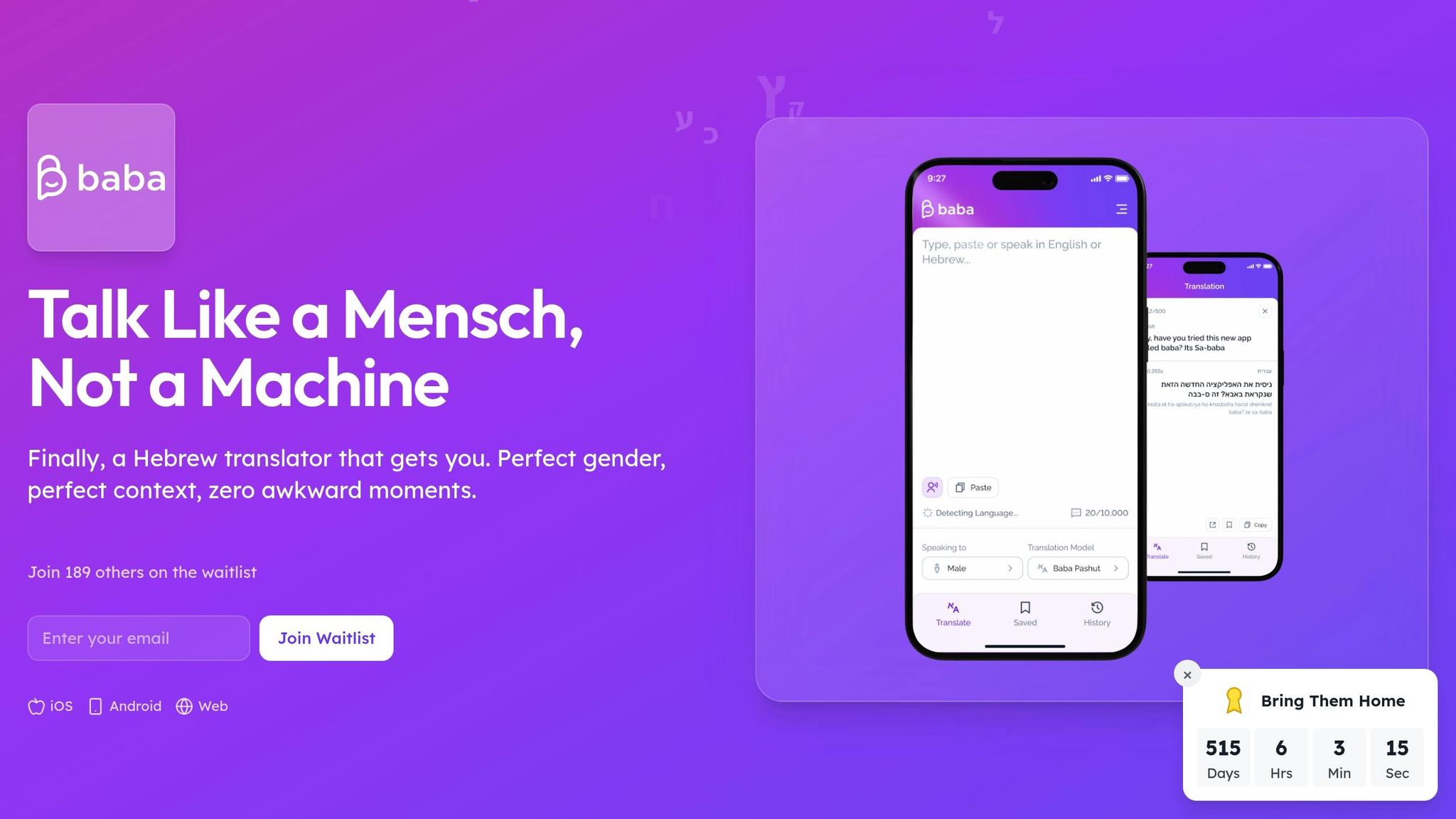
baba is changing the game in Hebrew translation by tackling the language's unique cultural and gender-specific nuances. Unlike other tools that default to masculine forms, baba carefully considers gender for both the speaker and the listener, delivering translations that feel natural to native speakers.
Take the phrase "I want a cookie" as an example. A basic translation might incorrectly apply gender markers. baba, however, ensures these markers are accurate, producing translations that align with Hebrew's linguistic rules.
Here’s how baba shines in real-world scenarios:
- Professional Settings: Automatically adjusts tone and formality for business communication.
- Social Conversations: Keeps the flow casual while respecting cultural context.
- Group Communication: Handles complex plural forms, accounting for both gender and number.
Since its launch, baba has powered millions of precise translations, helping thousands of newcomers navigate Israeli society with ease [5].
The baba team explains it best:
"Unlike traditional translation tools, baba understands that Hebrew is more than just words - it's a living, breathing language deeply rooted in context, gender, and cultural nuance." [5]
This deep understanding allows baba to transform clunky, literal translations into smooth, natural Hebrew - whether you’re closing a business deal or chatting with friends [4].
Want to see it in action? Join the waitlist for the mobile app at www.itsbaba.com.
sbb-itb-7e51dcc
2. Standard Translation Methods
Standard translation methods often face challenges when dealing with Hebrew's complex linguistic and cultural aspects. Unlike AI tools that adjust dynamically, traditional methods struggle to manage Hebrew's unique nuances effectively.
These services typically depend on human translators, who provide accuracy but lack the speed of automated systems. Here's how they handle Hebrew's specific challenges:
-
Gender and Grammar Issues
Human translators often default to masculine forms, which can result in awkward or culturally insensitive translations. -
Cultural and Legal Context
Traditional methods sometimes overlook the cultural and legal subtleties that are critical in Hebrew, particularly in contractual language [6].
Comparative Overview
| Aspect | Human Translation | Basic Machine Translation |
|---|---|---|
| Cultural Context | Strong understanding but slower | Limited cultural awareness |
| Gender Handling | Requires manual adjustments | Defaults to masculine forms |
| Legal Documents | Accurate with cultural sensitivity | May miss important nuances |
| Idiomatic Expressions | Interpreted correctly | Often translated literally |
These shortcomings have led many organizations to adopt hybrid approaches, combining the speed of AI with the nuanced understanding of human translators [3].
Errors in translation can have serious consequences, especially in legal contexts. For instance, mistranslating "termination" as "cancellation" in legal documents has led to significant misunderstandings and disputes [6]. Similarly, using incorrect gendered terms in contracts can change the intended meaning entirely [6].
This highlights the increasing demand for advanced solutions that balance cultural and linguistic accuracy with efficiency. Many organizations are turning to hybrid methods that integrate human expertise with technology to produce contextually accurate translations [3].
