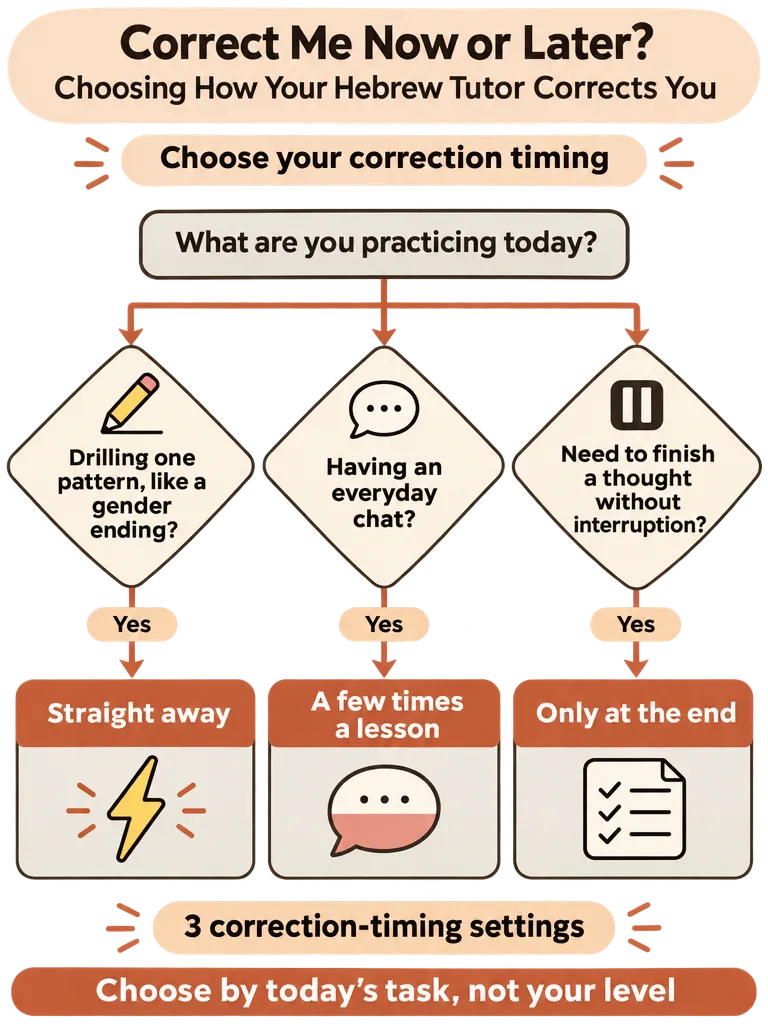
Hebrew tutor corrections don't have to interrupt every mistake. Choose feedback straight away, a few times a lesson, or only at the end.
Will the tutor interrupt me every time I make a mistake?
No. Hebrew tutor corrections don't have to interrupt every mistake: you can be corrected straight away, a few times a lesson, or only at the end. Baba's corrections guide, dated October 30, 2026, says none of the three is universally better, because the right one depends on what you're practicing that day.
Try this before your next speaking session. Pick today's goal:
One gender ending: choose straight away.
An everyday conversation: choose a few times a lesson.
Finishing a thought without being cut off: choose only at the end.
The outcome is a feedback timing chosen for today's speaking task, not a fixed preference you have to live with.
baba Learn is a speaking app in private beta that offers conversation with Maya and David, its AI tutors, along with these three timing options. "A few times a lesson" is a setting, not a promised count, and nothing here claims that straight-away mode catches every mistake.
Put these words into a conversation
A Hebrew speaking app with Maya and David, AI tutors who hold conversations, explain corrections and help you practise what you need to say. Private beta on iPhone and Android. Public store launch is still ahead.
Should you get corrected during the conversation or after it ends?
You can be corrected straight away (the moment a mistake happens), a few times a lesson (a handful of corrections, with most talk uninterrupted), or only at the end (everything reviewed together afterward). Baba's corrections guide lays out these same three options, and the table below follows it.
Setting
How it works
Best for
What happens to your flow
Straight away
The correction arrives right as the mistake occurs
Deliberately drilling one pattern, like a gender ending
The sentence in progress is interrupted
A few times a lesson
A handful of corrections surface across the conversation
Most everyday practice
Most of the talk continues uninterrupted
Only at the end
Corrections wait until the conversation ends and are reviewed together
Learners who freeze when interrupted mid-sentence
Nothing breaks your sentence while you speak
When a correction appears is a separate question from how a tutor delivers it. ChitterChatter, a different tool, separates the two. Its guide treats how mistakes are handled (keep the conversation moving, recast naturally, or correct briefly) as one control, and recast frequency (rarely, sometimes, often) as another. The three settings above are about timing only. They don't say what form a correction takes, and this article doesn't claim recasts or any other modes.
Which setting is best if you freeze when someone interrupts you?
If interruptions make you lose your sentence, choose the end-of-lesson setting. Corrections wait until the conversation is over, so your thought stays whole while you speak. Baba's corrections guide matches this setting to learners who freeze when interrupted mid-sentence, and notes that a beginner who still freezes may do better with fewer interruptions and a clean review afterward.
Here is the situation. You know the words for ordering a coffee. You start the sentence, a correction cuts in halfway through, and you can no longer remember how the sentence was going to end.
With end-of-lesson review, you finish the thought, even a clumsy one, and the conversation keeps going. Afterward, the corrections are reviewed together instead of one at a time as you speak. If the freeze is your main problem, this is the setting to try first.
When is it worth being corrected straight away?
Straight-away correction is worth it when you're deliberately drilling one pattern, because the fix lands right next to the word that triggered it. Baba's corrections guide names a gender ending as the classic case: one wrong ending can be the entire problem, not a sign the whole sentence needs rebuilding.
Try this short drill. The verb "want" changes with the speaker's own gender:
A man says: אֲנִי רוֹצֶה קָפֶה (a·NI ro·TSE ka·FE), "I want coffee."
A woman says: אֲנִי רוֹצָה קָפֶה (a·NI ro·TSA ka·FE), "I want coffee."
The only change is the last vowel of the verb: רוֹצֶה (rotse, said by a man) and רוֹצָה (rotsa, said by a woman). The guide points out that this swap runs against what English trains you to expect, which is why it's easy to get wrong.
Why does straight away suit this drill? The sentence is short and the target is one word, so the correction appears close to the word you're practicing. Test how disruptive that feels. If it breaks your sentence, try a looser setting. Then say the corrected word again right away.
Keep to one detail at a time. If you're drilling רוֹצֶה/רוֹצָה, don't also hunt for prefixes or word order in the same round. When the drill stops feeling like work, move back to a looser setting.
Should you pick a correction setting by your Hebrew level or by what you're practicing today?
Choose correction timing by today's practice task, not overall Hebrew level. Baba's corrections guide says the right choice changes with what you're practicing that day. A beginner can sensibly use any of the three settings on different days, and so can a more advanced learner.
Use this checklist as practical guidance:
If you're drilling one gender ending, choose straight away. The correction lands beside the word that caused it.
If you're having an everyday chat, choose a few times a lesson. You get some feedback while most of the talk keeps moving.
If you want to finish a thought without interruption, choose only at the end. Review the corrections together afterward.
If you're not sure, run the same short task twice under two settings and notice which one lets you keep talking.
A note on evidence. The studies supplied for this article concern other learners and subjects. A Worcester Polytechnic Institute study of middle school math tutoring found that less-proficient students benefited from more tutor interaction and more-proficient students from less. That is math, not adult Hebrew. A Carnegie Mellon paper on a reading tutor concerns children reading aloud. Neither establishes outcomes for adult Hebrew learners, so treat the checklist as practical guidance, not proven results or a promise about how fast you'll progress.
How do you switch your correction setting, and when does it take effect?
The product material available for this article doesn't document baba Learn's correction-setting controls, a navigation path, or whether a change applies mid-conversation or from the next lesson, so none of that is described here. Baba's corrections guide says only, in general terms, that tutoring tools offering all three settings let a learner switch between them at any time. That statement doesn't confirm how switching works in this app.
So check the in-app setting before each lesson. The beta may change, and what's on screen is the only reliable guide.
Then run a separate experiment of your own. Pick one short task, such as ordering a coffee, and do it once under each setting. Afterward, note whether you finished your thought and whether you could use the feedback you got.
What should you do with the corrections once the lesson is over?
Pick one saved correction and give it a minute of speaking practice. Baba's guide to using corrections from your Hebrew conversations covers the full five-step method with worked examples. This is the short version, shaped for corrections you reviewed at the end of a lesson:
Choose one correction from your review.
Say the fixed phrase aloud, exactly as given, not a paraphrase.
Change one detail, such as a place name or a gender ending, and say it again.
Use the new version in a later conversation.
Frequently asked questions
How many corrections does "a few times a lesson" mean in a Hebrew tutor?
It means a handful of corrections spread across the conversation, with most of the talk uninterrupted. In baba Learn, a speaking app in private beta, it is a timing setting rather than a promised count, so the app doesn't guarantee a specific number. It suits most everyday practice, where you want some feedback without losing your flow.
Is it better to fix a whole sentence or one detail at a time after a Hebrew correction?
One detail at a time works better. Many Hebrew corrections have a single moving part, such as a verb's gender form or an attached prefix like ב, ל, or מ, and fixing one thing means you aren't tracking several changes while speaking. For example, the fix in בְּתֵל אָבִיב (be·TEL a·VIV, "in Tel Aviv") is only removing the space after ב.
Why does a gender ending matter so much when a tutor corrects my Hebrew?
One wrong gender ending can be the entire problem, not a sign the whole sentence needs rebuilding. Hebrew gender spreads from a noun to its adjectives, present-tense verbs, and even nearby numbers. The verb "want" changes with your own gender: a man says רוֹצֶה (ro·TSE), a woman says רוֹצָה (ro·TSA), which runs backward from what English trains you to expect.
Can an AI Hebrew tutor's correction be wrong?
Yes. Feedback can be wrong, so check that the corrected sentence still says what you meant before accepting it. A useful correction keeps your original meaning and changes one nameable thing, such as a letter, a space, an ending, or a vowel. If the fix quietly turns your sentence into a tidier one about a different topic, it hasn't helped.
Is when a tutor corrects me the same as how it corrects me?
No. Timing is when a correction appears, and delivery is the form it takes. Another tutoring tool's guide treats how mistakes are handled, such as keeping the conversation moving or recasting naturally, as a separate control from recast frequency. The straight-away, a-few-times, and end-of-lesson settings cover timing only and say nothing about the form a correction takes.
Does research show how often a tutor should interrupt a learner?
Not for adult Hebrew learners. A Worcester Polytechnic Institute study of middle school math tutoring found that less-proficient students benefited from more tutor interaction and more-proficient students from less. That is math, not Hebrew, so treat it as a reason to test different correction timings on the same short task yourself, not as proof of a rule.